
Sign In Start Free Trial
Account

Add to playlist

Create a Playlist

Modal Close icon
You need to login to use this feature.
  • Book Overview & Buying Beginning C++ Programming
  • Table Of Contents Toc
  • Feedback & Rating feedback
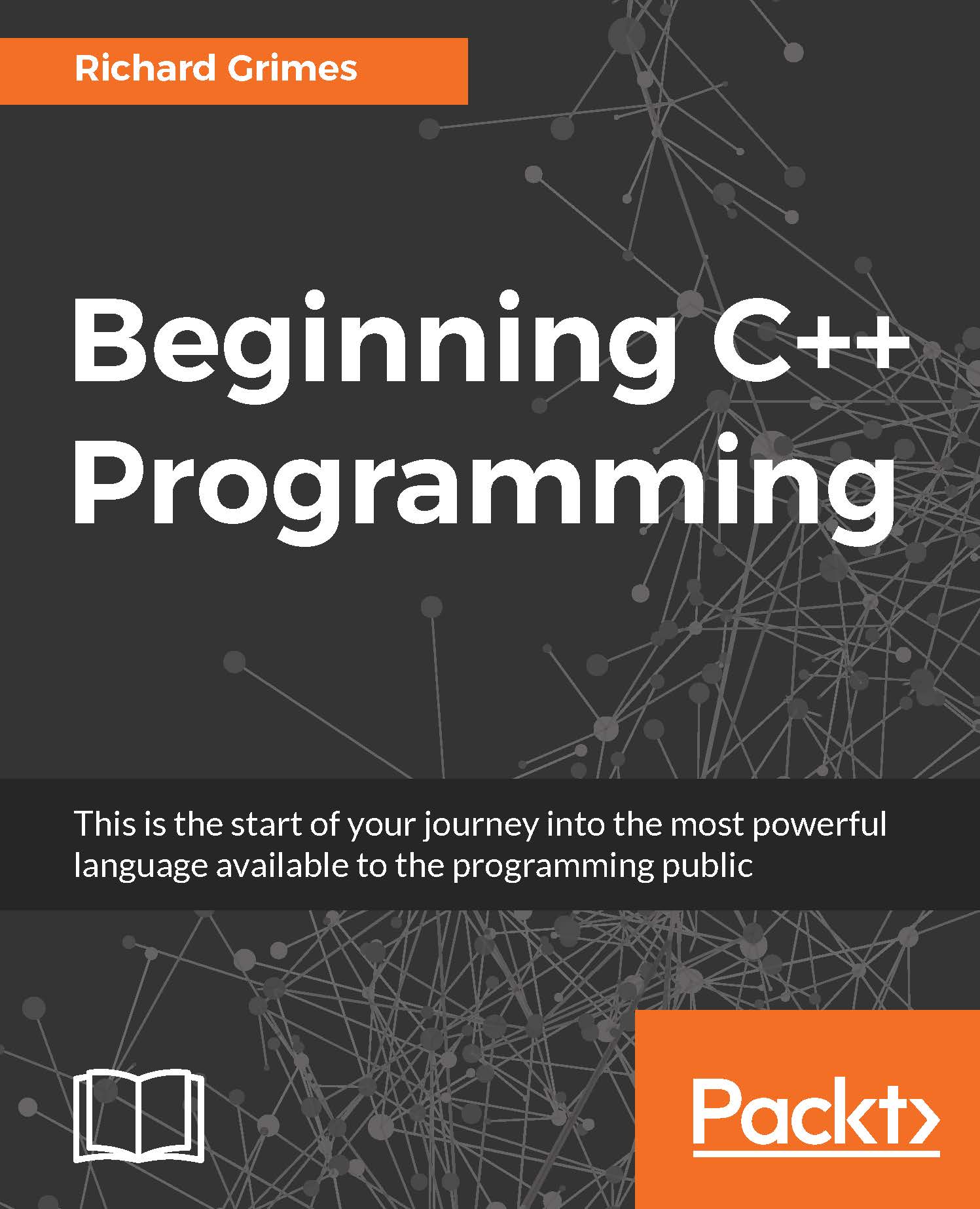
Beginning C++ Programming

Beginning C++ Programming

By : Grimes
3.3 (8)
close
close
Beginning C++ Programming

Beginning C++ Programming

3.3 (8)
By: Grimes

Overview of this book

C++ has come a long way and is now adopted in several contexts. Its key strengths are its software infrastructure and resource-constrained applications, including desktop applications, servers, and performance-critical applications, not to forget its importance in game programming. Despite its strengths in these areas, beginners usually tend to shy away from learning the language because of its steep learning curve. The main mission of this book is to make you familiar and comfortable with C++. You will finish the book not only being able to write your own code, but more importantly, you will be able to read other projects. It is only by being able to read others' code that you will progress from a beginner to an advanced programmer. This book is the first step in that progression. The first task is to familiarize you with the structure of C++ projects so you will know how to start reading a project. Next, you will be able to identify the main structures in the language, functions, and classes, and feel confident being able to identify the execution flow through the code. You will then become aware of the facilities of the standard library and be able to determine whether you need to write a routine yourself, or use an existing routine in the standard library. Throughout the book, there is a big emphasis on memory and pointers. You will understand memory usage, allocation, and access, and be able to write code that does not leak memory. Finally, you will learn about C++ classes and get an introduction to object orientation and polymorphism.
Table of Contents (11 chapters)
close
close

Using functions in C++

The example in this chapter uses the techniques you have learned in this chapter to list all the files in a folder, and subfolders, in order of file size, giving a listing of the filenames and their sizes. The example is the equivalent of typing the following at the command line:

dir /b /s /os /a-d folder


Here, folder is the folder you are listing. The /s option recurses, /a-d removes folders from the list, and /os orders by size. The problem is that without the /b option we get information about each folder, but using it removes the file size in the list. We want a list of filenames (and their paths), their size, ordered by the smallest first.

Start by creating a new folder for this chapter (Chapter_05) under the Beginning_C++ folder. In Visual C++ create a new C++ source file and save it as files.cpp under this new folder. The example will use basic...

Visually different images
CONTINUE READING
83
Tech Concepts
36
Programming languages
73
Tech Tools
Icon Unlimited access to the largest independent learning library in tech of over 8,000 expert-authored tech books and videos.
Icon Innovative learning tools, including AI book assistants, code context explainers, and text-to-speech.
Icon 50+ new titles added per month and exclusive early access to books as they are being written.
Beginning C++ Programming
notes
bookmark Notes and Bookmarks search Search in title playlist Add to playlist download Download options font-size Font size

Change the font size

margin-width Margin width

Change margin width

day-mode Day/Sepia/Night Modes

Change background colour

Close icon Search
Country selected

Close icon Your notes and bookmarks

Confirmation

Modal Close icon
claim successful

Buy this book with your credits?

Modal Close icon
Are you sure you want to buy this book with one of your credits?
Close
YES, BUY

Submit Your Feedback

Modal Close icon
Modal Close icon
Modal Close icon