
Sign In Start Free Trial
Account

Add to playlist

Create a Playlist

Modal Close icon
You need to login to use this feature.
  • Book Overview & Buying Mastering the C++17 STL
  • Table Of Contents Toc
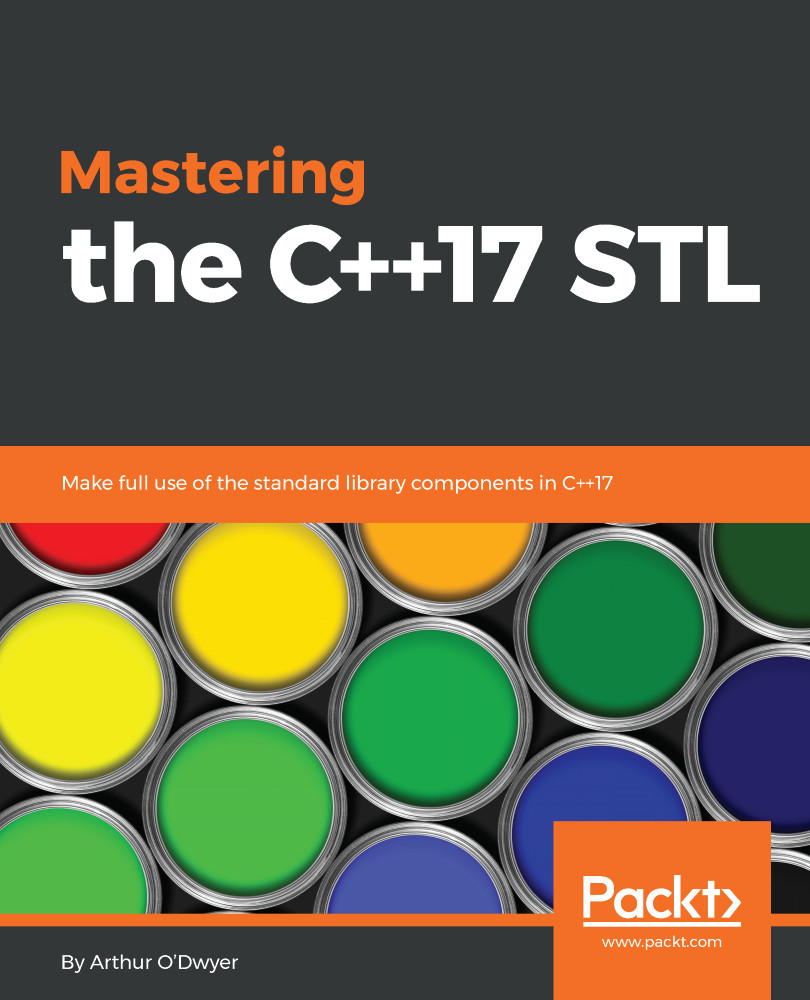
Mastering the C++17 STL

Mastering the C++17 STL

By : Arthur O'Dwyer
4.5 (11)
close
close
Mastering the C++17 STL

Mastering the C++17 STL

4.5 (11)
By: Arthur O'Dwyer

Overview of this book

Modern C++ has come a long way since 2011. The latest update, C++17, has just been ratified and several implementations are on the way. This book is your guide to the C++ standard library, including the very latest C++17 features. The book starts by exploring the C++ Standard Template Library in depth. You will learn the key differences between classical polymorphism and generic programming, the foundation of the STL. You will also learn how to use the various algorithms and containers in the STL to suit your programming needs. The next module delves into the tools of modern C++. Here you will learn about algebraic types such as std::optional, vocabulary types such as std::function, smart pointers, and synchronization primitives such as std::atomic and std::mutex. In the final module, you will learn about C++'s support for regular expressions and file I/O. By the end of the book you will be proficient in using the C++17 standard library to implement real programs, and you'll have gained a solid understanding of the library's own internals.
Table of Contents (13 chapters)
close
close

What are regular expressions?

A regular expression is a way of writing down the rules for recognizing a string of bytes or characters as belonging (or not belonging) to a certain "language." In this context, a "language" can be anything from "the set of all digit-sequences" to "the set of all sequences of valid C++ tokens." Essentially, a "language" is just a rule for dividing the world of all strings into two sets--the set of strings matching the rules of the language, and the set of strings that don't match.

Some kinds of languages follow simple enough rules that they can be recognized by a finite state machine, a computer program with no memory at all--just a program counter and a pointer that scans over the input in a single pass. The language of "digit-sequences" is certainly in the category of languages that...

CONTINUE READING
83
Tech Concepts
36
Programming languages
73
Tech Tools
Icon Unlimited access to the largest independent learning library in tech of over 8,000 expert-authored tech books and videos.
Icon Innovative learning tools, including AI book assistants, code context explainers, and text-to-speech.
Icon 50+ new titles added per month and exclusive early access to books as they are being written.
Mastering the C++17 STL
notes
bookmark Notes and Bookmarks search Search in title playlist Add to playlist download Download options font-size Font size

Change the font size

margin-width Margin width

Change margin width

day-mode Day/Sepia/Night Modes

Change background colour

Close icon Search
Country selected

Close icon Your notes and bookmarks

Confirmation

Modal Close icon
claim successful

Buy this book with your credits?

Modal Close icon
Are you sure you want to buy this book with one of your credits?
Close
YES, BUY

Submit Your Feedback

Modal Close icon
Modal Close icon
Modal Close icon