
Sign In Start Free Trial
Account

Add to playlist

Create a Playlist

Modal Close icon
You need to login to use this feature.
  • Book Overview & Buying Mastering the C++17 STL
  • Table Of Contents Toc
  • Feedback & Rating feedback
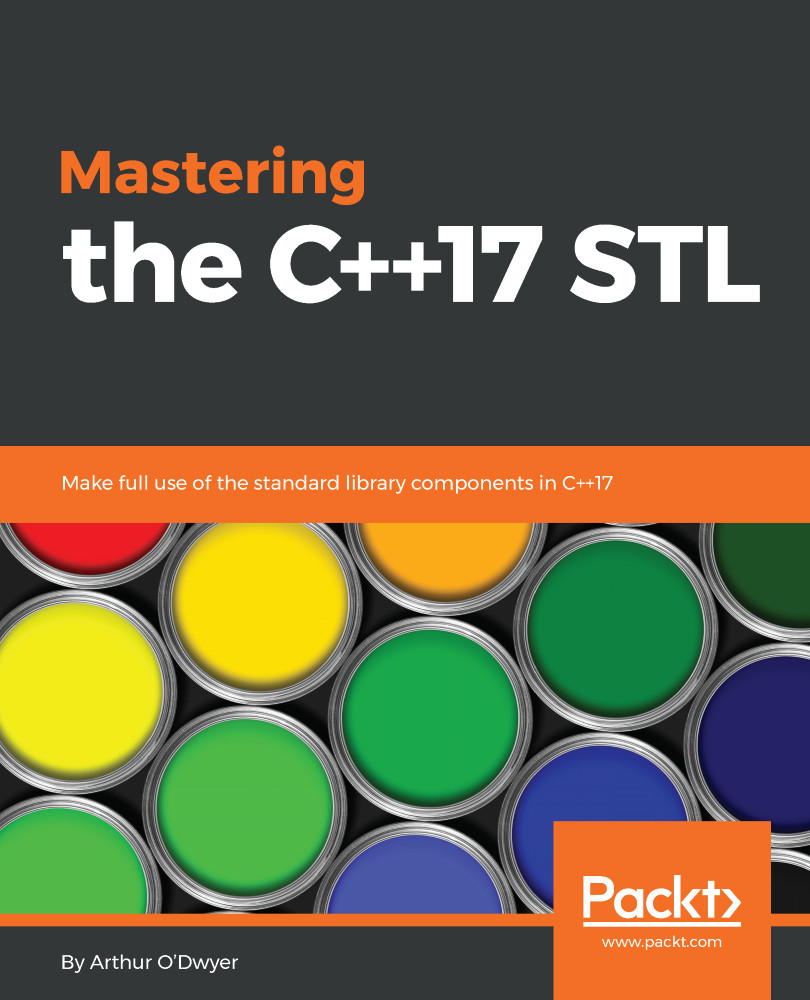
Mastering the C++17 STL

Mastering the C++17 STL

By : Arthur O'Dwyer
4.5 (11)
close
close
Mastering the C++17 STL

Mastering the C++17 STL

4.5 (11)
By: Arthur O'Dwyer

Overview of this book

Modern C++ has come a long way since 2011. The latest update, C++17, has just been ratified and several implementations are on the way. This book is your guide to the C++ standard library, including the very latest C++17 features. The book starts by exploring the C++ Standard Template Library in depth. You will learn the key differences between classical polymorphism and generic programming, the foundation of the STL. You will also learn how to use the various algorithms and containers in the STL to suit your programming needs. The next module delves into the tools of modern C++. Here you will learn about algebraic types such as std::optional, vocabulary types such as std::function, smart pointers, and synchronization primitives such as std::atomic and std::mutex. In the final module, you will learn about C++'s support for regular expressions and file I/O. By the end of the book you will be proficient in using the C++17 standard library to implement real programs, and you'll have gained a solid understanding of the library's own internals.
Table of Contents (13 chapters)
close
close

The useful adaptor: std::priority_queue<T>

In Chapter 3, The Iterator-Pair Algorithms, we introduced the family of "heap" algorithms: make_heap, push_heap, and pop_heap. You can use these algorithms to give a range of elements the max-heap property. If you maintain the max-heap property on your data as an invariant, you get a data structure commonly known as a priority queue. In data-structure textbooks, a priority queue is often depicted as a kind of binary tree, but as we saw in Chapter 3, The Iterator-Pair Algorithms, there's nothing about the max-heap property that requires an explicitly pointer-based tree structure.

The standard container std::priority_queue<T, Ctr, Cmp> represents a priority queue, represented internally as an instance of Ctr where the elements of the Ctr are invariably in max-heap order (as determined by an instance of the comparator...

Visually different images
CONTINUE READING
83
Tech Concepts
36
Programming languages
73
Tech Tools
Icon Unlimited access to the largest independent learning library in tech of over 8,000 expert-authored tech books and videos.
Icon Innovative learning tools, including AI book assistants, code context explainers, and text-to-speech.
Icon 50+ new titles added per month and exclusive early access to books as they are being written.
Mastering the C++17 STL
notes
bookmark Notes and Bookmarks search Search in title playlist Add to playlist download Download options font-size Font size

Change the font size

margin-width Margin width

Change margin width

day-mode Day/Sepia/Night Modes

Change background colour

Close icon Search
Country selected

Close icon Your notes and bookmarks

Confirmation

Modal Close icon
claim successful

Buy this book with your credits?

Modal Close icon
Are you sure you want to buy this book with one of your credits?
Close
YES, BUY

Submit Your Feedback

Modal Close icon
Modal Close icon
Modal Close icon