
Sign In Start Free Trial
Account

Add to playlist

Create a Playlist

Modal Close icon
You need to login to use this feature.
  • Book Overview & Buying Python High Performance, Second Edition
  • Table Of Contents Toc
  • Feedback & Rating feedback
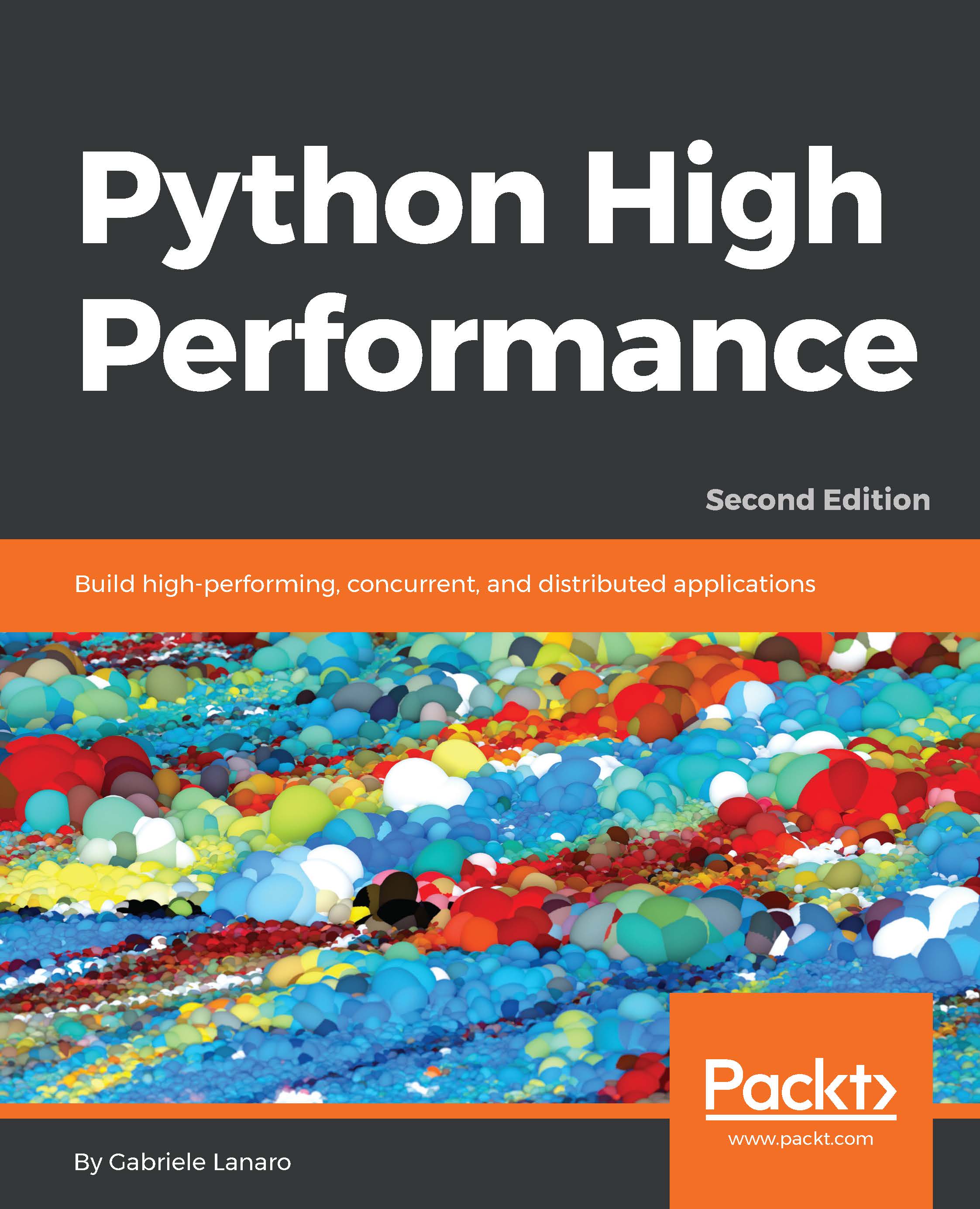
Python High Performance, Second Edition

Python High Performance, Second Edition - Second Edition

By : Dr. Gabriele Lanaro
4 (2)
close
close
Python High Performance, Second Edition

Python High Performance, Second Edition

4 (2)
By: Dr. Gabriele Lanaro

Overview of this book

Python is a versatile language that has found applications in many industries. The clean syntax, rich standard library, and vast selection of third-party libraries make Python a wildly popular language. Python High Performance is a practical guide that shows how to leverage the power of both native and third-party Python libraries to build robust applications. The book explains how to use various profilers to find performance bottlenecks and apply the correct algorithm to fix them. The reader will learn how to effectively use NumPy and Cython to speed up numerical code. The book explains concepts of concurrent programming and how to implement robust and responsive applications using Reactive programming. Readers will learn how to write code for parallel architectures using Tensorflow and Theano, and use a cluster of computers for large-scale computations using technologies such as Dask and PySpark. By the end of the book, readers will have learned to achieve performance and scale from their Python applications.
Table of Contents (10 chapters)
close
close

Implementing Concurrency

So far, we have explored how to measure and improve the performance of programs by reducing the number of operations performed by the CPU through clever algorithms and more efficient machine code. In this chapter, we will shift our focus to programs where most of the time is spent waiting for resources that are much slower than the CPU, such as persistent storage and network resources.

Asynchronous programming is a programming paradigm that helps to deal with slow and unpredictable resources (such as users) and is widely used to build responsive services and user interfaces. In this chapter, we will show you how to program asynchronously in Python using techniques such as coroutines and reactive programming.

In this chapter, we will cover the following topics:

  • The memory hierarchy
  • Callbacks
  • Futures
  • Event loops
  • Writing coroutines with asyncio
  • Converting synchronous code to asynchronous code...
Visually different images
CONTINUE READING
83
Tech Concepts
36
Programming languages
73
Tech Tools
Icon Unlimited access to the largest independent learning library in tech of over 8,000 expert-authored tech books and videos.
Icon Innovative learning tools, including AI book assistants, code context explainers, and text-to-speech.
Icon 50+ new titles added per month and exclusive early access to books as they are being written.
Python High Performance, Second Edition
notes
bookmark Notes and Bookmarks search Search in title playlist Add to playlist download Download options font-size Font size

Change the font size

margin-width Margin width

Change margin width

day-mode Day/Sepia/Night Modes

Change background colour

Close icon Search
Country selected

Close icon Your notes and bookmarks

Confirmation

Modal Close icon
claim successful

Buy this book with your credits?

Modal Close icon
Are you sure you want to buy this book with one of your credits?
Close
YES, BUY

Submit Your Feedback

Modal Close icon
Modal Close icon
Modal Close icon