
Sign In Start Free Trial
Account

Add to playlist

Create a Playlist

Modal Close icon
You need to login to use this feature.
  • Book Overview & Buying Swift Functional Programming
  • Table Of Contents Toc
  • Feedback & Rating feedback
Swift Functional Programming

Swift Functional Programming - Second Edition

By : Nayebi
4.3 (3)
close
close
Swift Functional Programming

Swift Functional Programming

4.3 (3)
By: Nayebi

Overview of this book

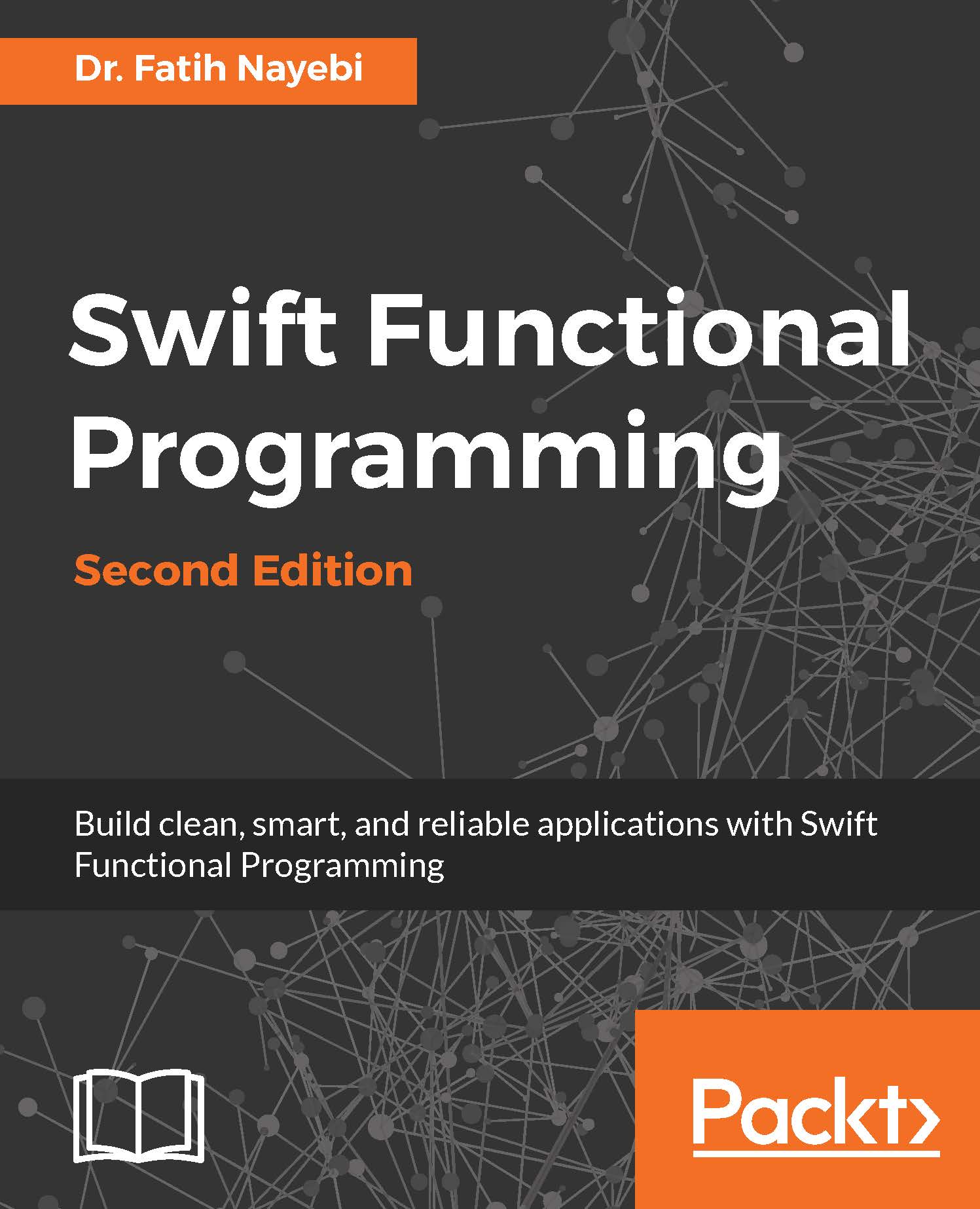
Swift is a multi-paradigm programming language enabling you to tackle different problems in various ways. Understanding each paradigm and knowing when and how to utilize and combine them can lead to a better code base. Functional programming (FP) is an important paradigm that empowers us with declarative development and makes applications more suitable for testing, as well as performant and elegant. This book aims to simplify the FP paradigms, making them easily understandable and usable, by showing you how to solve many of your day-to-day development problems using Swift FP. It starts with the basics of FP, and you will go through all the core concepts of Swift and the building blocks of FP. You will also go through important aspects, such as function composition and currying, custom operator definition, monads, functors, applicative functors,memoization, lenses, algebraic data types, type erasure, functional data structures, functional reactive programming (FRP), and protocol-oriented programming(POP). You will then learn to combine those techniques to develop a fully functional iOS application from scratch
Table of Contents (12 chapters)
close
close

Mixing OOP and FP

So far, we have seen that adding FP capabilities to an OOP language leads to benefits in the OOP design.

In summary, OOP fits perfectly with FP when our objects are as immutable as possible. To make our objects as immutable as possible, we can consider the following principles:

  • Objects should be types that encapsulate related pieces of data.
  • Objects can have methods; however, these methods shouldn't change the object and should instead return a new one of the appropriate type.
  • All the required state data should be injected into the class's initialization so that it will be ready to use immediately.
  • Static methods can be used freely and static variables should be avoided. Protocols and generics should be used to avoid code duplicates.

These principles not only empower us to employ functional design patterns, but also enrich our object-oriented code.

...
Visually different images
CONTINUE READING
83
Tech Concepts
36
Programming languages
73
Tech Tools
Icon Unlimited access to the largest independent learning library in tech of over 8,000 expert-authored tech books and videos.
Icon Innovative learning tools, including AI book assistants, code context explainers, and text-to-speech.
Icon 50+ new titles added per month and exclusive early access to books as they are being written.
Swift Functional Programming
notes
bookmark Notes and Bookmarks search Search in title playlist Add to playlist download Download options font-size Font size

Change the font size

margin-width Margin width

Change margin width

day-mode Day/Sepia/Night Modes

Change background colour

Close icon Search
Country selected

Close icon Your notes and bookmarks

Confirmation

Modal Close icon
claim successful

Buy this book with your credits?

Modal Close icon
Are you sure you want to buy this book with one of your credits?
Close
YES, BUY

Submit Your Feedback

Modal Close icon
Modal Close icon
Modal Close icon