
Sign In Start Free Trial
Account

Add to playlist

Create a Playlist

Modal Close icon
You need to login to use this feature.
  • Book Overview & Buying Java 9 Regular Expressions
  • Table Of Contents Toc
  • Feedback & Rating feedback
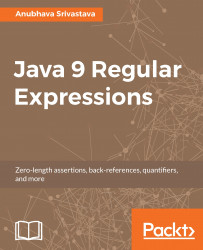
Java 9 Regular Expressions

Java 9 Regular Expressions

By : Anubhava Srivastava
5 (2)
close
close
Java 9 Regular Expressions

Java 9 Regular Expressions

5 (2)
By: Anubhava Srivastava

Overview of this book

Regular expressions are a powerful tool in the programmer's toolbox and allow pattern matching. They are also used for manipulating text and data. This book will provide you with the know-how (and practical examples) to solve real-world problems using regex in Java. You will begin by discovering what regular expressions are and how they work with Java. This easy-to-follow guide is a great place from which to familiarize yourself with the core concepts of regular expressions and to master its implementation with the features of Java 9. You will learn how to match, extract, and transform text by matching specific words, characters, and patterns. You will learn when and where to apply the methods for finding patterns in digits, letters, Unicode characters, and string literals. Going forward, you will learn to use zero-length assertions and lookarounds, parsing the source code, and processing the log files. Finally, you will master tips, tricks, and best practices in regex with Java.
Table of Contents (9 chapters)
close
close
Lock Free Chapter
1
Getting Started with Regular Expressions

The union of character classes


The union of character classes will match a character that would be matched by any of the composing character classes. Essentially, this is the definition of the union operation in general. In regular expressions, it is possible to create unions of character classes by simply writing a character class inside another.

You may remember that character classes open with the [ character and close with the ] character, and we can list characters and character ranges between the opening and closing brackets.

In addition to those, we can use other character sets inside the brackets, and the resulting set will be the union of all these character classes. This way, there is no union operator to create the composition of these character classes; we just simply write them inside each other.

For example, consider the following composite character class:

[A-D[PQR]] 

This matches any character in the range of A to D or any single character P, Q, or R. This regular expression can...

Visually different images
CONTINUE READING
83
Tech Concepts
36
Programming languages
73
Tech Tools
Icon Unlimited access to the largest independent learning library in tech of over 8,000 expert-authored tech books and videos.
Icon Innovative learning tools, including AI book assistants, code context explainers, and text-to-speech.
Icon 50+ new titles added per month and exclusive early access to books as they are being written.
Java 9 Regular Expressions
notes
bookmark Notes and Bookmarks search Search in title playlist Add to playlist download Download options font-size Font size

Change the font size

margin-width Margin width

Change margin width

day-mode Day/Sepia/Night Modes

Change background colour

Close icon Search
Country selected

Close icon Your notes and bookmarks

Confirmation

Modal Close icon
claim successful

Buy this book with your credits?

Modal Close icon
Are you sure you want to buy this book with one of your credits?
Close
YES, BUY

Submit Your Feedback

Modal Close icon
Modal Close icon
Modal Close icon