Sign In Start Free Trial
Account

Add to playlist

Create a Playlist

Modal Close icon
You need to login to use this feature.
  • Book Overview & Buying Julia Programming Projects
  • Table Of Contents Toc
  • Feedback & Rating feedback
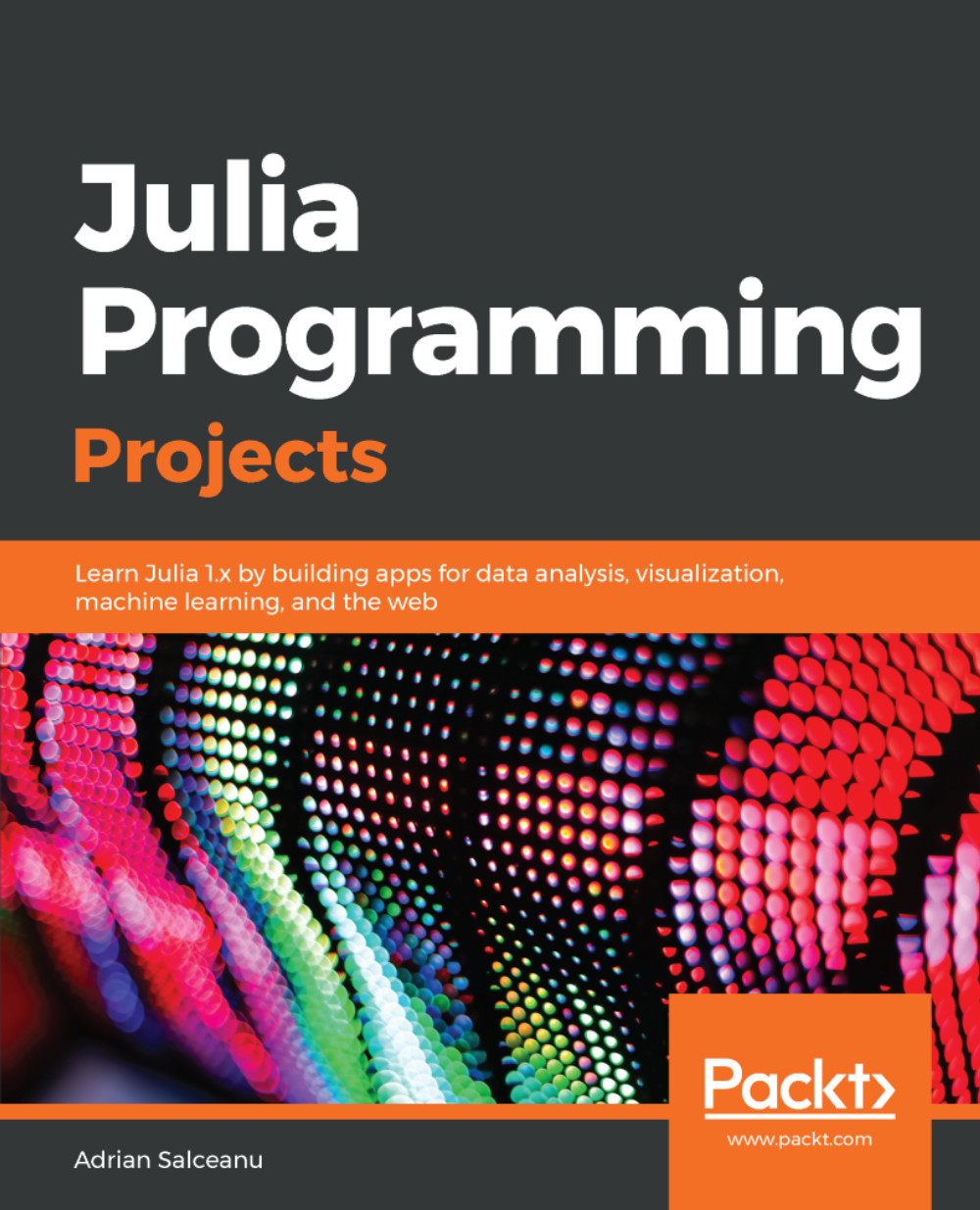
Julia Programming Projects

Julia Programming Projects

By : Adrian Salceanu
4 (10)
close
close
Julia Programming Projects

Julia Programming Projects

4 (10)
By: Adrian Salceanu

Overview of this book

Julia is a new programming language that offers a unique combination of performance and productivity. Its powerful features, friendly syntax, and speed are attracting a growing number of adopters from Python, R, and Matlab, effectively raising the bar for modern general and scientific computing. After six years in the making, Julia has reached version 1.0. Now is the perfect time to learn it, due to its large-scale adoption across a wide range of domains, including fintech, biotech, education, and AI. Beginning with an introduction to the language, Julia Programming Projects goes on to illustrate how to analyze the Iris dataset using DataFrames. You will explore functions and the type system, methods, and multiple dispatch while building a web scraper and a web app. Next, you'll delve into machine learning, where you'll build a books recommender system. You will also see how to apply unsupervised machine learning to perform clustering on the San Francisco business database. After metaprogramming, the final chapters will discuss dates and time, time series analysis, visualization, and forecasting. We'll close with package development, documenting, testing and benchmarking. By the end of the book, you will have gained the practical knowledge to build real-world applications in Julia.
Table of Contents (13 chapters)
close
close

Strings


A string represents a sequence of characters. We can create a string by enclosing the corresponding sequence of characters between double quotes, as shown in the following:

julia> "Measuring programming progress by lines of code is like measuring aircraft building progress by weight." 

If the string also includes quotes, we can escape these by prefixing them with a backslash \:

julia> "Beta is Latin for \"still doesn't work\"."

Triple-quoted strings

However, escaping can get messy, so there's a much better way of dealing with this—by using triple quotes """...""".

julia> """Beta is Latin for "still doesn't work"."""


Within triple quotes, it is no longer necessary to escape the single quotes. However, make sure that the single quotes and the triple quotes are separated—or else the compiler will get confused:

julia> """Beta is Latin for "still doesn't work"""" 
syntax: cannot juxtapose string literal

The triple quotes come with some extra special powers when used with multiline...

Visually different images
CONTINUE READING
83
Tech Concepts
36
Programming languages
73
Tech Tools
Icon Unlimited access to the largest independent learning library in tech of over 8,000 expert-authored tech books and videos.
Icon Innovative learning tools, including AI book assistants, code context explainers, and text-to-speech.
Icon 50+ new titles added per month and exclusive early access to books as they are being written.
Julia Programming Projects
notes
bookmark Notes and Bookmarks search Search in title playlist Add to playlist download Download options font-size Font size

Change the font size

margin-width Margin width

Change margin width

day-mode Day/Sepia/Night Modes

Change background colour

Close icon Search
Country selected

Close icon Your notes and bookmarks

Confirmation

Modal Close icon
claim successful

Buy this book with your credits?

Modal Close icon
Are you sure you want to buy this book with one of your credits?
Close
YES, BUY

Submit Your Feedback

Modal Close icon
Modal Close icon
Modal Close icon