
Sign In Start Free Trial
Account

Add to playlist

Create a Playlist

Modal Close icon
You need to login to use this feature.
  • Book Overview & Buying Reactive Programming in Kotlin
  • Table Of Contents Toc
  • Feedback & Rating feedback
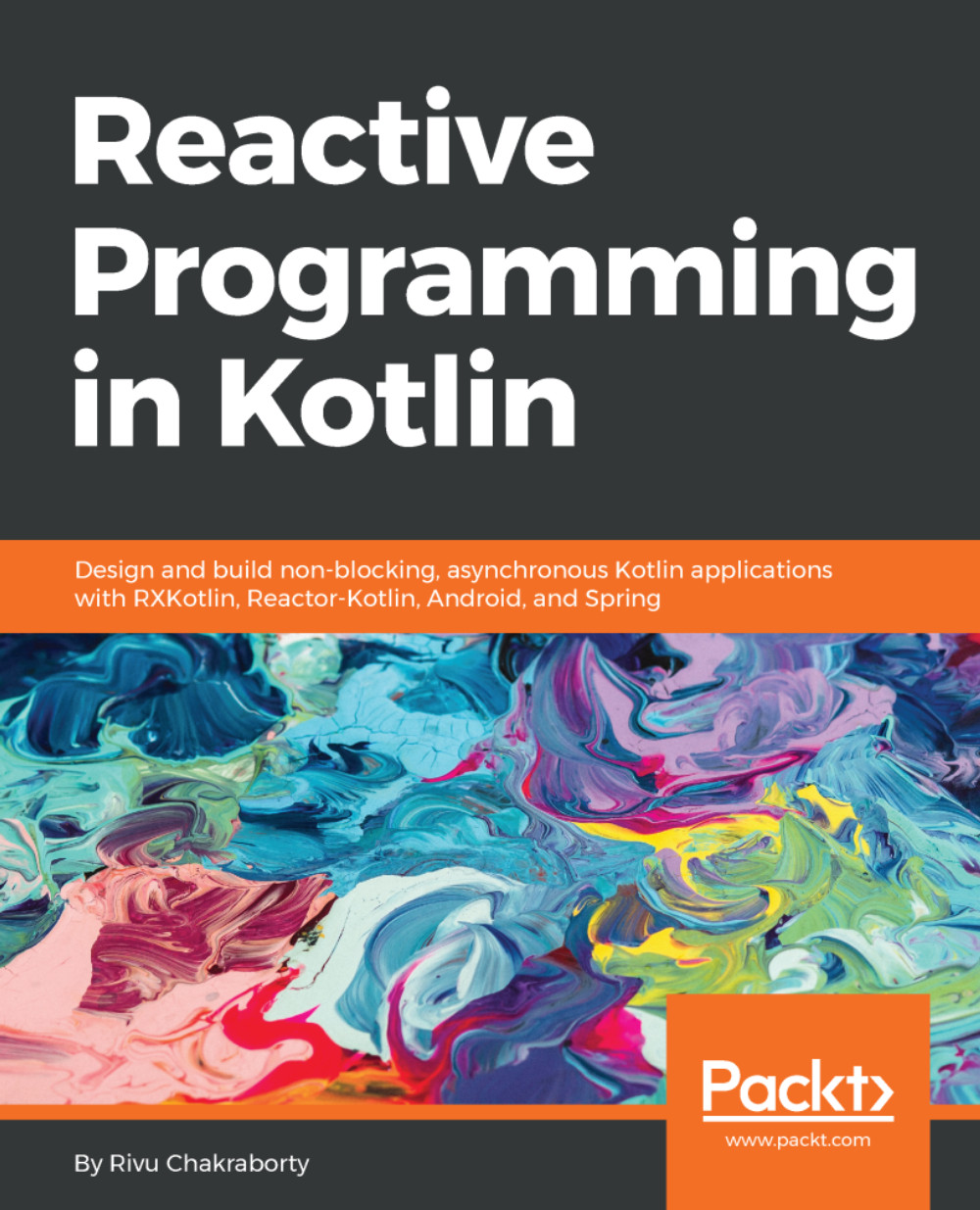
Reactive Programming in Kotlin

Reactive Programming in Kotlin

By : Rivu Chakraborty
2.3 (3)
close
close
Reactive Programming in Kotlin

Reactive Programming in Kotlin

2.3 (3)
By: Rivu Chakraborty

Overview of this book

In today's app-driven era, when programs are asynchronous, and responsiveness is so vital, reactive programming can help you write code that's more reliable, easier to scale, and better-performing. Reactive programming is revolutionary. With this practical book, Kotlin developers will first learn how to view problems in the reactive way, and then build programs that leverage the best features of this exciting new programming paradigm. You will begin with the general concepts of Reactive programming and then gradually move on to working with asynchronous data streams. You will dive into advanced techniques such as manipulating time in data-flow, customizing operators and provider and how to use the concurrency model to control asynchronicity of code and process event handlers effectively. You will then be introduced to functional reactive programming and will learn to apply FRP in practical use cases in Kotlin. This book will also take you one step forward by introducing you to Spring 5 and Spring Boot 2 using Kotlin. By the end of the book, you will be able to build real-world applications with reactive user interfaces as well as you'll learn to implement reactive programming paradigms in Android.
Table of Contents (13 chapters)
close
close

What is reactive programming?

Reactive programming is an asynchronous programming paradigm that revolves around data streams and the propagation of change. In simpler words, those programs which propagate all the changes that affected its data/data streams to all the interested parties (such as end users, components and sub-parts, and other programs that are somehow related) are called reactive programs.

For example, take any spreadsheet (say the Google Sheet), put any number in the A1 cell, and in the B1 cell, write the =ISEVEN(A1) function; it'll show TRUE or  FALSE, depending on whether you've entered an even or odd number. Now, if you modify the number in A1, the value of B1 will also get changed automatically; such behavior is called reactive.

Not clear enough? Let's look at a coding example and then try to understand it again. The following is a normal Kotlin code block to determine if a number is even or odd:

    fun main(args: Array<String>) { 
      var number = 4 
      var isEven = isEven(number) 
      println("The number is " + (if (isEven) "Even" else "Odd")) 
      number = 9 
      println("The number is " + (if (isEven) "Even" else "Odd")) 
    } 
 
    fun isEven(n:Int):Boolean = ((n % 2) == 0) 

If you check the output of the program, then you'll see that, although the number is assigned a new value, isEven is still true; however, if isEven was made to track changes of the number, then it would automatically become false. A reactive program would just do the same.

Visually different images
CONTINUE READING
83
Tech Concepts
36
Programming languages
73
Tech Tools
Icon Unlimited access to the largest independent learning library in tech of over 8,000 expert-authored tech books and videos.
Icon Innovative learning tools, including AI book assistants, code context explainers, and text-to-speech.
Icon 50+ new titles added per month and exclusive early access to books as they are being written.
Reactive Programming in Kotlin
notes
bookmark Notes and Bookmarks search Search in title playlist Add to playlist download Download options font-size Font size

Change the font size

margin-width Margin width

Change margin width

day-mode Day/Sepia/Night Modes

Change background colour

Close icon Search
Country selected

Close icon Your notes and bookmarks

Confirmation

Modal Close icon
claim successful

Buy this book with your credits?

Modal Close icon
Are you sure you want to buy this book with one of your credits?
Close
YES, BUY

Submit Your Feedback

Modal Close icon
Modal Close icon
Modal Close icon