
Sign In Start Free Trial
Account

Add to playlist

Create a Playlist

Modal Close icon
You need to login to use this feature.
  • Book Overview & Buying Reactive Programming in Kotlin
  • Table Of Contents Toc
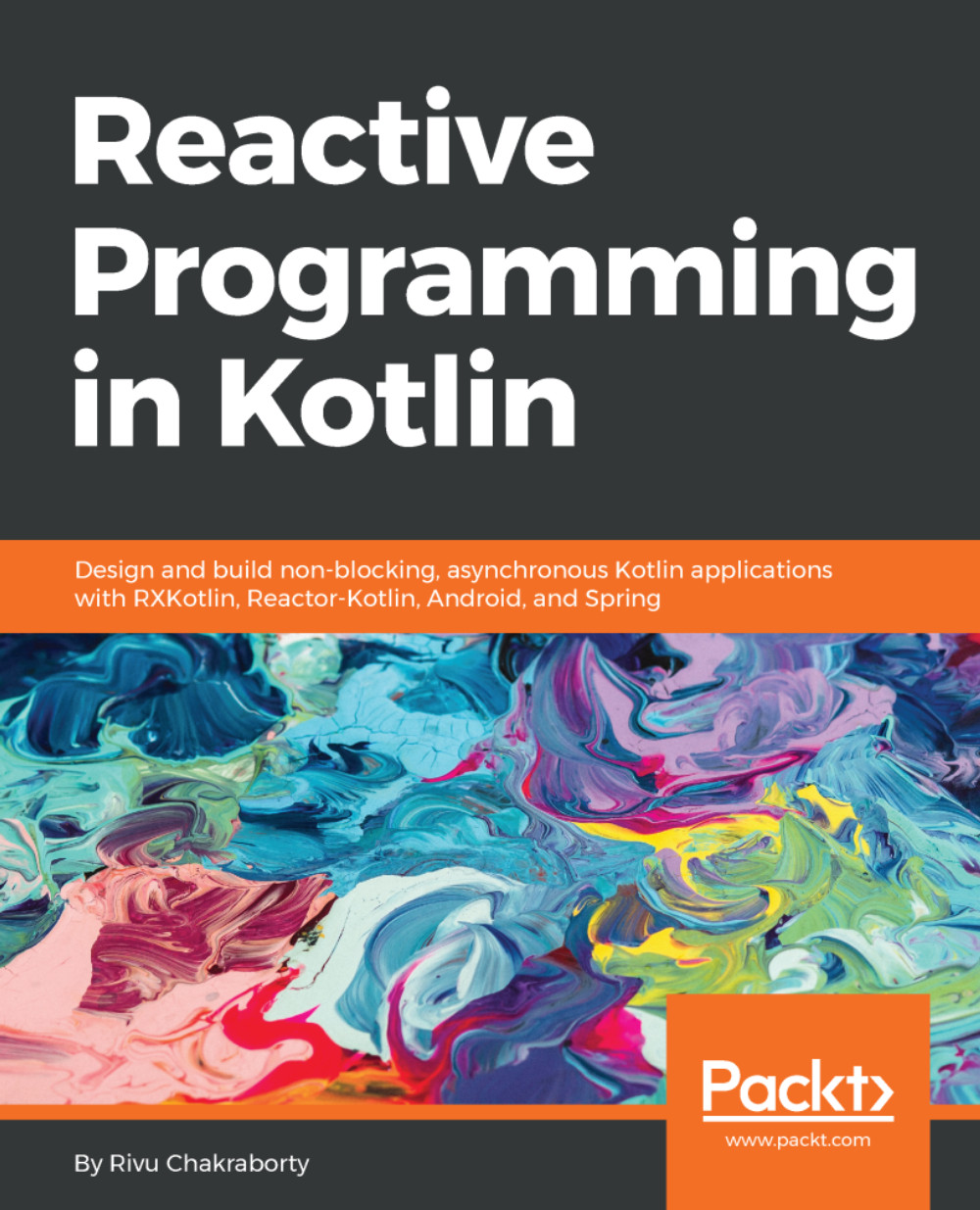
Reactive Programming in Kotlin

Reactive Programming in Kotlin

By : Rivu Chakraborty
2.3 (3)
close
close
Reactive Programming in Kotlin

Reactive Programming in Kotlin

2.3 (3)
By: Rivu Chakraborty

Overview of this book

In today's app-driven era, when programs are asynchronous, and responsiveness is so vital, reactive programming can help you write code that's more reliable, easier to scale, and better-performing. Reactive programming is revolutionary. With this practical book, Kotlin developers will first learn how to view problems in the reactive way, and then build programs that leverage the best features of this exciting new programming paradigm. You will begin with the general concepts of Reactive programming and then gradually move on to working with asynchronous data streams. You will dive into advanced techniques such as manipulating time in data-flow, customizing operators and provider and how to use the concurrency model to control asynchronicity of code and process event handlers effectively. You will then be introduced to functional reactive programming and will learn to apply FRP in practical use cases in Kotlin. This book will also take you one step forward by introducing you to Spring 5 and Spring Boot 2 using Kotlin. By the end of the book, you will be able to build real-world applications with reactive user interfaces as well as you'll learn to implement reactive programming paradigms in Android.
Table of Contents (13 chapters)
close
close

Composing operators with transformer

So, you have learned how to create custom operators, but think of a situation when you want to create a new operator by combining multiple operators. For instance, I often wanted to combine the functionality of the subscribeOn and observeOn operators so that all the computations can be pushed to computation threads, and, when the results are ready, we can receive them on the main thread.

Yes, it's possible to get the benefits of both operators by adding both operators one after the other to the chain, as shown here:

    fun main(args: Array<String>) { 
      Observable.range(1,10) 
        .map { 
           println("map - ${Thread.currentThread().name} $it") 
           it 
         } 
         .subscribeOn(Schedulers.computation()) 
         .observeOn(Schedulers.io()) 
         .subscribe { 
            println(&quot...
CONTINUE READING
83
Tech Concepts
36
Programming languages
73
Tech Tools
Icon Unlimited access to the largest independent learning library in tech of over 8,000 expert-authored tech books and videos.
Icon Innovative learning tools, including AI book assistants, code context explainers, and text-to-speech.
Icon 50+ new titles added per month and exclusive early access to books as they are being written.
Reactive Programming in Kotlin
notes
bookmark Notes and Bookmarks search Search in title playlist Add to playlist download Download options font-size Font size

Change the font size

margin-width Margin width

Change margin width

day-mode Day/Sepia/Night Modes

Change background colour

Close icon Search
Country selected

Close icon Your notes and bookmarks

Confirmation

Modal Close icon
claim successful

Buy this book with your credits?

Modal Close icon
Are you sure you want to buy this book with one of your credits?
Close
YES, BUY

Submit Your Feedback

Modal Close icon
Modal Close icon
Modal Close icon