


The easiest way of creating a Stack class is using an array to store its elements. When working with a large set of data (which is very common in real-world projects), we also need to analyze what is the most efficient way of manipulating the data. When working with arrays, most methods have a complexity of time O(n); we will learn more algorithm complexity in the last chapter of this book, Chapter 15, Algorithm Complexity. What this means is that, for most methods, we need to iterate through the array until we find the element we are looking for and, in the worst-case scenario, we will iterate through all the positions of the array, where n is the size of the array. If the array has more elements, it will take longer to iterate through all elements compared to an array with fewer elements. In addition, an array is...
-
Book Overview & Buying
-
Table Of Contents

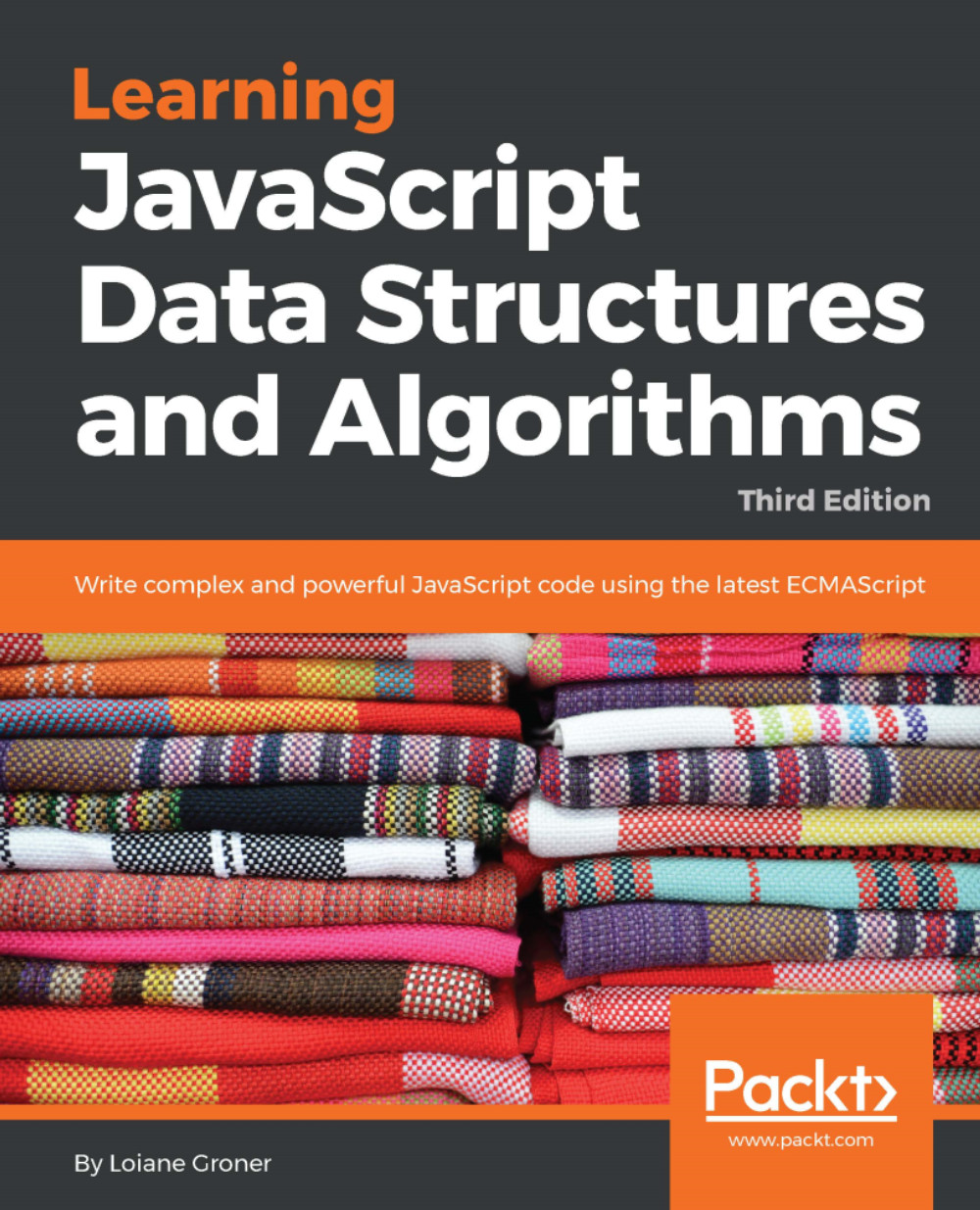
Learning JavaScript Data Structures and Algorithms - Third Edition
By :


Learning JavaScript Data Structures and Algorithms
By:
Overview of this book
A data structure is a particular way of organizing data in a computer to utilize resources efficiently. Data structures and algorithms are the base of every solution to any programming problem. With this book, you will learn to write complex and powerful code using the latest ES 2017 features.
Learning JavaScript Data Structures and Algorithms begins by covering the basics of JavaScript and introduces you to ECMAScript 2017, before gradually moving on to the most important data structures such as arrays, queues, stacks, and linked lists. You will gain in-depth knowledge of how hash tables and set data structures function as well as how trees and hash maps can be used to search files in an HD or represent a database. This book serves as a route to take you deeper into JavaScript. You’ll also get a greater understanding of why and how graphs, one of the most complex data structures, are largely used in GPS navigation systems in social networks.
Toward the end of the book, you’ll discover how all the theories presented in this book can be applied to solve real-world problems while working on your own computer networks and Facebook searches.
Table of Contents (17 chapters)
Preface

 Free Chapter
JavaScript – A Quick Overview
ECMAScript and TypeScript Overview
Arrays
Stacks

Queues and Deques
Linked Lists
Sets
Dictionaries and Hashes
Recursion
Trees
Binary Heap and Heap Sort
Graphs
Sorting and Searching Algorithms
Algorithm Designs and Techniques
Algorithm Complexity
Other Books You May Enjoy


