
Sign In Start Free Trial
Account

Add to playlist

Create a Playlist

Modal Close icon
You need to login to use this feature.
  • Book Overview & Buying Concurrent Patterns and Best Practices
  • Table Of Contents Toc
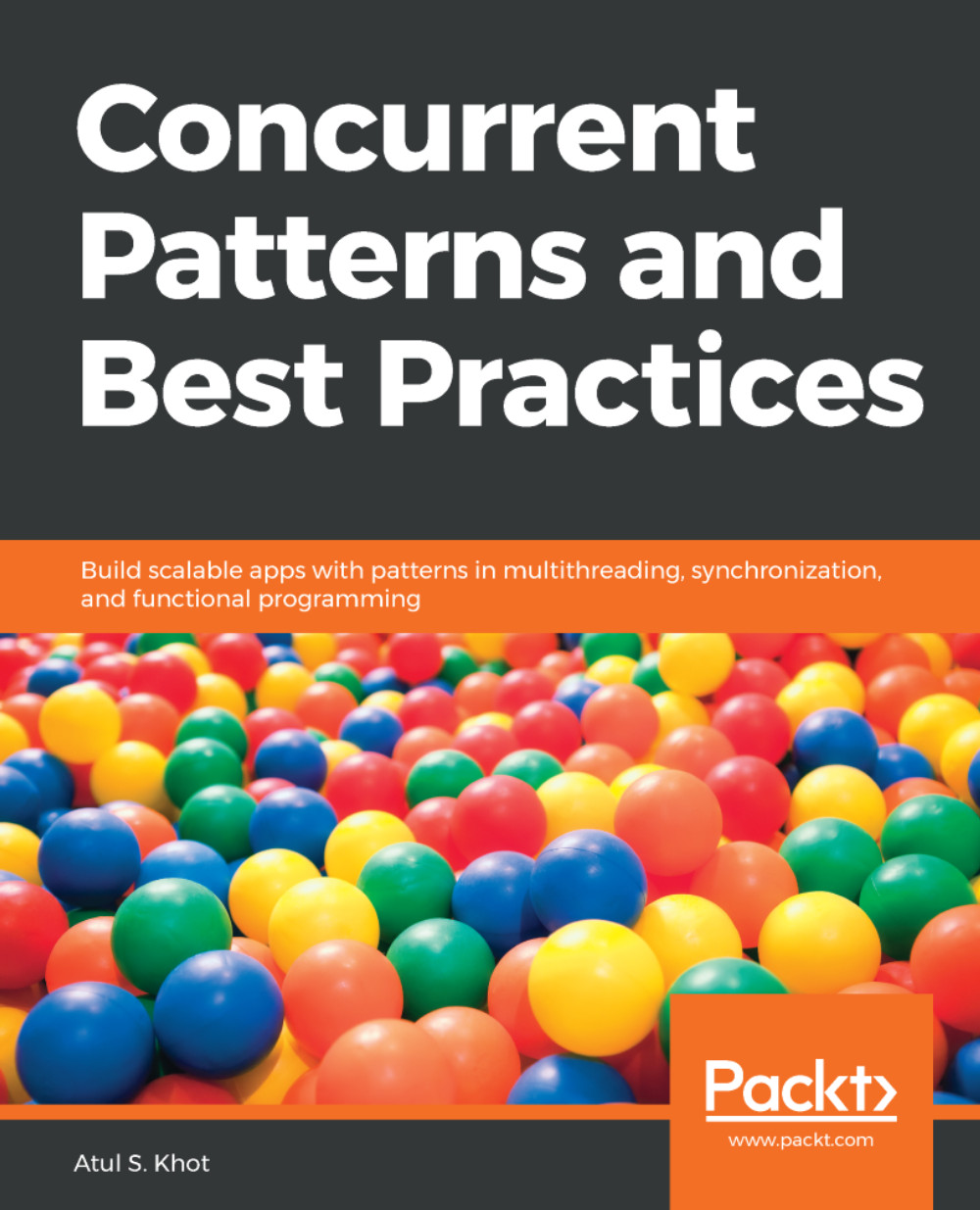
Concurrent Patterns and Best Practices

Concurrent Patterns and Best Practices

By : S. Khot
5 (1)
close
close
Concurrent Patterns and Best Practices

Concurrent Patterns and Best Practices

5 (1)
By: S. Khot

Overview of this book

Selecting the correct concurrency architecture has a significant impact on the design and performance of your applications. Concurrent design patterns help you understand the different characteristics of parallel architecture to make your code faster and more efficient. This book will help Java developers take a hands-on approach to building scalable and distributed apps by following step-by-step explanations of essential concepts and practical examples. You’ll begin with basic concurrency concepts and delve into the patterns used for explicit locking, lock-free programming, futures, and actors. You’ll explore coding with multithreading design patterns, including master, slave, leader, follower, and map-reduce, and then move on to solve problems using synchronizer patterns. You'll even discover the rationale for these patterns in distributed and parallel applications, and understand how future composition, immutability, and the monadic flow help you create more robust code. By the end of the book, you’ll be able to use concurrent design patterns to build high performance applications confidently.
Table of Contents (9 chapters)
close
close

Countdown latch

A latch is yet another synchronizer. It acts as a gate—threads wait for the gate to open; once the gate— that is—the latch opens, all threads enter it:

Why do we need latches? A latch is used to ensure that, unless some essential, precursor activity has happened, other activities wait for it. Let's look at a real-life example:

The preceding diagram shows how running a race happens on a nice evening. All the players need to assemble at the starting point and wait for the whistle to blow. Once the whistle goes, the players start running, and the race starts.

The starting point is the place of rendezvous: everyone needs to come and wait there for the important activity of the whistle blowing. We can't even imagine a race without it!

So, the runners are threads, the whistle being blown is a one-time activity, such as initialization...

CONTINUE READING
83
Tech Concepts
36
Programming languages
73
Tech Tools
Icon Unlimited access to the largest independent learning library in tech of over 8,000 expert-authored tech books and videos.
Icon Innovative learning tools, including AI book assistants, code context explainers, and text-to-speech.
Icon 50+ new titles added per month and exclusive early access to books as they are being written.
Concurrent Patterns and Best Practices
notes
bookmark Notes and Bookmarks search Search in title playlist Add to playlist download Download options font-size Font size

Change the font size

margin-width Margin width

Change margin width

day-mode Day/Sepia/Night Modes

Change background colour

Close icon Search
Country selected

Close icon Your notes and bookmarks

Confirmation

Modal Close icon
claim successful

Buy this book with your credits?

Modal Close icon
Are you sure you want to buy this book with one of your credits?
Close
YES, BUY

Submit Your Feedback

Modal Close icon
Modal Close icon
Modal Close icon