
Sign In Start Free Trial
Account

Add to playlist

Create a Playlist

Modal Close icon
You need to login to use this feature.
  • Book Overview & Buying Modern Python Standard Library Cookbook
  • Table Of Contents Toc
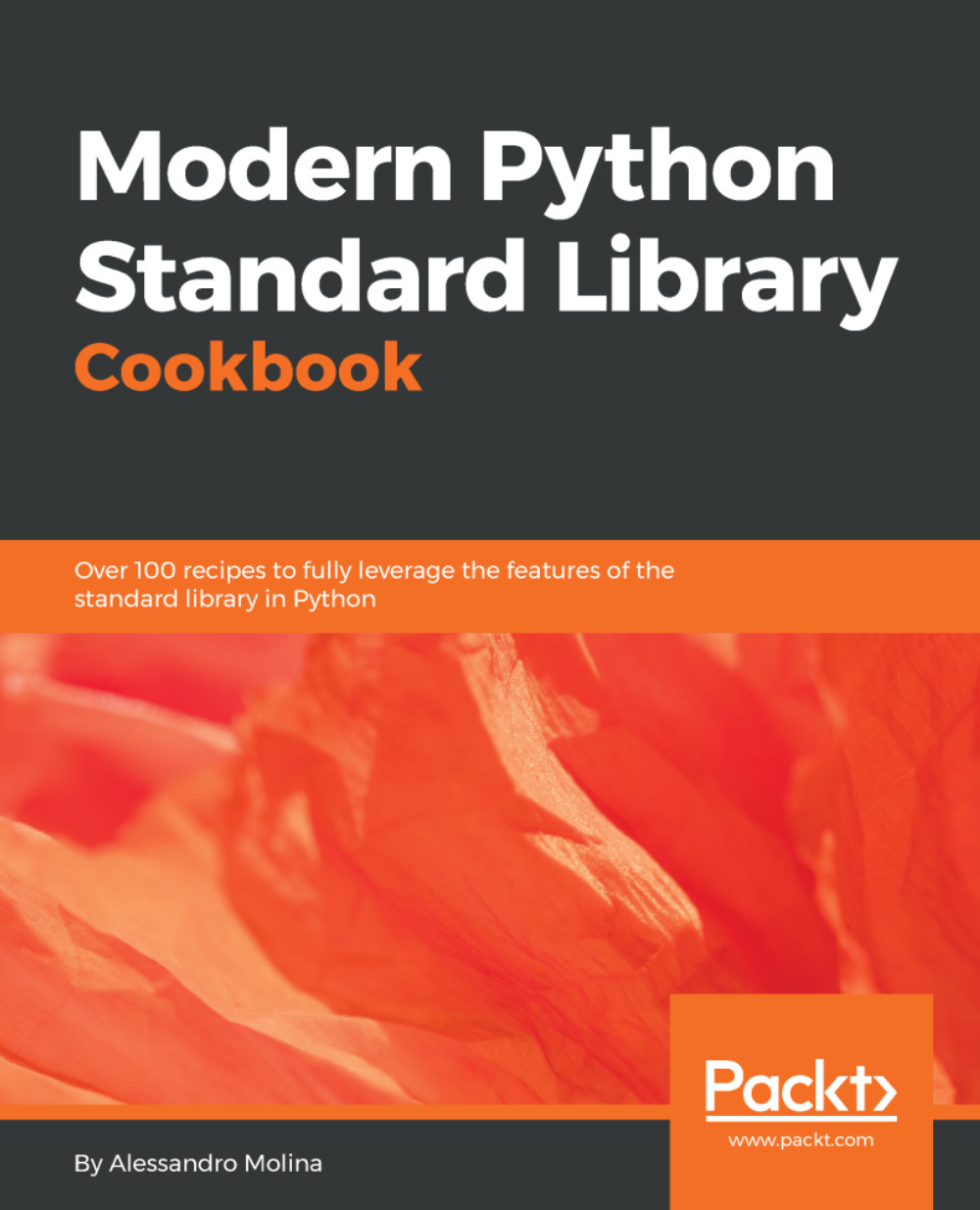
Modern Python Standard Library Cookbook

Modern Python Standard Library Cookbook

By : Molina
4.4 (7)
close
close
Modern Python Standard Library Cookbook

Modern Python Standard Library Cookbook

4.4 (7)
By: Molina

Overview of this book

The Python 3 Standard Library is a vast array of modules that you can use for developing various kinds of applications. It contains an exhaustive list of libraries, and this book will help you choose the best one to address specific programming problems in Python. The Modern Python Standard Library Cookbook begins with recipes on containers and data structures and guides you in performing effective text management in Python. You will find Python recipes for command-line operations, networking, filesystems and directories, and concurrent execution. You will learn about Python security essentials in Python and get to grips with various development tools for debugging, benchmarking, inspection, error reporting, and tracing. The book includes recipes to help you create graphical user interfaces for your application. You will learn to work with multimedia components and perform mathematical operations on date and time. The recipes will also show you how to deploy different searching and sorting algorithms on your data. By the end of the book, you will have acquired the skills needed to write clean code in Python and develop applications that meet your needs.
Table of Contents (16 chapters)
close
close

Dictionary with fallback

When working with configuration values, it's common to look them up in multiple places—maybe we load them from a configuration file—but we can override them with an environment variable or a command-line option, and in case the option is not provided, we can have a default value.

This can easily lead to long chains of if statements like these:

value = command_line_options.get('optname')
if value is None:
    value = os.environ.get('optname')
if value is None:
    value = config_file_options.get('optname')
if value is None:
    value = 'default-value'

This is annoying, and while for a single value it might be just annoying, it will tend to grow into a huge, confusing list of conditions as more options get added.

Command-line options are a very frequent use case, but the problem is related to chained scopes resolution. Variables in Python are resolved by looking at locals(); if they are not found, the interpreter looks at globals(), and if they are not yet found, it looks for built-ins.

How to do it...

For this step, you need to go through the following steps:

  1. The alternative for chaining default values of dict.getinstead of using multiple if instances, probably wouldn't improve much the code and if we want to add one additional scope, we would have to add it in every single place where we are looking up the values.
  2. collections.ChainMap is a very convenient solution to this problem; we can provide a list of mapping containers and it will look for a key through them all.


  1. Our previous example involving multiple different if instances can be converted to something like this:
import os
from collections import ChainMap

options = ChainMap(command_line_options, os.environ, config_file_options)
value = options.get('optname', 'default-value')
  1. We can also get rid of the last .get call by combining ChainMap with defaultdict. In this case, we can use defaultdict to provide a default value for every key:
import os
from collections import ChainMap, defaultdict

options = ChainMap(command_line_options, os.environ, config_file_options,
                   defaultdict(lambda: 'default-value'))
value = options['optname']
value2 = options['other-option']
  1. Print value and value2 will result in the following:
optvalue
default-value

optname will be retrieved from the command_line_options containing it, while other-option will end up being resolved by defaultdict.

How it works...

The ChainMap class receives multiple dictionaries as arguments; whenever a key is requested to ChainMap, it's actually going through the provided dictionaries one by one to check whether the key is available in any of them. Once the key is found, it is returned, as if it was a key owned by ChainMap itself.

The default value for options that are not provided is implemented by having defaultdict as the last dictionary provided to ChainMap. Whenever a key is not found in any of the previous dictionaries, it gets looked up in defaultdict, which uses the provided factory function to return a default value for all keys.

There's more...

Another great feature of ChainMap is that it allows updating too, but instead of updating the dictionary where it found the key, it always updates the first dictionary. The result is the same, as on next lookup of that key, we would have the first dictionary override any other value for that key (as it's the first place where the key is checked). The advantage is that if we provide an empty dictionary as the first mapping provided to ChainMap, we can change those values without touching the original container:

>>> population=dict(italy=60, japan=127, uk=65)
>>> changes = dict()
>>> editablepop = ChainMap(changes, population)

>>> print(editablepop['japan'])
127
>>> editablepop['japan'] += 1
>>> print(editablepop['japan'])
128

But even though we changed the population of Japan to 128 million, the original population didn't change:

>>> print(population['japan'])
127

And we can even use changes to find out which values were changed and which values were not:

>>> print(changes.keys()) 
dict_keys(['japan'])
>>> print(population.keys() - changes.keys())
{'italy', 'uk'}

It's important to know, by the way, that if the object contained in the dictionary is mutable and we directly mutate it, there is little ChainMap can do to avoid mutating the original object. So if, instead of numbers, we store lists in the dictionaries, we will be mutating the original dictionary whenever we append values to the dictionary:

>>> citizens = dict(torino=['Alessandro'], amsterdam=['Bert'], raleigh=['Joseph']) 
>>> changes = dict()
>>> editablecits = ChainMap(changes, citizens)
>>> editablecits['torino'].append('Simone')
>>> print(editablecits['torino']) ['Alessandro', 'Simone']
>>> print(changes)
{}
>>> print(citizens)
{'amsterdam': ['Bert'],
'torino': ['Alessandro', 'Simone'],
'raleigh': ['Joseph']}
CONTINUE READING
83
Tech Concepts
36
Programming languages
73
Tech Tools
Icon Unlimited access to the largest independent learning library in tech of over 8,000 expert-authored tech books and videos.
Icon Innovative learning tools, including AI book assistants, code context explainers, and text-to-speech.
Icon 50+ new titles added per month and exclusive early access to books as they are being written.
Modern Python Standard Library Cookbook
notes
bookmark Notes and Bookmarks search Search in title playlist Add to playlist download Download options font-size Font size

Change the font size

margin-width Margin width

Change margin width

day-mode Day/Sepia/Night Modes

Change background colour

Close icon Search
Country selected

Close icon Your notes and bookmarks

Confirmation

Modal Close icon
claim successful

Buy this book with your credits?

Modal Close icon
Are you sure you want to buy this book with one of your credits?
Close
YES, BUY

Submit Your Feedback

Modal Close icon
Modal Close icon
Modal Close icon