Sign In Start Free Trial
Account

Add to playlist

Create a Playlist

Modal Close icon
You need to login to use this feature.
  • Book Overview & Buying Julia 1.0 Programming
  • Table Of Contents Toc
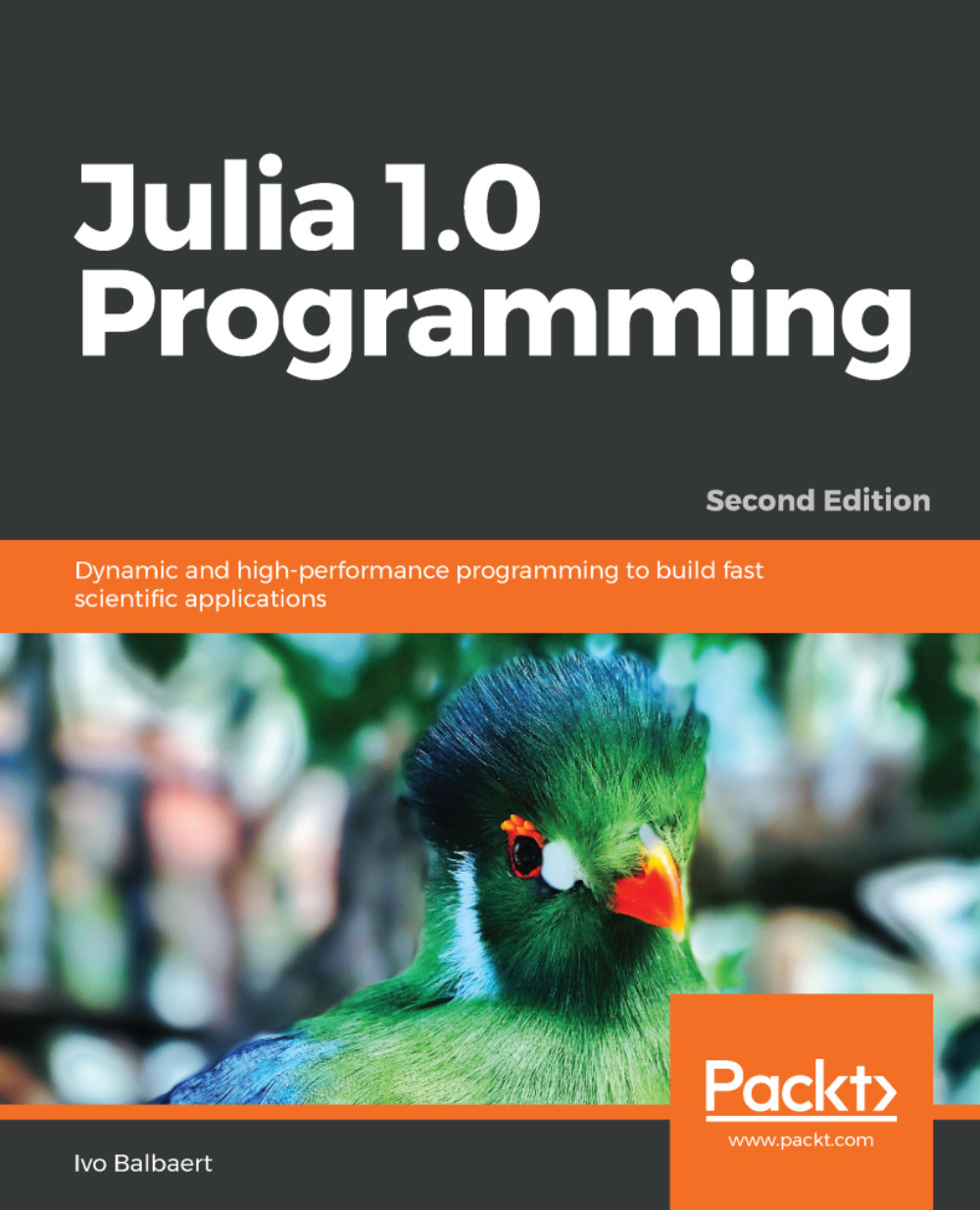
Julia 1.0 Programming

Julia 1.0 Programming - Second Edition

By : Ivo Balbaert
3.5 (2)
close
close
Julia 1.0 Programming

Julia 1.0 Programming

3.5 (2)
By: Ivo Balbaert

Overview of this book

The release of Julia 1.0 is now ready to change the technical world by combining the high productivity and ease of use of Python and R with the lightning-fast speed of C++. Julia 1.0 programming gives you a head start in tackling your numerical and data problems. You will begin by learning how to set up a running Julia platform, before exploring its various built-in types. With the help of practical examples, this book walks you through two important collection types: arrays and matrices. In addition to this, you will be taken through how type conversions and promotions work. In the course of the book, you will be introduced to the homo-iconicity and metaprogramming concepts in Julia. You will understand how Julia provides different ways to interact with an operating system, as well as other languages, and then you'll discover what macros are. Once you have grasped the basics, you’ll study what makes Julia suitable for numerical and scientific computing, and learn about the features provided by Julia. By the end of this book, you will also have learned how to run external programs. This book covers all you need to know about Julia in order to leverage its high speed and efficiency for your applications.
Table of Contents (12 chapters)
close
close

Parallel operations and computing


In our multicore CPU and clustered computing world, it is imperative for a new language to have excellent parallel computing capabilities. This is one of the main strengths of Julia: providing an environment based on message-passing between multiple processes that can execute on the same machine or on remote machines.

In that sense, it implements the actor model (as Erlang, Elixir, and Pony do), but we'll see that the actual coding happens on a higher level than receiving and sending messages between processes, or workers (processors) as Julia calls them. The developer only needs to explicitly manage the main process from which all other workers are started. The message send and receive operations are simulated by higher-level operations that look like function calls.

Creating processes

To start with processes, add and make available the Distributed package with add Distributed, and using Distributed.

Julia can be started as a REPL or as a separate application...

CONTINUE READING
83
Tech Concepts
36
Programming languages
73
Tech Tools
Icon Unlimited access to the largest independent learning library in tech of over 8,000 expert-authored tech books and videos.
Icon Innovative learning tools, including AI book assistants, code context explainers, and text-to-speech.
Icon 50+ new titles added per month and exclusive early access to books as they are being written.
Julia 1.0 Programming
notes
bookmark Notes and Bookmarks search Search in title playlist Add to playlist font-size Font size

Change the font size

margin-width Margin width

Change margin width

day-mode Day/Sepia/Night Modes

Change background colour

Close icon Search
Country selected

Close icon Your notes and bookmarks

Confirmation

Modal Close icon
claim successful

Buy this book with your credits?

Modal Close icon
Are you sure you want to buy this book with one of your credits?
Close
YES, BUY

Submit Your Feedback

Modal Close icon
Modal Close icon
Modal Close icon