
Sign In Start Free Trial
Account

Add to playlist

Create a Playlist

Modal Close icon
You need to login to use this feature.
  • Book Overview & Buying Hands-On System Programming with C++
  • Table Of Contents Toc
  • Feedback & Rating feedback
Hands-On System Programming with C++

Hands-On System Programming with C++

By : Quinn
4 (7)
close
close
Hands-On System Programming with C++

Hands-On System Programming with C++

4 (7)
By: Quinn

Overview of this book

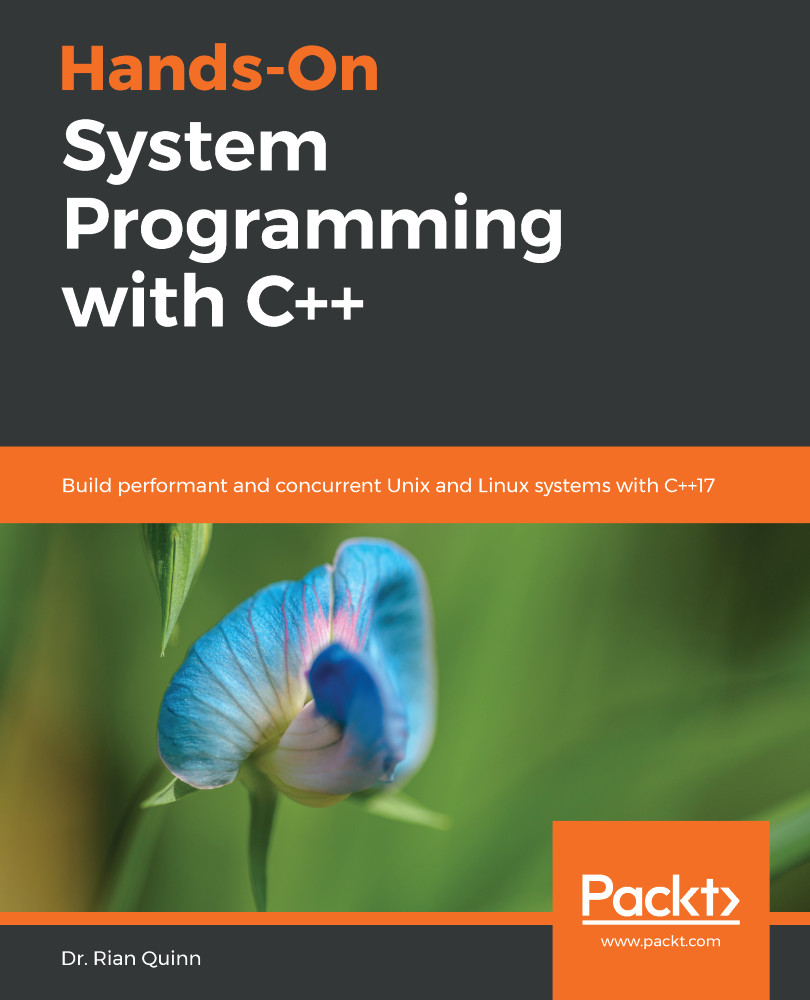
C++ is a general-purpose programming language with a bias toward system programming as it provides ready access to hardware-level resources, efficient compilation, and a versatile approach to higher-level abstractions. This book will help you understand the benefits of system programming with C++17. You will gain a firm understanding of various C, C++, and POSIX standards, as well as their respective system types for both C++ and POSIX. After a brief refresher on C++, Resource Acquisition Is Initialization (RAII), and the new C++ Guideline Support Library (GSL), you will learn to program Linux and Unix systems along with process management. As you progress through the chapters, you will become acquainted with C++'s support for IO. You will then study various memory management methods, including a chapter on allocators and how they benefit system programming. You will also explore how to program file input and output and learn about POSIX sockets. This book will help you get to grips with safely setting up a UDP and TCP server/client. Finally, you will be guided through Unix time interfaces, multithreading, and error handling with C++ exceptions. By the end of this book, you will be comfortable with using C++ to program high-quality systems.
Table of Contents (16 chapters)
close
close

Beginning with POSIX sockets

Unfortunately, C++ does not contain a native networking library (something that will hopefully be addressed with C++20). For this reason, POSIX sockets are needed to perform networking with C++. The POSIX sockets API defines an API for sending and receiving network packets using the standard, Unix file-descriptor paradigm. When programming with sockets, both a server and a client must be created. Servers are responsible for binding a specific port to the socket protocol that is being developed by the user of the sockets library. Clients are any other application that is connected to a previously-bound port. Both servers and clients have their own IP addresses.

When programming sockets, besides picking address types, such as IPv4 versus IPv6, typically the programmer must also choose between UDP versus TCP. UDP is a connectionless protocol that provides...

Visually different images
CONTINUE READING
83
Tech Concepts
36
Programming languages
73
Tech Tools
Icon Unlimited access to the largest independent learning library in tech of over 8,000 expert-authored tech books and videos.
Icon Innovative learning tools, including AI book assistants, code context explainers, and text-to-speech.
Icon 50+ new titles added per month and exclusive early access to books as they are being written.
Hands-On System Programming with C++
notes
bookmark Notes and Bookmarks search Search in title playlist Add to playlist download Download options font-size Font size

Change the font size

margin-width Margin width

Change margin width

day-mode Day/Sepia/Night Modes

Change background colour

Close icon Search
Country selected

Close icon Your notes and bookmarks

Confirmation

Modal Close icon
claim successful

Buy this book with your credits?

Modal Close icon
Are you sure you want to buy this book with one of your credits?
Close
YES, BUY

Submit Your Feedback

Modal Close icon
Modal Close icon
Modal Close icon