
Sign In Start Free Trial
Account

Add to playlist

Create a Playlist

Modal Close icon
You need to login to use this feature.
  • Book Overview & Buying Learn Data Structures and Algorithms with Golang
  • Table Of Contents Toc
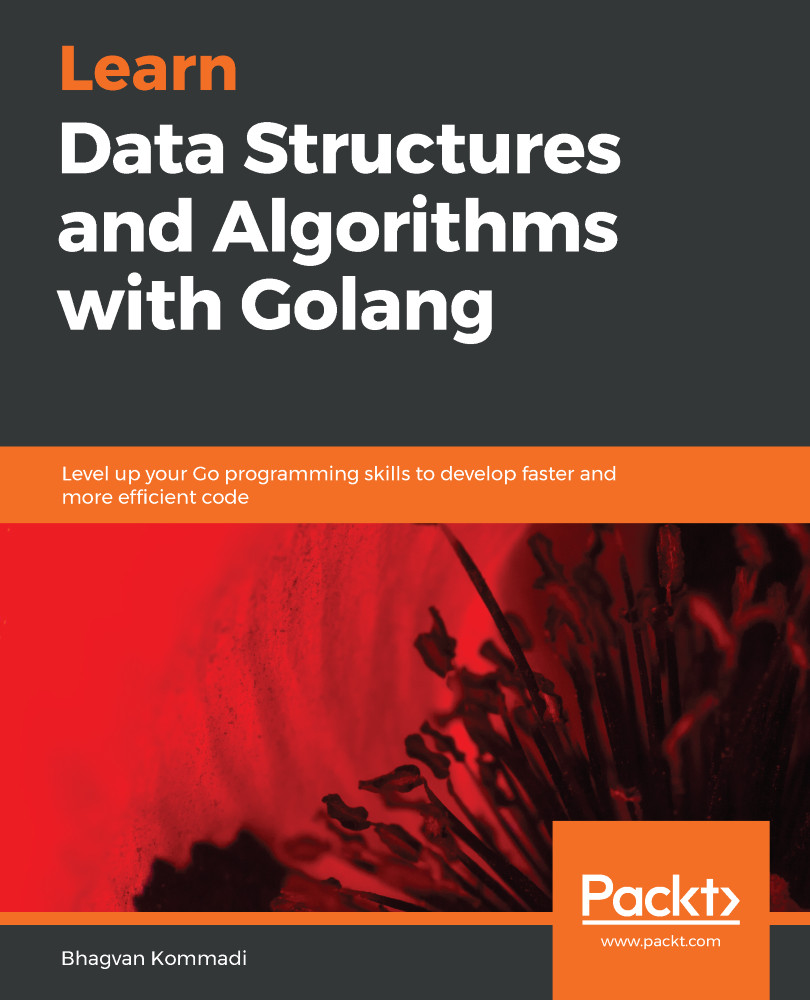
Learn Data Structures and Algorithms with Golang

Learn Data Structures and Algorithms with Golang

By : Bhagvan Kommadi
2.6 (10)
close
close
Learn Data Structures and Algorithms with Golang

Learn Data Structures and Algorithms with Golang

2.6 (10)
By: Bhagvan Kommadi

Overview of this book

Golang is one of the fastest growing programming languages in the software industry. Its speed, simplicity, and reliability make it the perfect choice for building robust applications. This brings the need to have a solid foundation in data structures and algorithms with Go so as to build scalable applications. Complete with hands-on tutorials, this book will guide you in using the best data structures and algorithms for problem solving. The book begins with an introduction to Go data structures and algorithms. You'll learn how to store data using linked lists, arrays, stacks, and queues. Moving ahead, you'll discover how to implement sorting and searching algorithms, followed by binary search trees. This book will also help you improve the performance of your applications by stringing data types and implementing hash structures in algorithm design. Finally, you'll be able to apply traditional data structures to solve real-world problems. By the end of the book, you'll have become adept at implementing classic data structures and algorithms in Go, propelling you to become a confident Go programmer.
Table of Contents (16 chapters)
close
close
Lock Free Chapter
1
Section 1: Introduction to Data Structures and Algorithms and the Go Language
4
Section 2: Basic Data Structures and Algorithms using Go
11
Section 3: Advanced Data Structures and Algorithms using Go

Stacks

A stack is a last in, first out structure in which items are added from the top. Stacks are used in parsers for solving maze algorithms. Push, pop, top, and get size are the typical operations that are allowed on stack data structures. Syntax parsing, backtracking, and compiling time memory management are some real-life scenarios where stacks can be used. An example of stack implementation is as follows (stack.go):

//main package has examples shown
// in Hands-On Data Structures and algorithms with Go book
package main
// importing fmt package
import (
"fmt"
"strconv"
)
//Element class
type Element struct {
elementValue int
}
// String method on Element class
func (element *Element) String() string {
return strconv.Itoa(element.elementValue)
}

The Element class has elementValue as an attribute. The String method returns the element's elementValue.

Stacks methods...

CONTINUE READING
83
Tech Concepts
36
Programming languages
73
Tech Tools
Icon Unlimited access to the largest independent learning library in tech of over 8,000 expert-authored tech books and videos.
Icon Innovative learning tools, including AI book assistants, code context explainers, and text-to-speech.
Icon 50+ new titles added per month and exclusive early access to books as they are being written.
Learn Data Structures and Algorithms with Golang
notes
bookmark Notes and Bookmarks search Search in title playlist Add to playlist download Download options font-size Font size

Change the font size

margin-width Margin width

Change margin width

day-mode Day/Sepia/Night Modes

Change background colour

Close icon Search
Country selected

Close icon Your notes and bookmarks

Confirmation

Modal Close icon
claim successful

Buy this book with your credits?

Modal Close icon
Are you sure you want to buy this book with one of your credits?
Close
YES, BUY

Submit Your Feedback

Modal Close icon
Modal Close icon
Modal Close icon