Sign In Start Free Trial
Account

Add to playlist

Create a Playlist

Modal Close icon
You need to login to use this feature.
  • Book Overview & Buying Dancing with Python
  • Table Of Contents Toc
Dancing with Python

Dancing with Python

By : Robert S. Sutor
5 (7)
close
close
Dancing with Python

Dancing with Python

5 (7)
By: Robert S. Sutor

Overview of this book

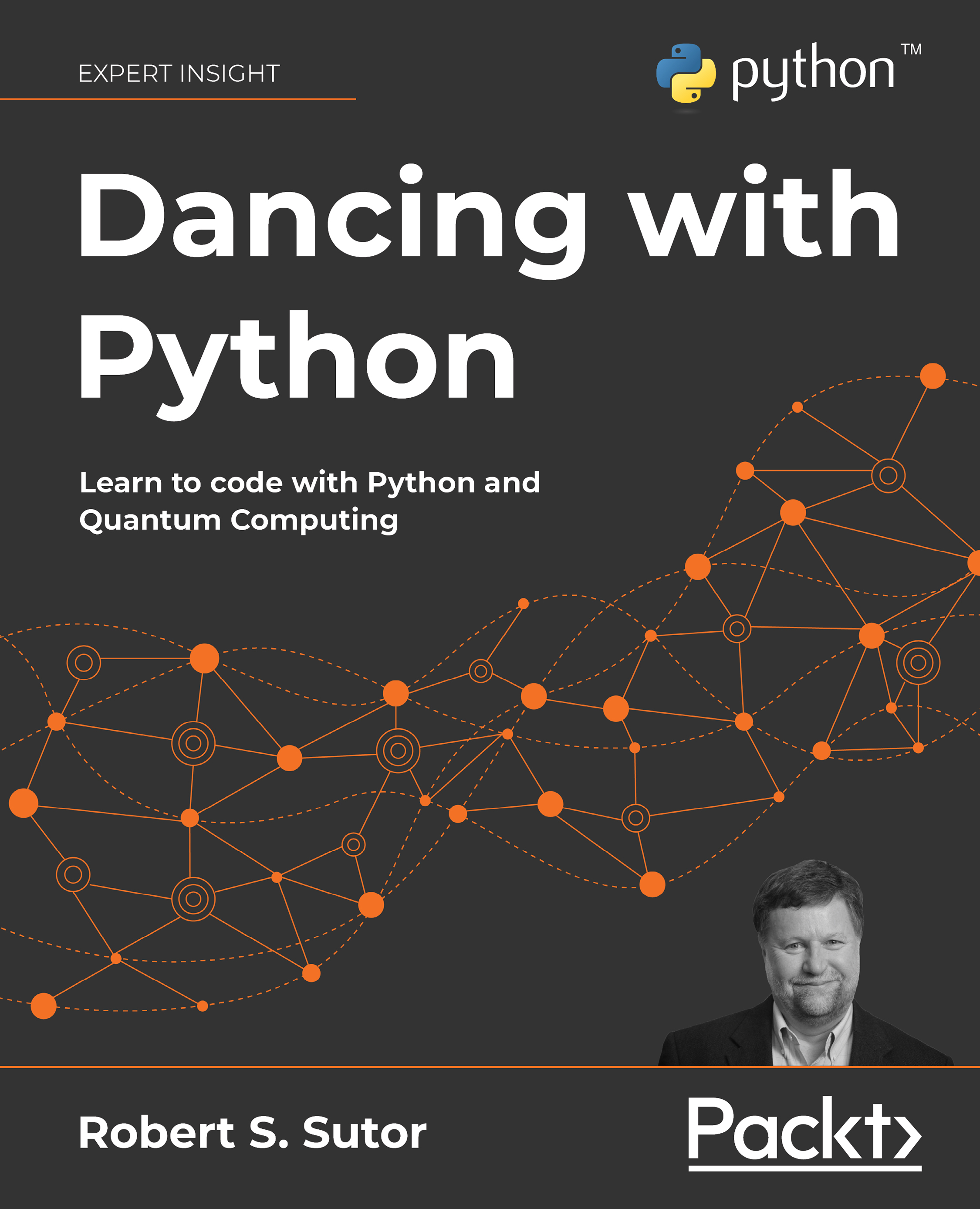
Dancing with Python helps you learn Python and quantum computing in a practical way. It will help you explore how to work with numbers, strings, collections, iterators, and files. The book goes beyond functions and classes and teaches you to use Python and Qiskit to create gates and circuits for classical and quantum computing. Learn how quantum extends traditional techniques using the Grover Search Algorithm and the code that implements it. Dive into some advanced and widely used applications of Python and revisit strings with more sophisticated tools, such as regular expressions and basic natural language processing (NLP). The final chapters introduce you to data analysis, visualizations, and supervised and unsupervised machine learning. By the end of the book, you will be proficient in programming the latest and most powerful quantum computers, the Pythonic way.
Table of Contents (29 chapters)
close
close
2
Part I: Getting to Know Python
10
PART II: Algorithms and Circuits
14
PART III: Advanced Features and Libraries
19
References
20
Other Books You May Enjoy
1
Appendices
4
Appendix C: The Complete UniPoly Class
5
Appendix D: The Complete Guitar Class Hierarchy
7
Appendix F: Production Notes

1.4 Libraries

While many books are now digital and available online, physical libraries are often still present in towns and cities. You can use a library to avoid doing something yourself, namely, buying a book. You can borrow it and read it. If it is a cookbook, you can use the recipes to make food.

A similar idea exists for programming languages and their environments. I can package together reusable data and functions, and then place them in a library. Via download or other sharing, coders can use my library to save themselves time. For example, if I built a library for math, it could contain functions like maximum, minimum, absolute_value, and is_prime. It could also include approximations to special values like π.

Once you have access to a library by installing it on your system, you need to tell your programming environment that you want to take advantage of it. Languages use different terminology for what they call the contents of libraries and how to make them available.

  • Python imports modules and packages.
  • Go imports packages.
  • JavaScript imports bindings from modules.
  • Ruby requires gems.
  • C and C++ include source header files that correspond to compiled libraries for runtime.

In languages like Python and Java, you can import specific constructs from a package, such as a class, or everything in it. With all these examples, the intent is to allow your environment to have a rich and expandable set of pre-built features that you can use within your code. Some libraries come with the core environment. You can also optionally install third-party libraries. Part III of this book looks at a broad range of frequently used Python libraries.

What happens if you import two libraries and they each have a function with the same name? If this happens, we have a naming collision and ambiguity. The solution to avoid this is to embellish the function’s name with something else, such as the library’s name. That way, you can explicitly say, “use this function from here and that other function from over there.” For example, math.sin in Python means “use the sin function from the math module.” This is the concept of a namespace.

CONTINUE READING
83
Tech Concepts
36
Programming languages
73
Tech Tools
Icon Unlimited access to the largest independent learning library in tech of over 8,000 expert-authored tech books and videos.
Icon Innovative learning tools, including AI book assistants, code context explainers, and text-to-speech.
Icon 50+ new titles added per month and exclusive early access to books as they are being written.
Dancing with Python
notes
bookmark Notes and Bookmarks search Search in title playlist Add to playlist download Download options font-size Font size

Change the font size

margin-width Margin width

Change margin width

day-mode Day/Sepia/Night Modes

Change background colour

Close icon Search
Country selected

Close icon Your notes and bookmarks

Confirmation

Modal Close icon
claim successful

Buy this book with your credits?

Modal Close icon
Are you sure you want to buy this book with one of your credits?
Close
YES, BUY

Submit Your Feedback

Modal Close icon
Modal Close icon
Modal Close icon