


-
Book Overview & Buying
-
Table Of Contents

GPU-Accelerated Computing with Python 3 and CUDA
By :


GPU-Accelerated Computing with Python 3 and CUDA
By:
Overview of this book
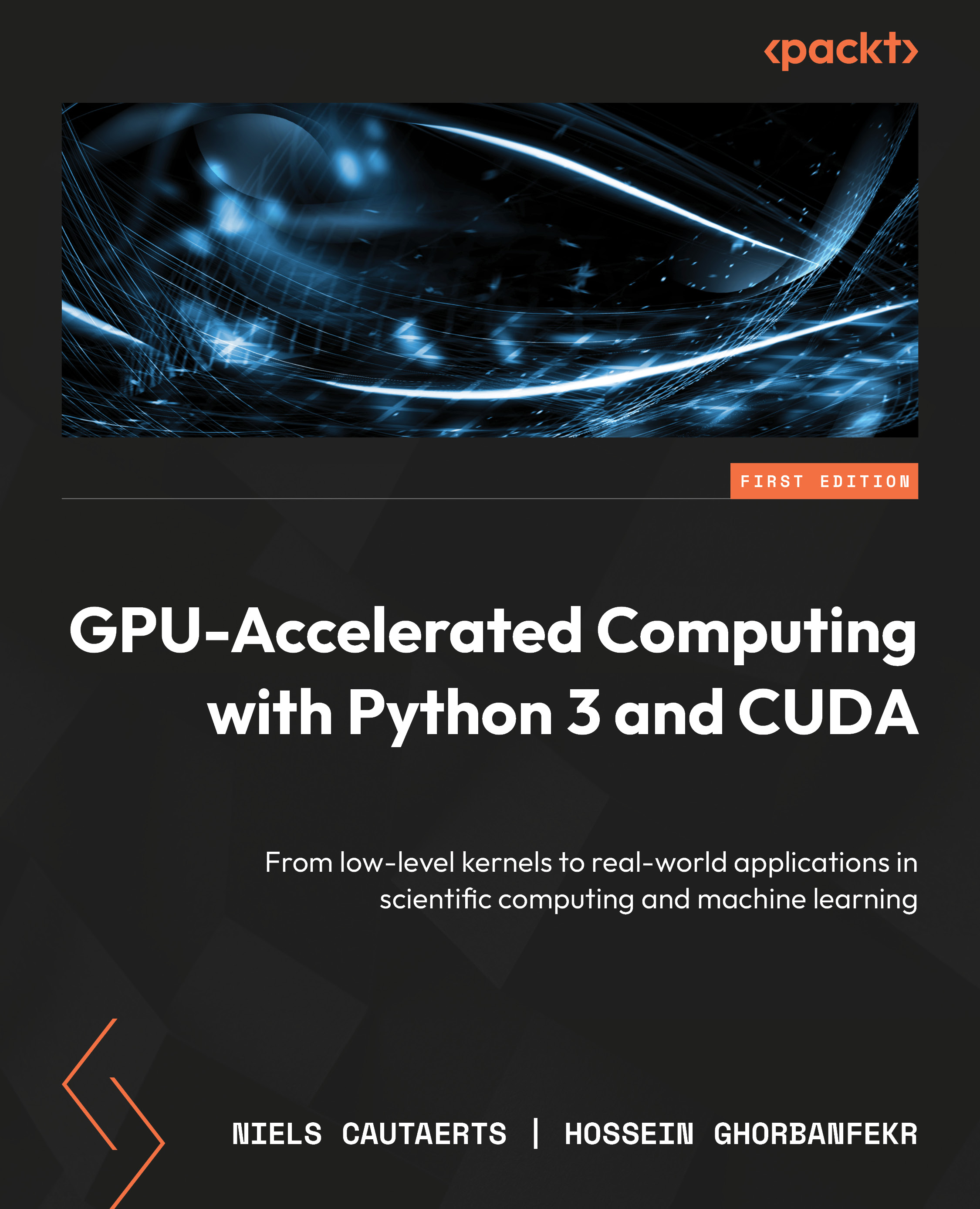
Writing high-performance Python code doesn’t have to mean switching to C++. This book shows you how to accelerate Python applications using NVIDIA’s CUDA platform and a modern ecosystem of Python tools and libraries. Aimed at researchers, engineers, and data scientists, it offers a practical yet deep understanding of GPU programming and how to fully exploit modern GPU hardware.
You’ll begin with the fundamentals of CUDA programming in Python using Numba-CUDA, learning how GPUs work and how to write, execute, and debug custom GPU kernels. Building on this foundation, the book explores memory access optimization, asynchronous execution with CUDA streams, and multi-GPU scaling using Dask-CUDA. Performance analysis and tuning are emphasized throughout, using NVIDIA Nsight profilers.
You’ll also learn to use high-level GPU libraries such as JAX, CuPy, and RAPIDS to accelerate numerical Python workflows with minimal code changes. These techniques are applied to real-world examples, including PDE solvers, image processing, physical simulations, and transformer models.
Written by experienced GPU practitioners, this hands-on guide emphasizes reproducible workflows using Python 3.10+, CUDA 12.3+, and tools like the Pixi package manager. By the end, you’ll have future-ready skills for building scalable GPU applications in Python.
Table of Contents (24 chapters)
Preface


Part 1: Fundamentals of GPU programming with CUDA in Python 3
 Free Chapter
Chapter 1: Why GPU Programming with CUDA in Python 3?
Chapter 2: Setting Up a GPU Programming Environment Locally and in the Cloud
Chapter 3: Writing and Executing CUDA Kernels with Numba-CUDA
Chapter 4: Profiling and Debugging CUDA Code
Part 2: Performance Optimization and Advanced CUDA Topics
Chapter 5: Optimizing the Performance of CUDA Code
Chapter 6: Enabling Concurrency Using CUDA Streams
Chapter 7: Scaling to Multiple GPUs
Part 3: Using High-Level Python Libraries for GPU Computation
Chapter 8: Bringing NumPy and SciPy to the GPU with CuPy
Chapter 9: Bringing pandas and scikit-learn to the GPU with Rapids
Chapter 10: Solving Optimization Problems on the GPU with JAX
Part 4: Real-World Example Applications
Chapter 11: Solving the Heat Equation on the GPU
Chapter 12: Image Processing and Computer Vision on the GPU

Chapter 13: Simulating Atomic Interactions on the GPU
Chapter 14: Implementing Your Own Transformer-Based Language Model
Part 5: Beyond This Book
Chapter 15: Expanding and Deepening Your GPU Programming Knowledge
Chapter 16: Unlock Your Exclusive Benefits
Other Books You May Enjoy
Index


