Sign In Start Free Trial
Account

Add to playlist

Create a Playlist

Modal Close icon
You need to login to use this feature.
  • Book Overview & Buying Building Modern SaaS Applications with C# and .NET
  • Table Of Contents Toc
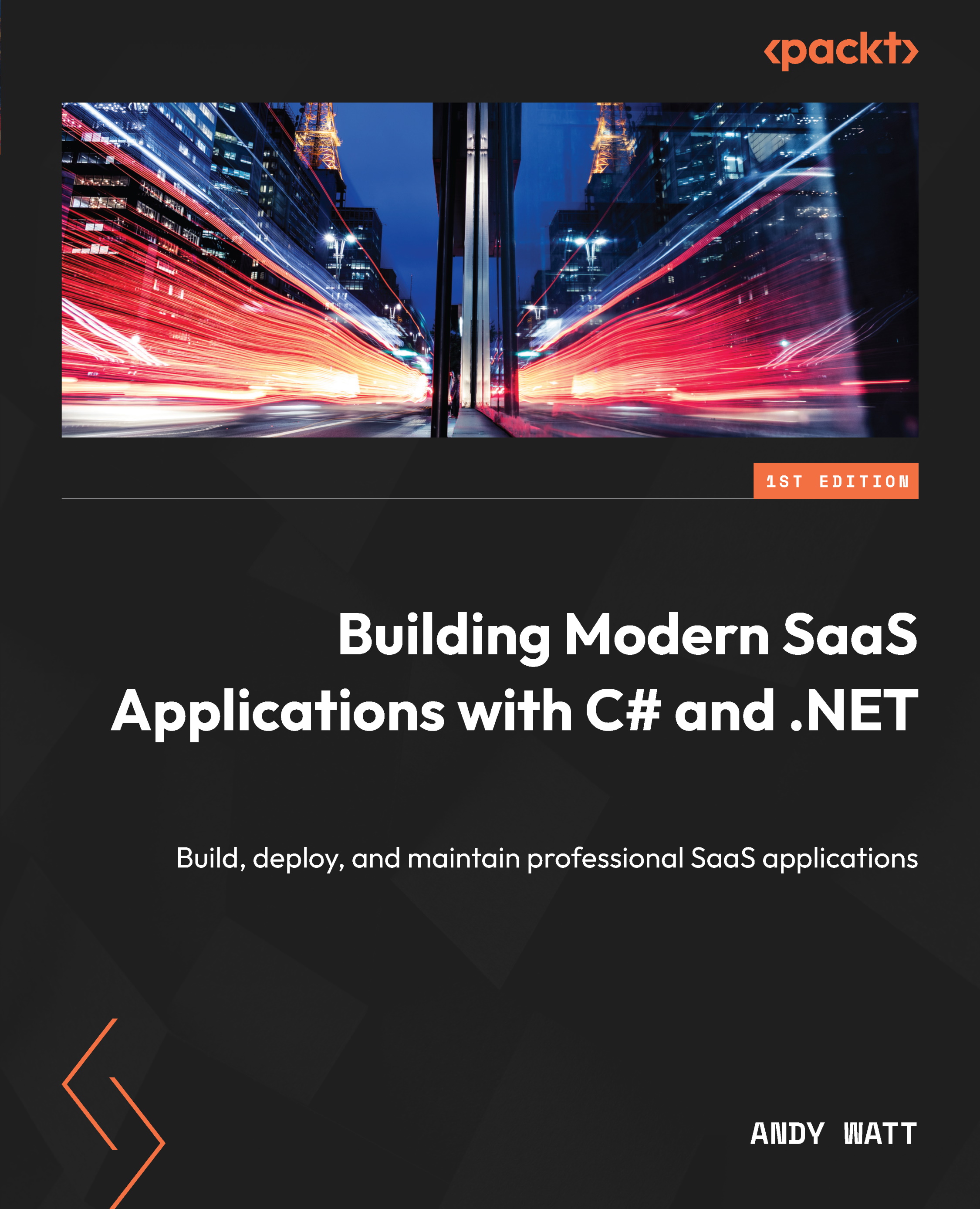
Building Modern SaaS Applications with C# and .NET

Building Modern SaaS Applications with C# and .NET

By : Andy Watt
4.7 (6)
close
close
Building Modern SaaS Applications with C# and .NET

Building Modern SaaS Applications with C# and .NET

4.7 (6)
By: Andy Watt

Overview of this book

There are several concepts that must be mastered to deliver functional and efficient SaaS applications. This book is perfect for developers and teams with experience in traditional application development looking to switch to SaaS and deliver slick and modern applications. You‘ll start with a general overview of SaaS as a concept and learn with the help of an example throughout the book to bring life to the technical descriptions. You’ll use the Microsoft .NET tech stack for development and C# as the programming language to develop your desired SaaS application. Delivering SaaS requires a deep understanding of all layers in the application stack. As you progress, you’ll learn how to approach the database layer, the API, and the UI to confidently approach application development using the SaaS model. Additionally, you’ll explore how to test, deploy, maintain, and upgrade each component of the application. By the end of this book, you will be well equipped to approach all aspects of delivering software using the SaaS paradigm.
Table of Contents (21 chapters)
close
close
1
Part 1: Getting Started
4
Part 2: Building the Backend
9
Part 3: Building the Frontend
12
Part 4: Deploying and Maintaining the Application
17
Part 5: Concluding Thoughts

What is SaaS?

SaaS has become the dominant paradigm in delivering an application to users. But what is SaaS?

You could say that SaaS applications are software applications that are delivered to their users over the internet and in a browser, often paid for by way of a monthly subscription fee.

And while that is technically correct, that single-sentence definition glosses over a lot of complexity! A lot of complexity for the user, the vendor, and most certainly for you—the developer of such applications!

In this chapter, we will start to build an understanding of SaaS, with a basic understanding of the technical, operational, and functional knowledge required to build a SaaS application from the ground up using Microsoft technologies. We will expand on that previous definition to the point that you—the reader, and soon-to-be SaaS developer—can confidently approach and solve problems by delivering SaaS-based solutions!

Let’s start by expanding on that definition a little.

SaaS is typically understood to be applications that are delivered and interacted with through a browser. The software is not purchased or “owned” by the user and installed on their computer. Instead (typically), a monthly membership fee is paid, which grants the user access to the service.

From the user’s point of view, the benefit of this is that they can access the application anywhere, at any time, on any device. They do not have to worry about installing the application or keeping the app up to date. All of that is just part of the service.

Many of the biggest tech companies in the world provide SaaS applications, and there is a good chance that you are using at least one of them!

Gmail is a great example of a SaaS application that is provided by Google. While it is free to most users, there is a fee for corporate or professional users who must pay for access to the G Suite tools. As well as a SaaS mail client, Google also offers a calendar application and a contact management application, as well as Office tools for authoring documents, building spreadsheets, or creating slides for a presentation.

For a small monthly fee, you can use your browser to access the Shopify application, which is—of course—a SaaS application.

All social media sites are also examples of SaaS applications, and while they may be free to use for the vast majority of the user base, there is a cost to the businesses that use the platforms to advertise their products.

As well as the examples given previously featuring enormous, multinational, billion-dollar corporations, there are many more examples of businesses that are supplying their software using the SaaS paradigm. There are software vendors—and from the vendors’ point of view, there are many benefits to delivering software in this way. The primary and most obvious benefit of this is that they have a huge market reach—a truly global market that they can tap into, with multiple very high ceilings on the revenues that are available. In addition, the tech team needs only support one version of the application, and the support team also only has one version to support. The vendor can push out updates, and all users will instantly be on the latest (and hopefully greatest) version of the application. In theory, at least, SaaS is a clear choice in almost every instance. However… SaaS is hard!

While the benefits to the business are many, the challenges that the team tasked with building the application will face are also many. And from the technologist’s point of view, this is where things get interesting!

But before we dive into the details of SaaS applications, let’s first consider what the alternatives are!

CONTINUE READING
83
Tech Concepts
36
Programming languages
73
Tech Tools
Icon Unlimited access to the largest independent learning library in tech of over 8,000 expert-authored tech books and videos.
Icon Innovative learning tools, including AI book assistants, code context explainers, and text-to-speech.
Icon 50+ new titles added per month and exclusive early access to books as they are being written.
Building Modern SaaS Applications with C# and .NET
notes
bookmark Notes and Bookmarks search Search in title playlist Add to playlist download Download options font-size Font size

Change the font size

margin-width Margin width

Change margin width

day-mode Day/Sepia/Night Modes

Change background colour

Close icon Search
Country selected

Close icon Your notes and bookmarks

Confirmation

Modal Close icon
claim successful

Buy this book with your credits?

Modal Close icon
Are you sure you want to buy this book with one of your credits?
Close
YES, BUY

Submit Your Feedback

Modal Close icon
Modal Close icon
Modal Close icon