Sign In Start Free Trial
Account

Add to playlist

Create a Playlist

Modal Close icon
You need to login to use this feature.
  • Book Overview & Buying Building Modern SaaS Applications with C# and .NET
  • Table Of Contents Toc
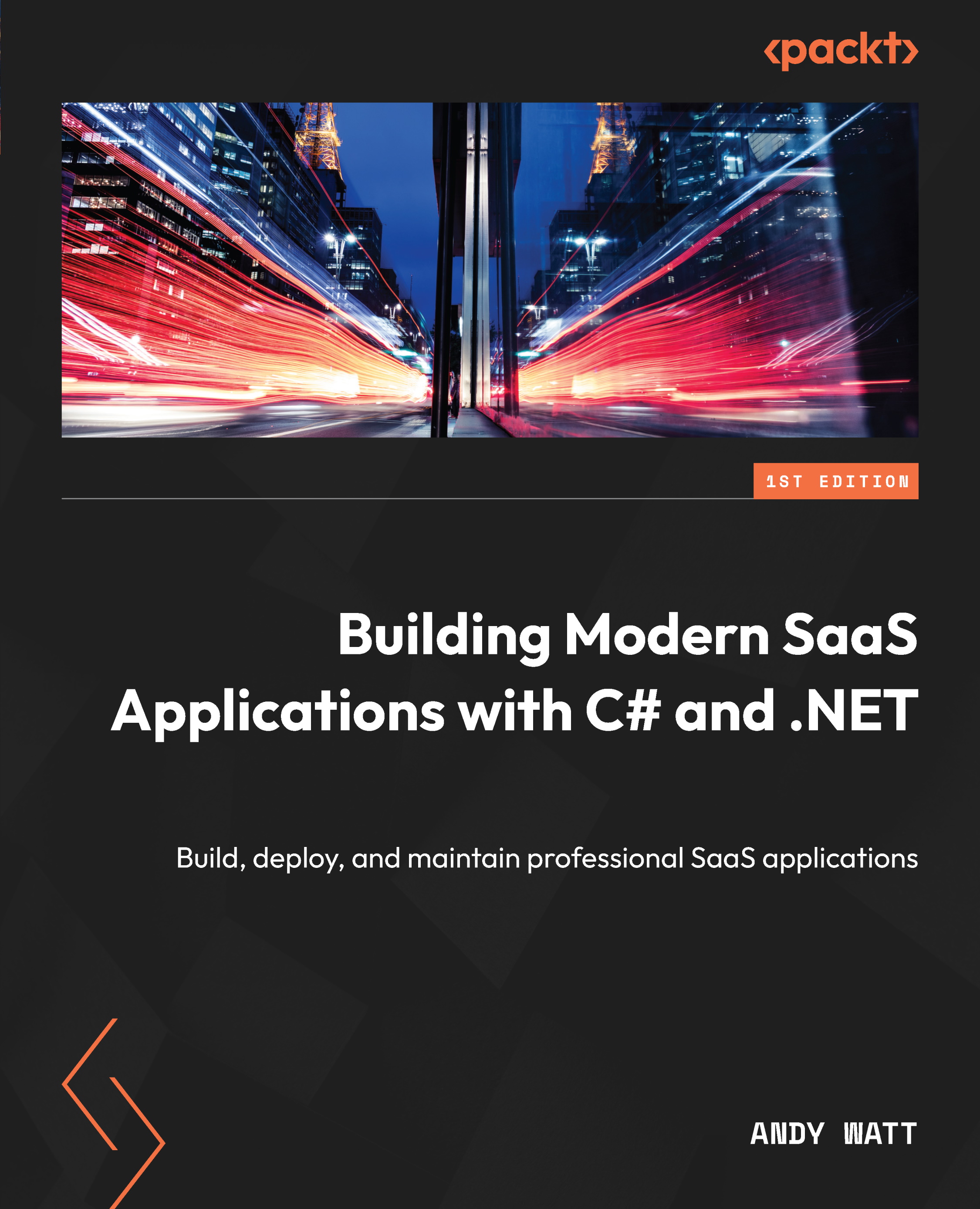
Building Modern SaaS Applications with C# and .NET

Building Modern SaaS Applications with C# and .NET

By : Andy Watt
4.7 (6)
close
close
Building Modern SaaS Applications with C# and .NET

Building Modern SaaS Applications with C# and .NET

4.7 (6)
By: Andy Watt

Overview of this book

There are several concepts that must be mastered to deliver functional and efficient SaaS applications. This book is perfect for developers and teams with experience in traditional application development looking to switch to SaaS and deliver slick and modern applications. You‘ll start with a general overview of SaaS as a concept and learn with the help of an example throughout the book to bring life to the technical descriptions. You’ll use the Microsoft .NET tech stack for development and C# as the programming language to develop your desired SaaS application. Delivering SaaS requires a deep understanding of all layers in the application stack. As you progress, you’ll learn how to approach the database layer, the API, and the UI to confidently approach application development using the SaaS model. Additionally, you’ll explore how to test, deploy, maintain, and upgrade each component of the application. By the end of this book, you will be well equipped to approach all aspects of delivering software using the SaaS paradigm.
Table of Contents (21 chapters)
close
close
1
Part 1: Getting Started
4
Part 2: Building the Backend
9
Part 3: Building the Frontend
12
Part 4: Deploying and Maintaining the Application
17
Part 5: Concluding Thoughts

How does this affect the development process?

In theory, the development process for building a SaaS app is rather similar to any other type of application, but in practice, there are nuances and considerations that you must note as a developer working on a SaaS project.

Release often, release early

There is no “annual release cycle” for a SaaS app. The expectation is that functionality will be broken down into manageable slices, developed, and then pushed out as soon as they are ready. This requires a bit of a mindset shift if coming from a more traditional release cycle. All changes have to be incremental, generally contained to a small part of the applications, and ready for release ASAP.

This mindset of getting the code into the hands of the users will have to be backed up by automated pipelines that build and release the new code without much manual intervention.

While it is possible to roll out the updates to sections of the audience to make sure there is nothing catastrophic in there, it is much more typical for a small-to-medium-sized SaaS application to simply push the updates out to all of the users all at once. For this to be successful…

Testing, testing, testing

If the code is released to the entire user base in one go, and often with no real way of rolling back the change, you had better hope that it works!

The only way to build any sort of trust that the code will operate as advertised is to test it, and in a “release often, release early” mindset, this means automated testing. While this doesn’t necessarily mean adhering to a TDD mentality, this can certainly be useful.

You’d better be full stack

Okay—this is not absolutely required. I’m sure that the larger SaaS applications are worked on by specialists in the database/backend/frontend disciplines. But it will certainly help to have a good knowledge across the different application layers.

The way that SaaS applications “grow” in an almost organic way through the fast cycles and near-instant releases means an understanding at least across the layers, and an understanding of how a decision in the database may affect the frontend is invaluable.

Know thy user

While this may not be required for each developer in the team, it is absolutely essential that the team as a whole understands who is using its product, why they are using it, and where the value is. This knowledge and understanding will come from assessing the analytics and also from “softer” approaches, such as focus groups and interviews with users.

This understanding should flow down into the development process through user stories. From the developers’ point of view, this may manifest in seemingly sudden shifts in direction, if a particular feature has not landed well with a focus group or user interviews have shown that a particular path is the wrong one. The ability to pivot quickly is important across the team.

CONTINUE READING
83
Tech Concepts
36
Programming languages
73
Tech Tools
Icon Unlimited access to the largest independent learning library in tech of over 8,000 expert-authored tech books and videos.
Icon Innovative learning tools, including AI book assistants, code context explainers, and text-to-speech.
Icon 50+ new titles added per month and exclusive early access to books as they are being written.
Building Modern SaaS Applications with C# and .NET
notes
bookmark Notes and Bookmarks search Search in title playlist Add to playlist download Download options font-size Font size

Change the font size

margin-width Margin width

Change margin width

day-mode Day/Sepia/Night Modes

Change background colour

Close icon Search
Country selected

Close icon Your notes and bookmarks

Confirmation

Modal Close icon
claim successful

Buy this book with your credits?

Modal Close icon
Are you sure you want to buy this book with one of your credits?
Close
YES, BUY

Submit Your Feedback

Modal Close icon
Modal Close icon
Modal Close icon