Sign In Start Free Trial
Account

Add to playlist

Create a Playlist

Modal Close icon
You need to login to use this feature.
  • Book Overview & Buying Kotlin for Java Developers
  • Table Of Contents Toc
  • Feedback & Rating feedback
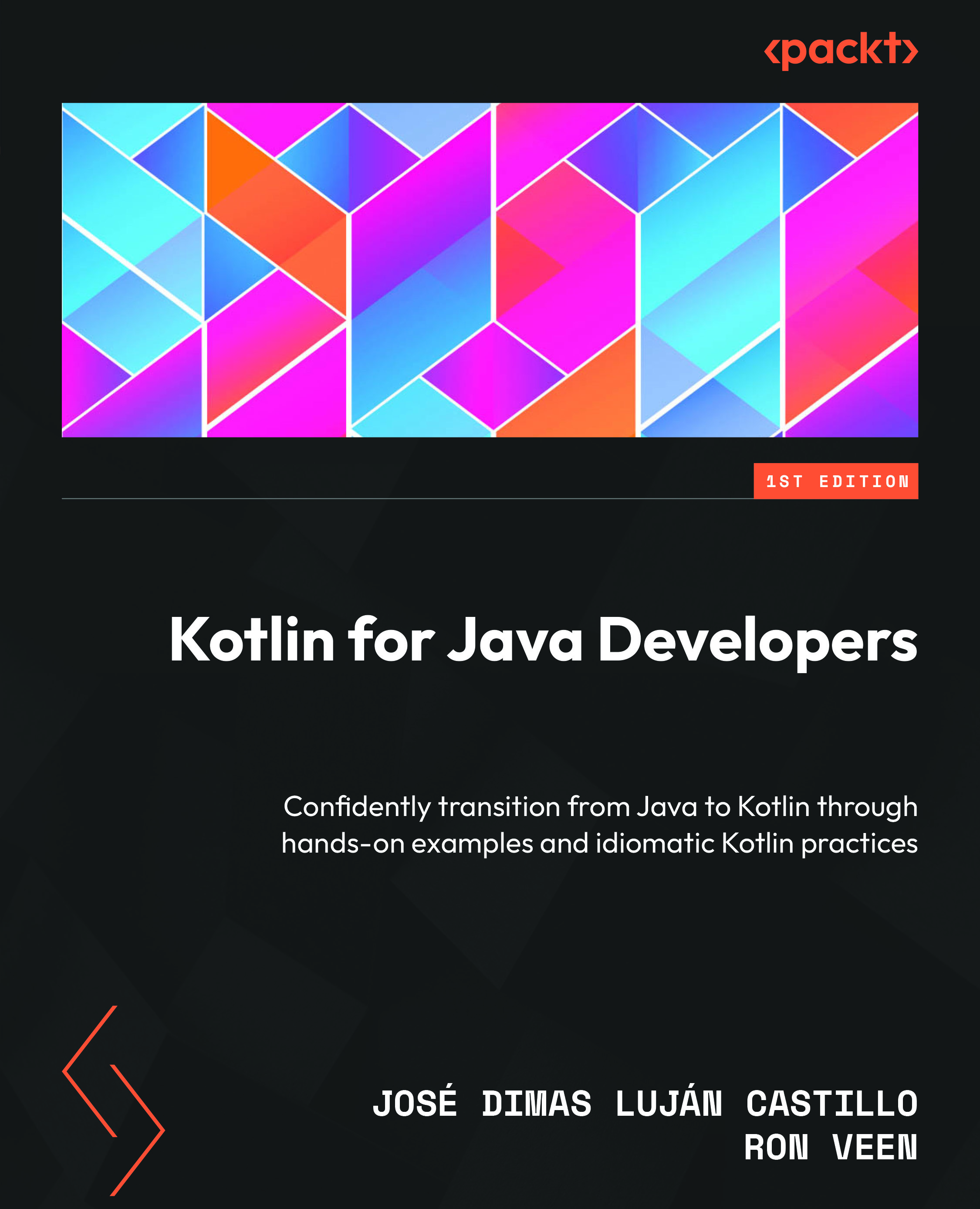
Kotlin for Java Developers

Kotlin for Java Developers

By : José Dimas Luján Castillo, Ron Veen
close
close
Kotlin for Java Developers

Kotlin for Java Developers

By: José Dimas Luján Castillo, Ron Veen

Overview of this book

This book is a hands-on programming guide for Java developers who want to gain practical, production-ready knowledge of Kotlin. Whether you’re maintaining Java systems or adopting Kotlin for Android, backend, or cross-platform projects, it will help you bridge the gap by building on your existing understanding of Java’s syntax and design principles. You’ll begin by learning why Kotlin was created and how it improves on Java – exploring types, expressions, control flow, and null handling while mapping each concept to familiar Java constructs. Each topic is introduced with clear purpose, showing how Kotlin’s concise syntax, safety features, and expressive APIs lead to cleaner, more maintainable code. As you progress, you’ll master object-oriented and functional programming, extension functions, smart casting, and interoperability with Java. The second half of the book dives into generics, data and sealed classes, coroutines for concurrency, and DSL design – demonstrating when and why to use these features to build scalable, elegant solutions. By the end, you’ll not only write idiomatic Kotlin but also understand the reasoning behind its design, enabling you to craft modern, reliable applications with confidence.
Table of Contents (22 chapters)
close
close
Lock Free Chapter
1
Getting Started with Kotlin
6
Object-Oriented Programming
10
Functional Programming
14
Coroutines, Testing and DSLs
20
Other Books You May Enjoy
21
Index

Differences between unit tests and integration tests

When writing automated tests, it’s important to understand the different levels of testing and what each one is intended to verify. Two common types are unit tests and integration tests, and while they may seem similar at first glance, they serve very different purposes and involve different levels of complexity:

  • Complexity: Integration tests are usually more complex to set up compared to unit tests. This is because they require the preparation of multiple components or systems that must work together. Additionally, they require more resources, such as databases, external services, or realistic test environments. For this reason, its execution tends to be slower and more demanding, both in time and computational capacity. On the other hand, unit tests are much simpler, since they test a single component in isolation. This makes them quick to run and easy to configure, making them an ideal tool for detecting small...
Visually different images
CONTINUE READING
83
Tech Concepts
36
Programming languages
73
Tech Tools
Icon Unlimited access to the largest independent learning library in tech of over 8,000 expert-authored tech books and videos.
Icon Innovative learning tools, including AI book assistants, code context explainers, and text-to-speech.
Icon 50+ new titles added per month and exclusive early access to books as they are being written.
Kotlin for Java Developers
notes
bookmark Notes and Bookmarks search Search in title playlist Add to playlist download Download options font-size Font size

Change the font size

margin-width Margin width

Change margin width

day-mode Day/Sepia/Night Modes

Change background colour

Close icon Search
Country selected

Close icon Your notes and bookmarks

Confirmation

Modal Close icon
claim successful

Buy this book with your credits?

Modal Close icon
Are you sure you want to buy this book with one of your credits?
Close
YES, BUY

Submit Your Feedback

Modal Close icon
Modal Close icon
Modal Close icon