


-
Book Overview & Buying
-
Table Of Contents

A Practical Guide to Quantum Computing
By :


A Practical Guide to Quantum Computing
By:
Overview of this book
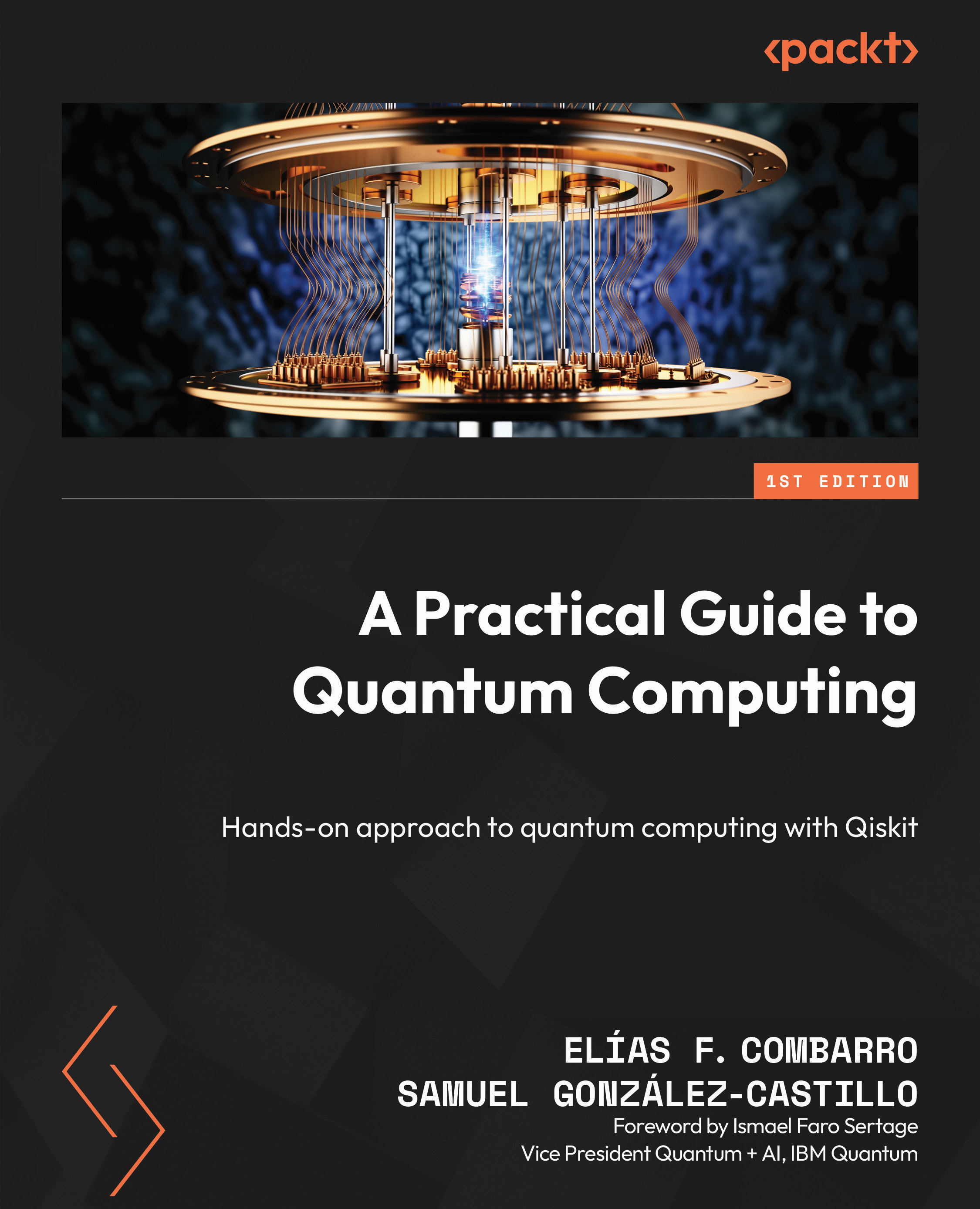
This book is an introduction, from scratch, to quantum computing and the most important and foundational quantum algorithms—ranging from humble protocols such as Deutsch’s algorithm to ones with far-reaching potential, such as Shor’s factoring algorithm—offering clear explanations and a hands-on approach with runnable code on simulators and real hardware. The book is self-contained and does not assume any previous experience in quantum computing. Starting with a single qubit, it scales to algorithms using superposition and entanglement.
At every step, examples of applications are provided, including how to create quantum money that is impossible to forge, quantum cryptography that cannot be broken, and algorithms for searching and factoring that are much faster than those that regular, non-quantum computers can use. Code for each of these algorithms is provided (and explained in detail) using Qiskit 2.1.
After reading this book, you will understand how quantum algorithms work, how to write your own quantum programs, and how to run them on quantum simulators and actual quantum computers. You will also be prepared to take the jump into quantum algorithms for optimization and artificial intelligence, like those presented in our previous book, A Practical Guide to Quantum Machine Learning and Quantum Optimization.
Table of Contents (29 chapters)
Preface


 Free Chapter
Part 1 One Qubit to Rule Them All: Working with One Qubit
Chapter 1 What Is (and What Is Not) a Quantum Computer

Chapter 2 Qubits, Gates, and Measurements
Chapter 3 Applications and Protocols with One Qubit
Chapter 4 Coding One-Qubit Protocols in Qiskit
Part 2 Qubit Meets Qubit: Two Qubits and Entanglement
Chapter 5 How to Work with Two Qubits
Chapter 6 Applications and Protocols with Two Qubits
Chapter 7 Coding Two-Qubit Algorithms in Qiskit
Part 3 Working with Many Qubits
Chapter 8 How to Work with Many Qubits
Chapter 9 The Full Power of Quantum Algorithms
Chapter 10 Coding with Many Qubits in Qiskit
Part 4 The Stars of the Show: Main Quantum Algorithms
Chapter 11 Finding the Period and Factoring Numbers
Chapter 12 Searching and Counting with a Quantum Computer
Chapter 13 Coding Shor and Grover’s Algorithms in Qiskit
Part 5 Ad Astra: The Road to Quantum Utility and Advantage
Chapter 14 Quantum Error Correction and Fault Tolerance
Chapter 15 Experiments for Quantum Advantage
Bibliography
Solutions
Index
Appendix A Mathematical Tools
Appendix B The Bra-Ket Notation and Other Foundational Notions
Appendix C Measuring the Complexity of Algorithms
Appendix D Installing the Tools
Appendix E Production Notes


