Sign In Start Free Trial
Account

Add to playlist

Create a Playlist

Modal Close icon
You need to login to use this feature.
  • Book Overview & Buying Efficient Algorithm Design
  • Table Of Contents Toc
Efficient Algorithm Design

Efficient Algorithm Design

By : Masoud Makrehchi
close
close
Efficient Algorithm Design

Efficient Algorithm Design

By: Masoud Makrehchi

Overview of this book

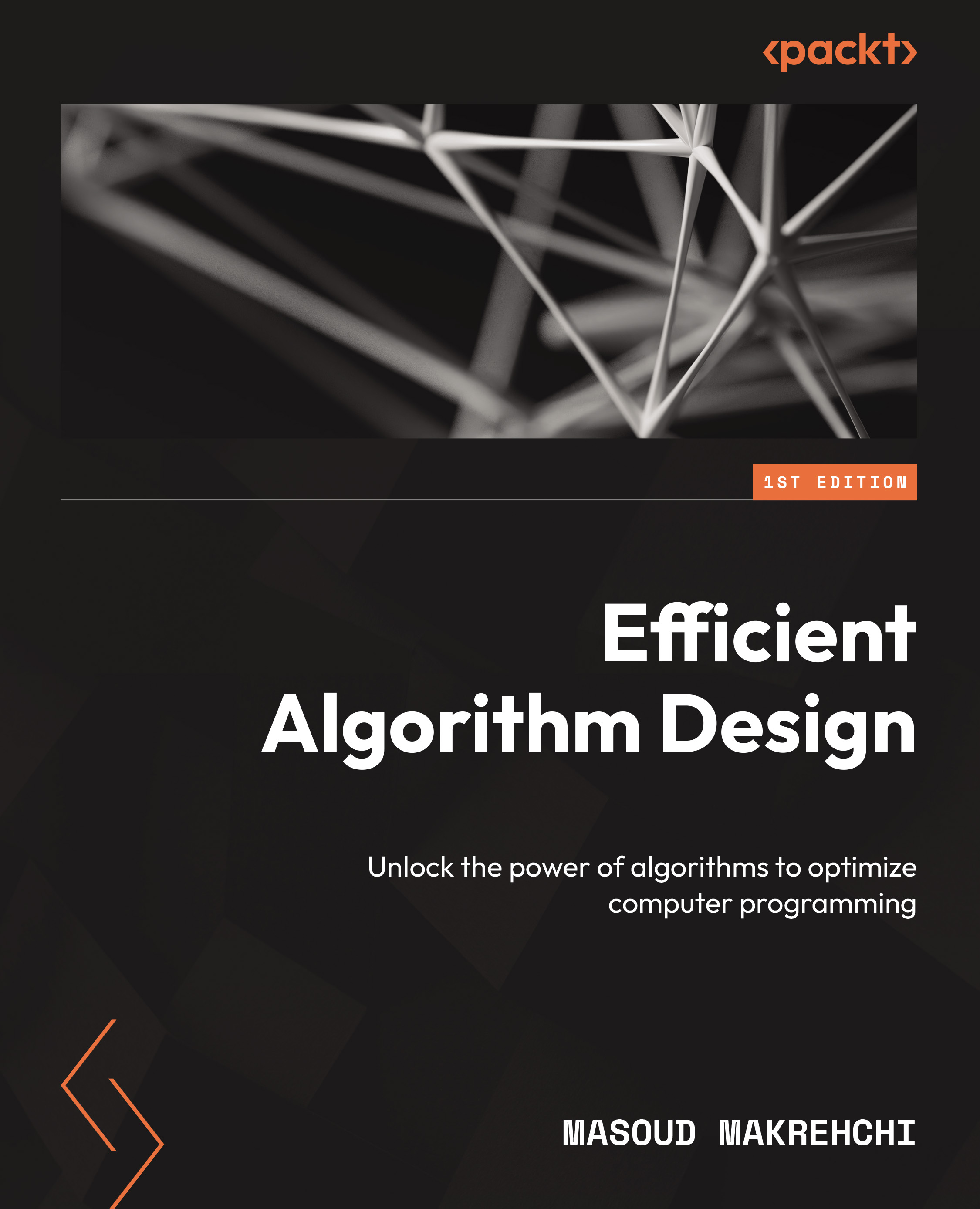
Efficient Algorithm Design redefines algorithms, tracing the evolution of computer science as a discipline bridging natural science and mathematics. Author Masoud Makrehchi, PhD, with his extensive experience in delivering publications and presentations, explores the duality of computers as mortal hardware and immortal algorithms. The book guides you through essential aspects of algorithm design and analysis, including proving correctness and the importance of repetition and loops. This groundwork sets the stage for exploring algorithm complexity, with practical exercises in design and analysis using sorting and search as examples. Each chapter delves into critical topics such as recursion and dynamic programming, reinforced with practical examples and exercises that link theory with real-world applications. What sets this book apart is its focus on the practical application of algorithm design and analysis, equipping you to solve real programming challenges effectively. By the end of this book, you’ll have a deep understanding of algorithmic foundations and gain proficiency in designing efficient algorithms, empowering you to develop more robust and optimized software solutions.
Table of Contents (21 chapters)
close
close
Lock Free Chapter
1
Part 1: Foundations of Algorithm Analysis
7
Part 2: Deep Dive in Algorithms
13
Part 3: Fundamental Data Structures
17
Part 4: Next Steps

Preface

In the second chapter of this book, we explore the concept of the “loop invariant,” which refers to an attribute within a changing process that remains constant. If we look at human progress since the Industrial Revolution, despite the volatility and constant change, we can identify a few unchanging attributes. One is our drive to automate more and more, and the other is our systematic approach to problem-solving, which took a formal direction with the invention of the digital computer. This is what we now call algorithms.

This book is another contribution to the world of algorithms. It’s not meant to replace the existing and remarkable works that I have enjoyed reading and teaching. Instead, it offers an alternative approach to learning algorithms by merging theoretical concepts with practical applications. It also represents the culmination of 30 years of experience in research, industry, and academia, particularly in computer science and artificial intelligence, as well as 12 years of continuous teaching of algorithms to students.

If it were possible, I would add my students as co-authors, because I have learned more from their challenging questions than I could ever teach them. Their inquiries have pushed me to uncover the deeper explanations and logic behind every aspect of algorithms. Yes, I do mean every aspect. Algorithms are about making human-made machines function correctly and deliver the results we expect. Here, nothing short of a logical process and behavior is acceptable.

This book does not claim to cover every aspect or topic in the vast field of algorithms. Instead, it narrows its focus to the design and analysis of algorithms, seeking to address the essential questions we must always consider when evaluating them. First and foremost, can we prove that the algorithm functions correctly and as intended? It’s crucial to establish that the algorithm reliably produces the expected results for all possible inputs.

Next, we must ask how we can ensure the algorithm consistently behaves as we anticipate. This involves scrutinizing its logic, understanding its steps, and confirming that each part contributes to the overall goal. Finally, we need to consider whether the algorithm terminates within an acceptable timeframe. No matter how elegantly an algorithm is designed, if it doesn’t complete its task efficiently, it becomes impractical for real-world use. By concentrating on these fundamental questions, this book aims to guide you through the process of designing robust, reliable, and efficient algorithms.

CONTINUE READING
83
Tech Concepts
36
Programming languages
73
Tech Tools
Icon Unlimited access to the largest independent learning library in tech of over 8,000 expert-authored tech books and videos.
Icon Innovative learning tools, including AI book assistants, code context explainers, and text-to-speech.
Icon 50+ new titles added per month and exclusive early access to books as they are being written.
Efficient Algorithm Design
notes
bookmark Notes and Bookmarks search Search in title playlist Add to playlist download Download options font-size Font size

Change the font size

margin-width Margin width

Change margin width

day-mode Day/Sepia/Night Modes

Change background colour

Close icon Search
Country selected

Close icon Your notes and bookmarks

Confirmation

Modal Close icon
claim successful

Buy this book with your credits?

Modal Close icon
Are you sure you want to buy this book with one of your credits?
Close
YES, BUY

Submit Your Feedback

Modal Close icon
Modal Close icon
Modal Close icon