Sign In Start Free Trial
Account

Add to playlist

Create a Playlist

Modal Close icon
You need to login to use this feature.
  • Book Overview & Buying The C++ Programmer's Mindset
  • Table Of Contents Toc
  • Feedback & Rating feedback
The C++ Programmer's Mindset

The C++ Programmer's Mindset

By : Sam Morley
close
close
The C++ Programmer's Mindset

The C++ Programmer's Mindset

By: Sam Morley

Overview of this book

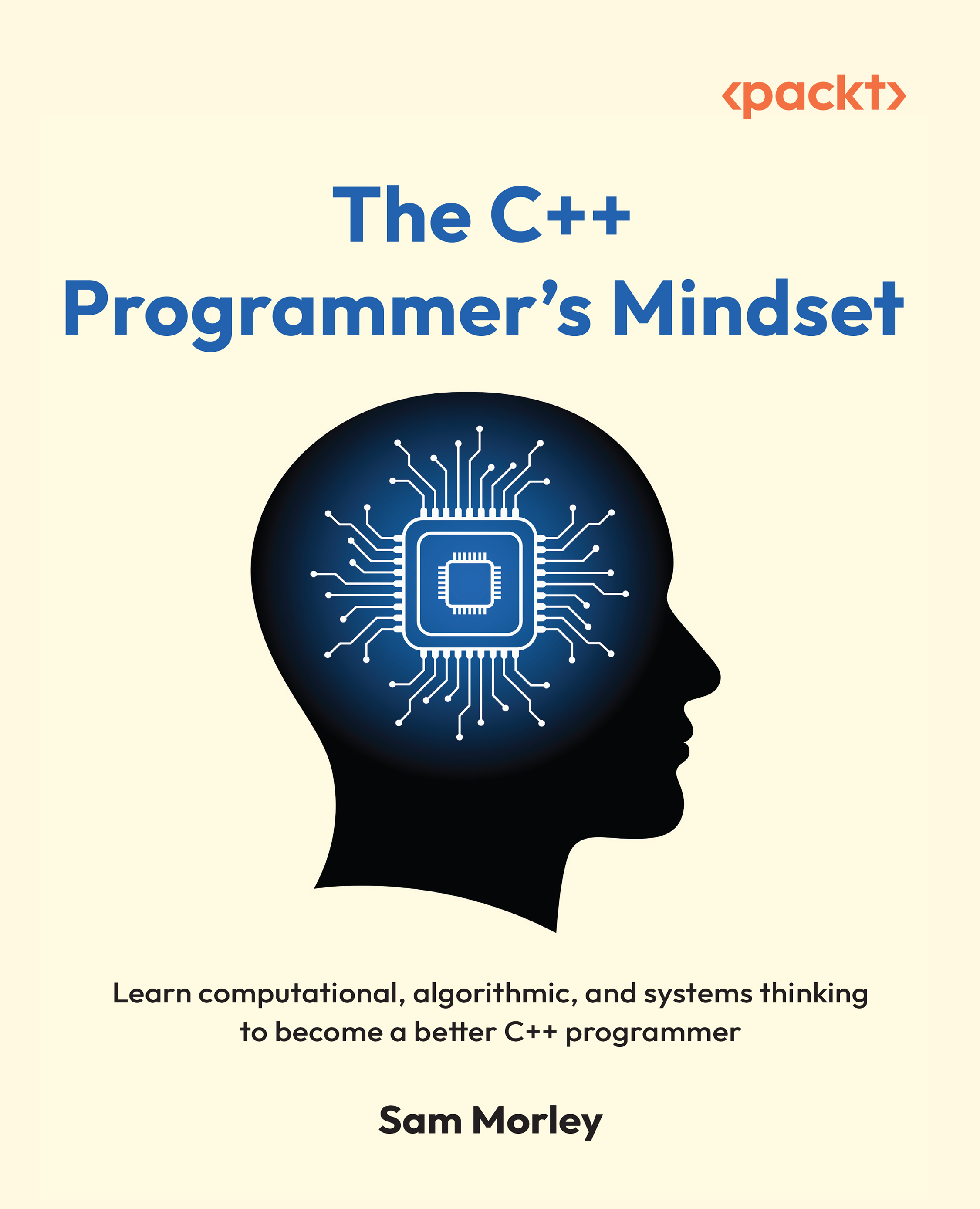
Solve complex problems in C++ by learning how to think like a computer scientist. This book introduces computational thinking—a framework for solving problems using decomposition, abstraction, and pattern recognition—and shows you how to apply it using modern C++ features. You'll learn how to break down challenges, choose the right abstractions, and build solutions that are both maintainable and efficient. Through small examples and a large case study, this book guides you from foundational concepts to high-performance applications. You’ll explore reusable templates, algorithms, modularity, and even parallel computing and GPU acceleration. With each chapter, you’ll not only expand your C++ skillset, but also refine the way you approach and solve real-world problems. Written by a seasoned research engineer and C++ developer, this book combines practical insight with academic rigor. Whether you're designing algorithms or profiling production code, this book helps you deliver elegant, effective solutions with confidence.
Table of Contents (19 chapters)
close
close
18
Index

Using SYCL to write code for many devices

SYCL is a C++ abstraction layer for heterogeneous computing. It makes writing code for a range of devices, including GPUs and other accelerators such as FPGAs, fairly simple by abstracting the core concepts. There are two parts to a SYCL application: the first being the source code, which is written in standard C++, with the help of the SYCL library. During compilation, the code that might be executed on devices is written into the binary in a form that allows it to be runtime-compiled for the requested device. (For instance, it might be compiled into an intermediate representation such as SPIR-V and placed in the binary for the device driver to compile further for the specific device.) The second component of a SYCL application is the runtime and device drivers. For instance, OpenCL can be used as a backend for SYCL applications. Intel provides its own backend called Level Zero.

SYCL applications need to be compiled using a SYCL-compatible...

Visually different images
CONTINUE READING
83
Tech Concepts
36
Programming languages
73
Tech Tools
Icon Unlimited access to the largest independent learning library in tech of over 8,000 expert-authored tech books and videos.
Icon Innovative learning tools, including AI book assistants, code context explainers, and text-to-speech.
Icon 50+ new titles added per month and exclusive early access to books as they are being written.
The C++ Programmer's Mindset
notes
bookmark Notes and Bookmarks search Search in title playlist Add to playlist download Download options font-size Font size

Change the font size

margin-width Margin width

Change margin width

day-mode Day/Sepia/Night Modes

Change background colour

Close icon Search
Country selected

Close icon Your notes and bookmarks

Confirmation

Modal Close icon
claim successful

Buy this book with your credits?

Modal Close icon
Are you sure you want to buy this book with one of your credits?
Close
YES, BUY

Submit Your Feedback

Modal Close icon
Modal Close icon
Modal Close icon