Sign In Start Free Trial
Account

Add to playlist

Create a Playlist

Modal Close icon
You need to login to use this feature.
  • Book Overview & Buying Microservices Design Patterns in .NET
  • Table Of Contents Toc
Microservices Design Patterns in .NET

Microservices Design Patterns in .NET - Second Edition

By : Trevoir Williams
close
close
Microservices Design Patterns in .NET

Microservices Design Patterns in .NET

By: Trevoir Williams

Overview of this book

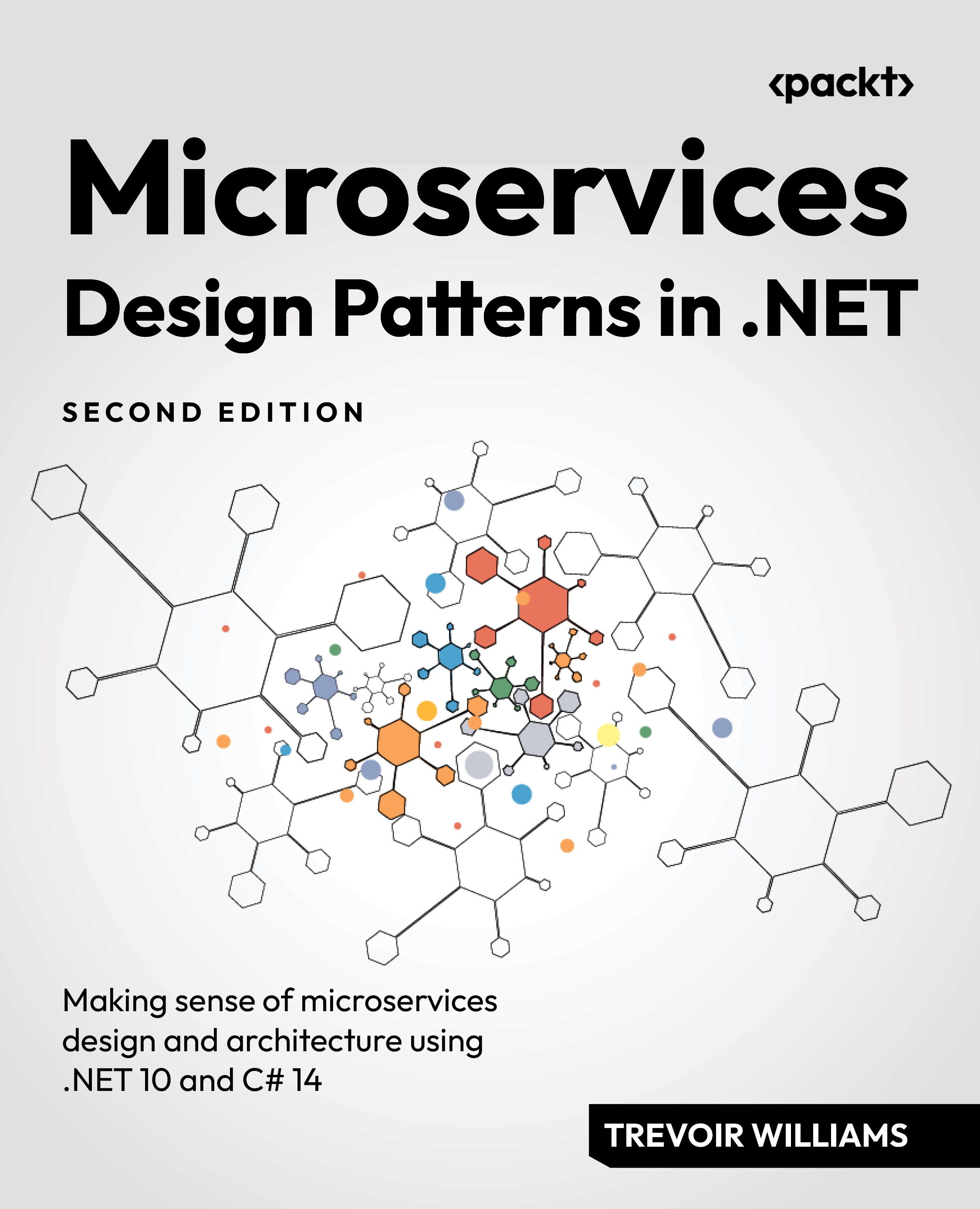
Are you a developer seeking practical, up-to-date insights into designing scalable and resilient microservices? Microservices Design Patterns in .NET, Second Edition provides a comprehensive exploration of modern microservices using C# 14 and .NET 10. This edition expands on core patterns such as CQRS, event sourcing, and Saga, while introducing advanced concepts such as observability with OpenTelemetry, zero-trust security, and container-based workflows. You’ll explore both synchronous and asynchronous communication, apply domain-driven design to define service boundaries, and manage data consistency using proven persistence strategies. The book also guides you through container hosting, serverless functions, and production-ready deployment pipelines. By the end of this book, you’ll know how to design and deploy secure, maintainable, and resilient microservices that fit perfectly in modern cloud ecosystems.
Table of Contents (24 chapters)
close
close
Lock Free Chapter
1
Understanding Microservices and Design Patterns
9
Database and Storage Design Patterns
12
Resiliency, Security, and Infrastructure Patterns
17
Cloud Development Strategies
22
Index
23
Other Books You May Enjoy

Preface

Welcome back! This second edition of Microservices Design Patterns in .NET builds upon the original text and reflects the evolution of the .NET and cloud-native ecosystems. You’ll still learn about the core architectural patterns that make microservices effective, but now with deeper, production-ready techniques, refreshed code, and end-to-end scenarios. The main idea is the same: decompose complex domains into smaller, cohesive services that collaborate to deliver a unified user experience, while being transparent about the new complexities this introduces and the patterns that tame them.

Why .NET remains our foundation hasn’t changed, but the platform itself has: modern .NET emphasizes performance, cross-platform reliability, and a rich toolchain that accelerates shipping high-quality distributed systems. In this edition, we expand into updated gateway patterns (including BFF), micro-frontends for domain-aligned UX, hardened security, container-hosting techniques for day-to-day development, serverless microservices on Azure, and unified observability with contemporary tooling. These topics complement the original arc (aggregation, CQRS, event sourcing, sagas, resilience, and health) and reflect how real teams build, secure, and operate microservices today.

We continue to focus on .NET for the following reasons:

  • Well-maintained ecosystem: Microsoft and the community iterate quickly with clear guidance, strong docs, and first-class tooling
  • Performance: Each release improves runtime and library performance, which is critical when service hops, serialization, and network latency dominate
  • Cross-platform: We can build and run on Windows, macOS, or Linux, and deploy to containers, orchestrators, and serverless platforms alike
  • Breadth: From web and messaging to identity, telemetry, and DevOps, .NET spans the full surface area you’ll touch in a microservices program

Our approach remains pragmatic: We explain why each pattern is used, implement it in .NET, and show how the pieces fit together in a cohesive healthcare domain so you can apply them with confidence in your own systems. We’ll cover container hosting and development patterns beyond docker run. You’ll transition from single-service containers to cohesive local stacks, registries, and orchestrators, utilizing Docker Compose and Kubernetes patterns that can be used in both production environments and day-to-day iteration and development.

We’ll also cover modern observability with OpenTelemetry, sidecars, and .NET Aspire. We go far beyond “enabling logging.” We’ll show how to standardize traces, metrics, and logs with OpenTelemetry; compare Jaeger and Prometheus; introduce sidecars and meshes where beneficial (and skip them where not); and wire it all together with .NET Aspire so that developers can see the entire system while coding.

We will revisit security for distributed boundaries. Building on token-based security, we connect identity, scopes/claims, service-to-service trust, and zero-trust network posture, striking a balance between usability and defense-in-depth across services and gateways.

These additions don’t replace the core patterns from the first edition; they refine them. You still need to choose between synchronous and asynchronous communication deliberately, partition data with intention, and design for failure from the outset. The difference is that you’ll now do so with stronger primitives and better tooling.

CONTINUE READING
83
Tech Concepts
36
Programming languages
73
Tech Tools
Icon Unlimited access to the largest independent learning library in tech of over 8,000 expert-authored tech books and videos.
Icon Innovative learning tools, including AI book assistants, code context explainers, and text-to-speech.
Icon 50+ new titles added per month and exclusive early access to books as they are being written.
Microservices Design Patterns in .NET
notes
bookmark Notes and Bookmarks search Search in title playlist Add to playlist download Download options font-size Font size

Change the font size

margin-width Margin width

Change margin width

day-mode Day/Sepia/Night Modes

Change background colour

Close icon Search
Country selected

Close icon Your notes and bookmarks

Confirmation

Modal Close icon
claim successful

Buy this book with your credits?

Modal Close icon
Are you sure you want to buy this book with one of your credits?
Close
YES, BUY

Submit Your Feedback

Modal Close icon
Modal Close icon
Modal Close icon