


- Why is it considered an antipattern to use interface{} values as arguments to functions and methods?
- You are trying to design and build a complex data-processing pipeline that requires copious amounts of computing power (for example, face recognition, audio transcription, or similar). However, when you try to run it on your local machine, you realize that the resource requirements for some of the stages exceed the ones that are currently available locally. Describe how you could modify your current pipeline setup so that you could still run the pipeline on your machine, but arrange for some parts of the pipeline to execute on a remote server that you control.
- Describe how you would apply the decorator pattern to log errors returned by the processor functions that you have attached to a pipeline.
- What are the key differences between a synchronous and an asynchronous...
-
Book Overview & Buying
-
Table Of Contents

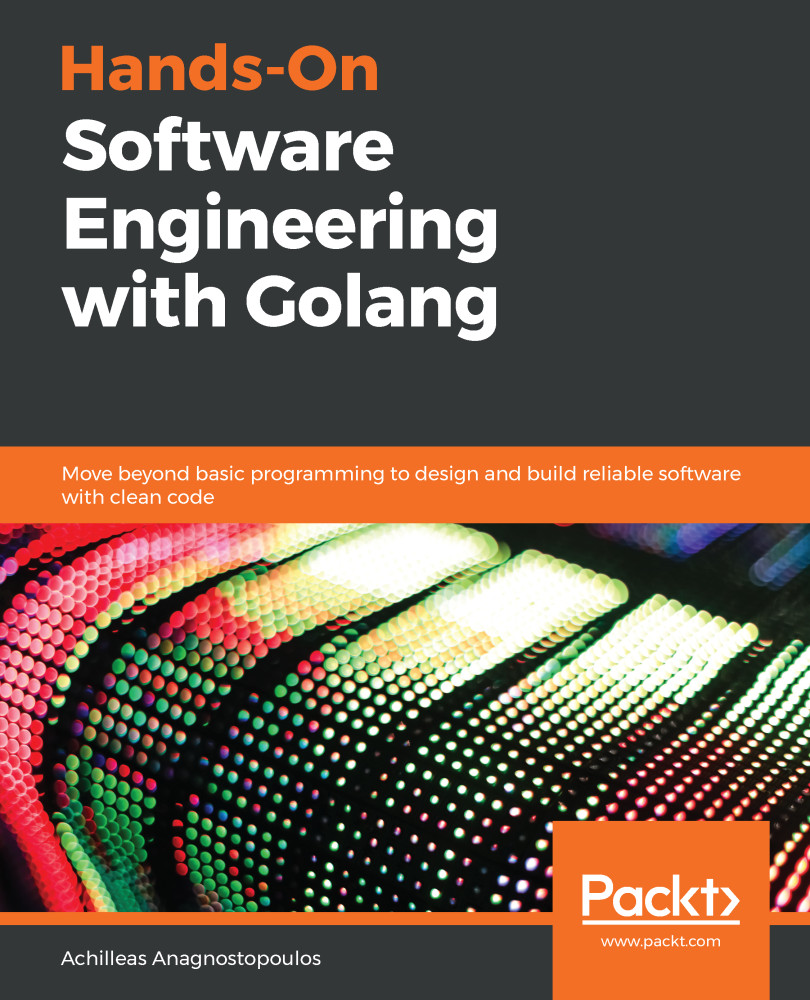
Hands-On Software Engineering with Golang
By :


Hands-On Software Engineering with Golang
By:
Overview of this book
Over the last few years, Go has become one of the favorite languages for building scalable and distributed systems. Its opinionated design and built-in concurrency features make it easy for engineers to author code that efficiently utilizes all available CPU cores.
This Golang book distills industry best practices for writing lean Go code that is easy to test and maintain, and helps you to explore its practical implementation by creating a multi-tier application called Links ‘R’ Us from scratch. You’ll be guided through all the steps involved in designing, implementing, testing, deploying, and scaling an application. Starting with a monolithic architecture, you’ll iteratively transform the project into a service-oriented architecture (SOA) that supports the efficient out-of-core processing of large link graphs. You’ll learn about various cutting-edge and advanced software engineering techniques such as building extensible data processing pipelines, designing APIs using gRPC, and running distributed graph processing algorithms at scale. Finally, you’ll learn how to compile and package your Go services using Docker and automate their deployment to a Kubernetes cluster.
By the end of this book, you’ll know how to think like a professional software developer or engineer and write lean and efficient Go code.
Table of Contents (21 chapters)
Preface

Section 1: Software Engineering and the Software Development Life Cycle
 Free Chapter
A Bird's-Eye View of Software Engineering
Section 2: Best Practices for Maintainable and Testable Go Code
Best Practices for Writing Clean and Maintainable Go Code
Dependency Management
The Art of Testing
Section 3: Designing and Building a Multi-Tier System from Scratch
The Links 'R'; Us Project
Building a Persistence Layer
Data-Processing Pipelines

Graph-Based Data Processing
Communicating with the Outside World
Building, Packaging, and Deploying Software
Section 4: Scaling Out to Handle a Growing Number of Users
Splitting Monoliths into Microservices
Building Distributed Graph-Processing Systems
Metrics Collection and Visualization
Epilogue
Assessments
Other Books You May Enjoy


