Sign In Start Free Trial
Account

Add to playlist

Create a Playlist

Modal Close icon
You need to login to use this feature.
  • Book Overview & Buying Multithreading in C# 5.0 Cookbook
  • Table Of Contents Toc
Multithreading in C# 5.0 Cookbook

Multithreading in C# 5.0 Cookbook

By : Agafonov
4.6 (5)
close
close
Multithreading in C# 5.0 Cookbook

Multithreading in C# 5.0 Cookbook

4.6 (5)
By: Agafonov

Overview of this book

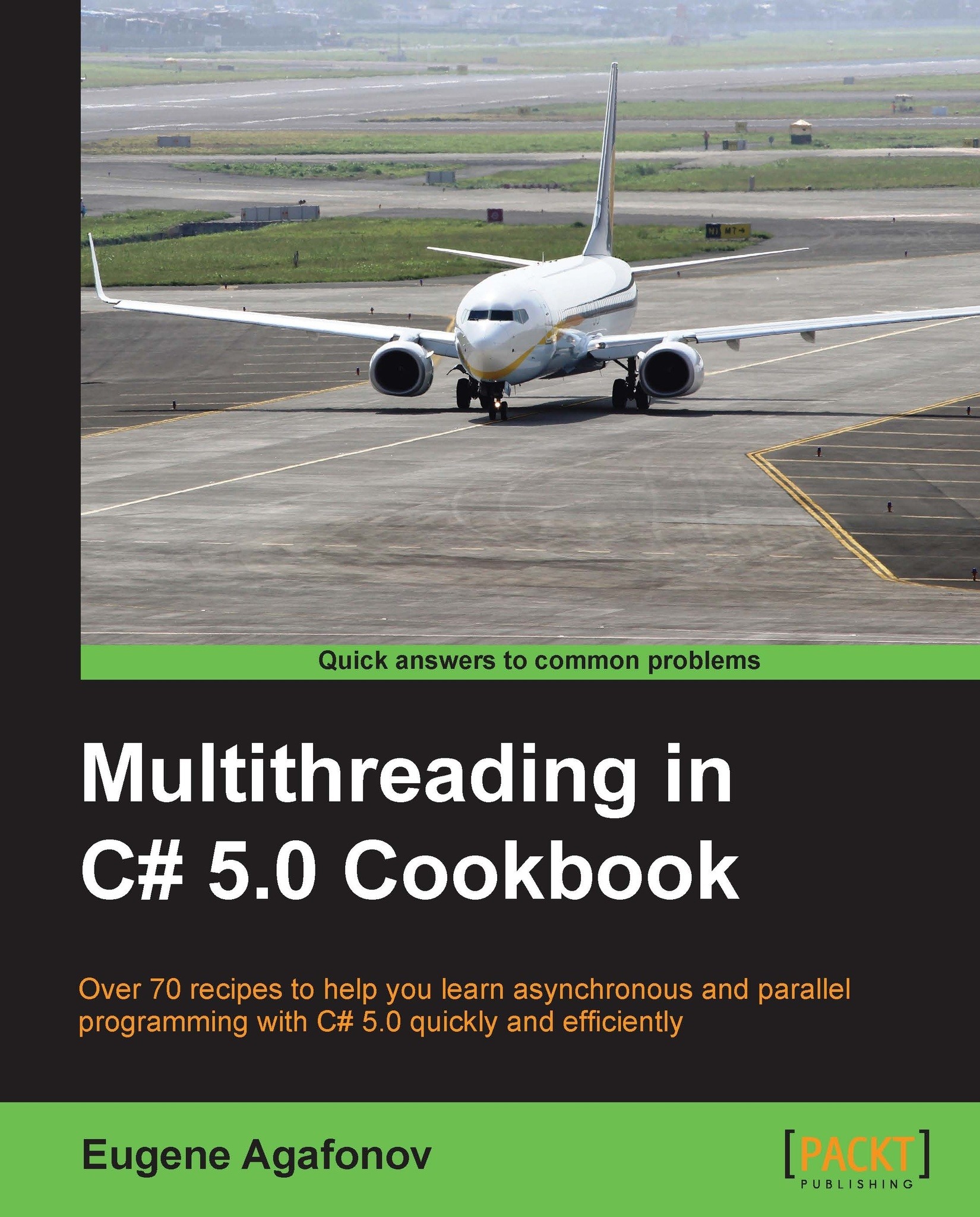
In an age when computer processors are being developed to contain more and more cores, multithreading is a key factor for creating scalable, effective, and responsive applications. If you fail to do it correctly, it can lead to puzzling problems that take a huge amount of time to resolve. Therefore, having a solid understanding of multithreading is a must for the modern application developer. Multithreading in C# 5.0 Cookbook is an easy-to-understand guide to the most puzzling programming problems. This book will guide you through practical examples dedicated to various aspects of multithreading in C# on Windows and will give you a good basis of practical knowledge which you can then use to program your own scalable and reliable multithreaded applications. This book guides you through asynchronous and parallel programming from basic examples to practical, real-world solutions to complex problems. You will start from the very beginning, learning what a thread is, and then proceed to learn new concepts based on the information you get from the previous examples. After describing the basics of threading, you will be able to grasp more advanced concepts like Task Parallel Library and C# asynchronous functions. Then, we move towards parallel programming, starting with basic data structures and gradually progressing to the more advanced patterns. The book concludes with a discussion of the specifics of Windows 8 application programming, giving you a complete understanding of how Windows 8 applications are different and how to program asynchronous applications for Windows 8.
Table of Contents (13 chapters)
close
close
12
Index

Determining a thread state

This recipe will describe possible states a thread could have. It is useful to get information about whether a thread is started yet or whether it is in a blocked state. Please note that because a thread runs independently, its state could be changed at any time.

Getting ready

To work through this recipe, you will need Visual Studio 2012. There are no other prerequisites. The source code for this recipe can be found at BookSamples\Chapter1\Recipe5.

How to do it...

To understand how to determine a thread state and acquire useful information about it, perform the following steps:

  1. Start Visual Studio 2012. Create a new C# Console Application project.
  2. In the Program.cs file, add the following using directives:
    using System;
    using System.Threading;
  3. Add the following code snippet below the Main method:
    static void DoNothing()
    {
      Thread.Sleep(TimeSpan.FromSeconds(2));
    }
    
    static void PrintNumbersWithStatus()
    {
      Console.WriteLine("Starting...");
      Console.WriteLine(Thread.CurrentThread
      .ThreadState.ToString());
      for (int i = 1; i < 10; i++)
      {
        Thread.Sleep(TimeSpan.FromSeconds(2));
        Console.WriteLine(i);
      }
    }
  4. Add the following code snippet inside the Main method:
    Console.WriteLine("Starting program...");
    Thread t = new Thread(PrintNumbersWithStatus);
    Thread t2 = new Thread(DoNothing);
    Console.WriteLine(t.ThreadState.ToString());
    t2.Start();
    t.Start();
    for (int i = 1; i < 30; i++)
    {
      Console.WriteLine(t.ThreadState.ToString());
    }
    Thread.Sleep(TimeSpan.FromSeconds(6));
    t.Abort();
    Console.WriteLine("A thread has been aborted");
    Console.WriteLine(t.ThreadState.ToString());
    Console.WriteLine(t2.ThreadState.ToString());
  5. Run the program.

How it works...

When the main program starts it defines two different threads; one of them will be aborted and the other runs successfully. The thread state is located in the ThreadState property of a Thread object, which is a C# enumeration. At first the thread has a ThreadState.Unstarted state. Then we run it and assume that, for the duration of 30 iterations of a cycle, the thread will change its state from ThreadState.Running to ThreadState.WaitSleepJoin.

Tip

Please note that the current Thread object is always accessible through the Thread.CurrentThread static property.

If it does not happen, just increase the number of iterations. Then we abort the first thread and see that now it has a ThreadState.Aborted state. It is also possible that the program will print out the ThreadState.AbortRequested state. This illustrates very well the complexity of synchronizing two threads. Please keep in mind that you should not use thread abortion in your programs. I've covered it here only to show the corresponding thread state.

Finally, we can see that our second thread t2 completed successfully and now has a ThreadState.Stopped state. There are several other states, but they are partly deprecated and partly not as useful as those we examined.

CONTINUE READING
83
Tech Concepts
36
Programming languages
73
Tech Tools
Icon Unlimited access to the largest independent learning library in tech of over 8,000 expert-authored tech books and videos.
Icon Innovative learning tools, including AI book assistants, code context explainers, and text-to-speech.
Icon 50+ new titles added per month and exclusive early access to books as they are being written.
Multithreading in C# 5.0 Cookbook
notes
bookmark Notes and Bookmarks search Search in title playlist Add to playlist font-size Font size

Change the font size

margin-width Margin width

Change margin width

day-mode Day/Sepia/Night Modes

Change background colour

Close icon Search
Country selected

Close icon Your notes and bookmarks

Confirmation

Modal Close icon
claim successful

Buy this book with your credits?

Modal Close icon
Are you sure you want to buy this book with one of your credits?
Close
YES, BUY

Submit Your Feedback

Modal Close icon
Modal Close icon
Modal Close icon