Sign In Start Free Trial
Account

Add to playlist

Create a Playlist

Modal Close icon
You need to login to use this feature.
  • Book Overview & Buying How to Measure Anything in Cybersecurity Risk
  • Table Of Contents Toc
How to Measure Anything in Cybersecurity Risk

How to Measure Anything in Cybersecurity Risk

By : Douglas W. Hubbard, Richard Seiersen
close
close
How to Measure Anything in Cybersecurity Risk

How to Measure Anything in Cybersecurity Risk

By: Douglas W. Hubbard, Richard Seiersen

Overview of this book

How to Measure Anything in Cybersecurity Risk exposes the shortcomings of current “risk management” practices, and offers a series of improvement techniques that help you fill the holes and ramp up security. In his bestselling book How to Measure Anything, author Douglas W. Hubbard opened the business world’s eyes to the critical need for better measurement. This book expands upon that premise and draws from The Failure of Risk Management to sound the alarm in the cybersecurity realm. Some of the field’s premier risk management approaches actually create more risk than they mitigate, and questionable methods have been duplicated across industries and embedded in the products accepted as gospel. This book sheds light on these blatant risks and provides alternate techniques that can help improve your current situation. You’ll also learn which approaches are too risky to save and are actually more damaging than a total lack of any security. Dangerous risk management methods abound; there is no industry more critically in need of solutions than cybersecurity. This book provides solutions where they exist and advises when to change tracks entirely.
Table of Contents (12 chapters)
close
close
Lock Free Chapter
1
Foreword
2
Foreword
3
Acknowledgments
4
About the Authors
9
Index
10
EULA

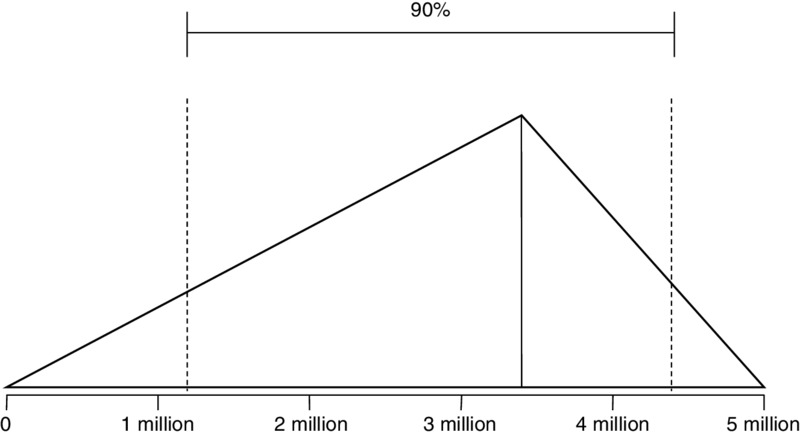
Distribution Name: Triangular

Graph: horizontal axis of 0-5 million has line ascending up to point between 3-4 million, descending to 5 million forming triangular shape. 90% of area marked for graph.

Figure A.1 Triangular Distribution

Parameters:

  • UB (Upper bound)
  • LB (Lower bound)
  • Mode—this may be any value between UB and LB.

Note that UB and LB are absolute outer limits—a 100% CI.

For a triangular distribution, the UB and LB represent absolute limits. There is no chance that a value could be generated outside of these bounds. In addition to the UB and LB, this distribution also has a mode that can vary to any value between the UB and LB. This is sometimes useful as a substitute for a lognormal, when you want to set absolute limits on what the values can be but you want to skew the output in a way similar to a lognormal. It is useful in any situation where you know of absolute limits but the most likely value might not be in the middle, like the normal distribution.

  • When to Use: When you want control over where the most likely value is compared to the range, and when the range has absolute limits.
  • Examples: Number of records lost...
CONTINUE READING
83
Tech Concepts
36
Programming languages
73
Tech Tools
Icon Unlimited access to the largest independent learning library in tech of over 8,000 expert-authored tech books and videos.
Icon Innovative learning tools, including AI book assistants, code context explainers, and text-to-speech.
Icon 50+ new titles added per month and exclusive early access to books as they are being written.
How to Measure Anything in Cybersecurity Risk
notes
bookmark Notes and Bookmarks search Search in title playlist Add to playlist font-size Font size

Change the font size

margin-width Margin width

Change margin width

day-mode Day/Sepia/Night Modes

Change background colour

Close icon Search
Country selected

Close icon Your notes and bookmarks

Confirmation

Modal Close icon
claim successful

Buy this book with your credits?

Modal Close icon
Are you sure you want to buy this book with one of your credits?
Close
YES, BUY

Submit Your Feedback

Modal Close icon
Modal Close icon
Modal Close icon