Sign In Start Free Trial
Account

Add to playlist

Create a Playlist

Modal Close icon
You need to login to use this feature.
  • Book Overview & Buying Learning Mongoid
  • Table Of Contents Toc
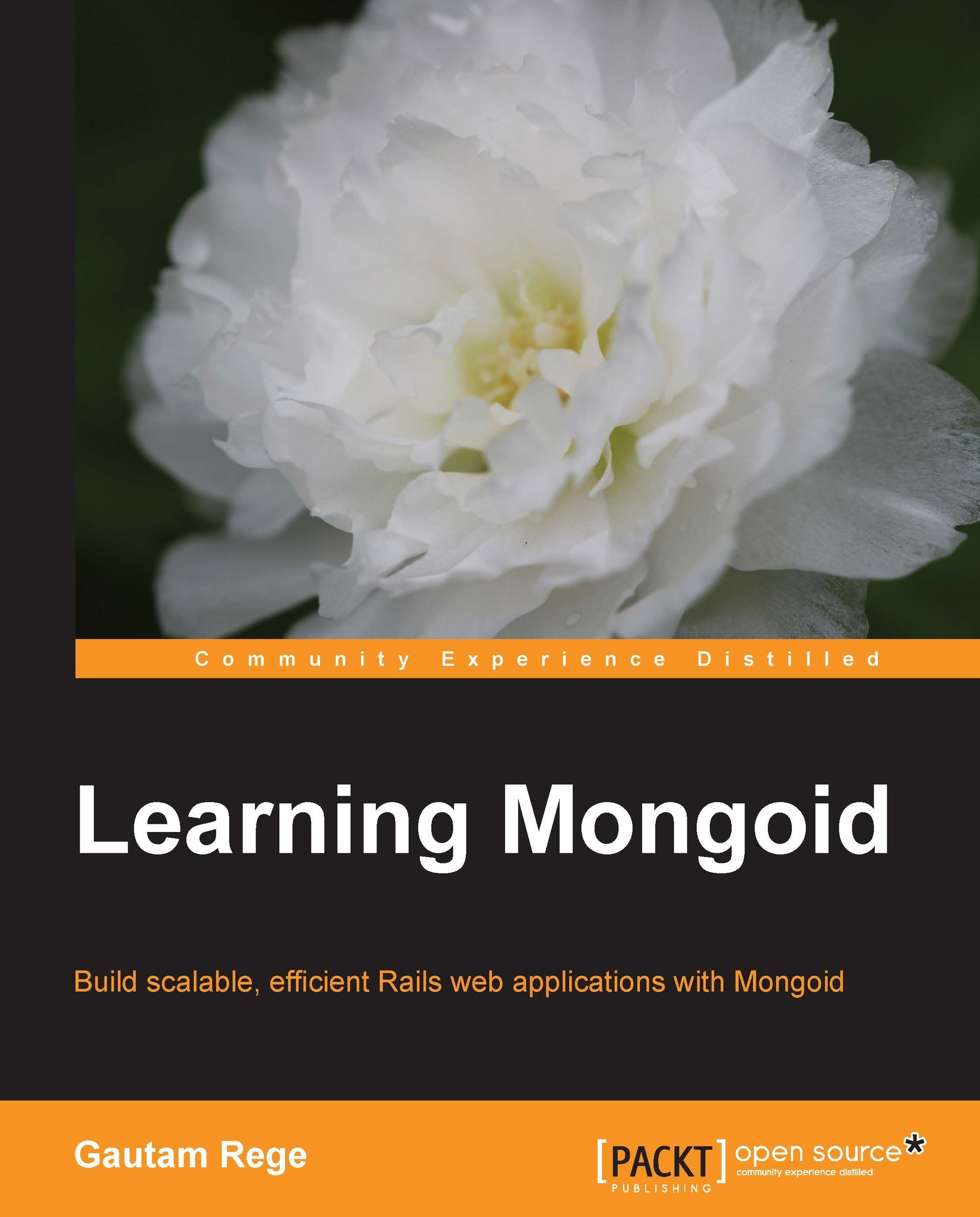
Learning Mongoid

Learning Mongoid

By : Gautam Rege
4.5 (2)
close
close
Learning Mongoid

Learning Mongoid

4.5 (2)
By: Gautam Rege

Overview of this book

Mongoid helps you to leverage the power of schema-less and efficient document-based design, dynamic queries, and atomic modifier operations. Mongoid eases the work of Ruby developers while they are working on complex frameworks. Starting with why and how you should use Mongoid, this book covers the various components of Mongoid. It then delves deeper into the detail of queries and relations, and you will learn some tips and tricks on improving performance. With this book, you will be able to build robust and large-scale web applications with Mongoid and Rails. Starting with the basics, this book introduces you to components such as moped and origin, and how information is managed, learn about the various datatypes, embedded documents, arrays, and hashes. You will learn how a document is stored and manipulated with callbacks, validations, and even atomic updates. This book will then show you the querying mechanism in detail, right from simple to complex queries, and even explains eager loading, lazy evaluation, and chaining of queries. Finally, this book will explain the importance of performance tuning and how to use the right indexes. It also explains MapReduce and the Aggregation Framework.
Table of Contents (14 chapters)
close
close
Learning Mongoid
Credits
About the Author
About the Reviewers
www.PacktPub.com
Preface
1
Index

MapReduce and the aggregation framework


MapReduce is a concept: we map data into multiple independent tasks, process the temporary results, and reduce the results in parallel. Basically, we spawn many parallel tasks to mappers. These mappers (which can be threads, processes, or servers, among others) process a specific dataset and spew out results to the reducers. As the reducers keep getting information, they update the final results with this data. This is basically the divide and conquer process.

Nothing explains this better than an example! Suppose we want to show the statistical count of authors by the first letter of their name; it is a good case for using MapReduce. We want to see information as follows:

   Authors starting with "a": 1020
   Authors starting with "b": 477
   Authors starting with "c": 719
   Authors starting with "d": 586
   Authors starting with "e": 678

First, let's create many authors in our database. For this, we shall use the faker gem so that we can generate nice...

CONTINUE READING
83
Tech Concepts
36
Programming languages
73
Tech Tools
Icon Unlimited access to the largest independent learning library in tech of over 8,000 expert-authored tech books and videos.
Icon Innovative learning tools, including AI book assistants, code context explainers, and text-to-speech.
Icon 50+ new titles added per month and exclusive early access to books as they are being written.
Learning Mongoid
notes
bookmark Notes and Bookmarks search Search in title playlist Add to playlist font-size Font size

Change the font size

margin-width Margin width

Change margin width

day-mode Day/Sepia/Night Modes

Change background colour

Close icon Search
Country selected

Close icon Your notes and bookmarks

Confirmation

Modal Close icon
claim successful

Buy this book with your credits?

Modal Close icon
Are you sure you want to buy this book with one of your credits?
Close
YES, BUY

Submit Your Feedback

Modal Close icon
Modal Close icon
Modal Close icon