Sign In Start Free Trial
Account

Add to playlist

Create a Playlist

Modal Close icon
You need to login to use this feature.
  • Book Overview & Buying Web Developer's Reference Guide
  • Table Of Contents Toc
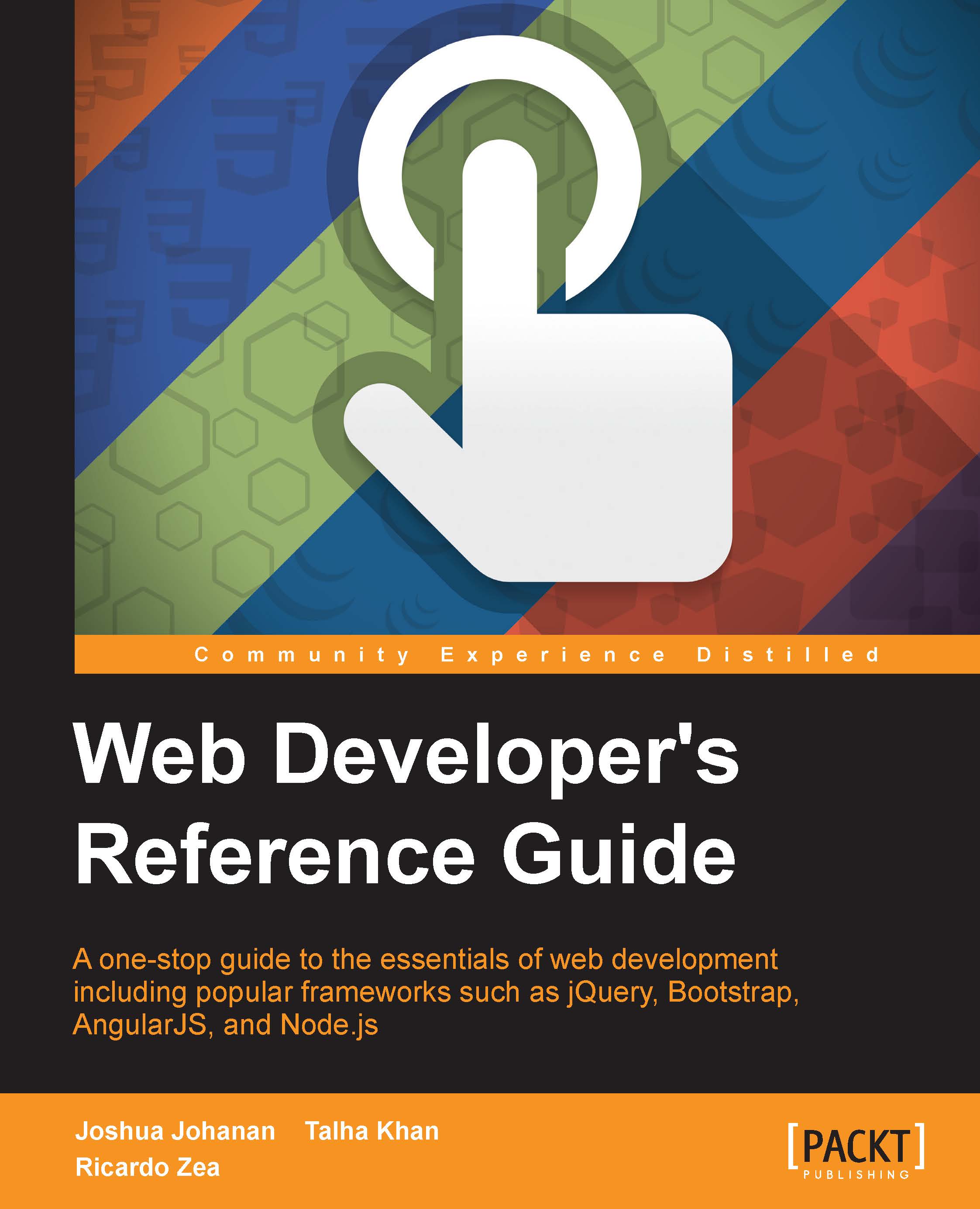
Web Developer's Reference Guide

Web Developer's Reference Guide

By : Joshua Johanan, Talha Khan, Ricardo Zea
4.7 (3)
close
close
Web Developer's Reference Guide

Web Developer's Reference Guide

4.7 (3)
By: Joshua Johanan, Talha Khan, Ricardo Zea

Overview of this book

This comprehensive reference guide takes you through each topic in web development and highlights the most popular and important elements of each area. Starting with HTML, you will learn key elements and attributes and how they relate to each other. Next, you will explore CSS pseudo-classes and pseudo-elements, followed by CSS properties and functions. This will introduce you to many powerful and new selectors. You will then move on to JavaScript. This section will not just introduce functions, but will provide you with an entire reference for the language and paradigms. You will discover more about three of the most popular frameworks today—Bootstrap, which builds on CSS, jQuery which builds on JavaScript, and AngularJS, which also builds on JavaScript. Finally, you will take a walk-through Node.js, which is a server-side framework that allows you to write programs in JavaScript.
Table of Contents (17 chapters)
close
close
9
9. JavaScript Expressions, Operators, Statements, and Arrays
16
Index

The HTTP module

We will cover the HTTP server module. Technically, you could write your HTTP server using the net module, but you do not have to.

Some of these functions are very similar to the net module functions. This should make sense as HTTP, at its core, is a network server.

All of these functions and objects are also used with the HTTPS module. The only difference is that for the options of createServer and https.request, you can pass certificates.

All of the following examples assume that the module has been loaded:

var http = require('http');

createServer

This creates an HTTP server:

http.createServer([requestListener])

Return Value

This returns an http.Server object.

Description

Much like net.createServer, this is required to serve anything. The requestListener parameter is attached to the request event.

Here is a simple example that just logs to the console any time a request is made:

var server = http.createServer(function (req, res) {
    console.log('Someone made a request...
CONTINUE READING
83
Tech Concepts
36
Programming languages
73
Tech Tools
Icon Unlimited access to the largest independent learning library in tech of over 8,000 expert-authored tech books and videos.
Icon Innovative learning tools, including AI book assistants, code context explainers, and text-to-speech.
Icon 50+ new titles added per month and exclusive early access to books as they are being written.
Web Developer's Reference Guide
notes
bookmark Notes and Bookmarks search Search in title playlist Add to playlist font-size Font size

Change the font size

margin-width Margin width

Change margin width

day-mode Day/Sepia/Night Modes

Change background colour

Close icon Search
Country selected

Close icon Your notes and bookmarks

Confirmation

Modal Close icon
claim successful

Buy this book with your credits?

Modal Close icon
Are you sure you want to buy this book with one of your credits?
Close
YES, BUY

Submit Your Feedback

Modal Close icon
Modal Close icon
Modal Close icon