Sign In Start Free Trial
Account

Add to playlist

Create a Playlist

Modal Close icon
You need to login to use this feature.
  • Book Overview & Buying Responsive Web Design with HTML5 and CSS3 Essentials
  • Table Of Contents Toc
Responsive Web Design with HTML5 and CSS3 Essentials

Responsive Web Design with HTML5 and CSS3 Essentials

By : Alex Libby, Gaurav Gupta, Asoj Talesra
2 (1)
close
close
Responsive Web Design with HTML5 and CSS3 Essentials

Responsive Web Design with HTML5 and CSS3 Essentials

2 (1)
By: Alex Libby, Gaurav Gupta, Asoj Talesra

Overview of this book

Responsive web design (RWD) is a web design approach aimed at crafting sites to provide an optimal viewing and interaction experience—providing easy reading and navigation with minimum resizing, panning, and scrolling—and all of this across a wide range of devices from desktop computer monitors to mobile phones. Responsive web design is becoming more important as the amount of mobile traffic now accounts for more than half of the Internet’s total traffic. This book will give you in depth knowledge about the basics of responsive web design. You will embark on a journey of building effective responsive web pages that work across a range of devices, from mobile phones to smart TVs, with nothing more than standard markup and styling techniques. You'll begin by getting an understanding of what RWD is and its significance to the modern web. Building on the basics, you'll learn about layouts and media queries. Following this, we’ll dive into creating layouts using grid based templates. We’ll also cover the important topic of performance management, and discover how to tackle cross-browser challenges.
Table of Contents (6 chapters)
close
close

Setting the available viewport for use


When viewing a website on different devices, we of course expect it to resize to the available device width automatically with no loss of experience; unfortunately, not every site does this quite the right way or successfully!

To understand why this is important, let's assume we operate a desktop version of our site (one in the 1280+ group in this screenshot), and a mobile equivalent from the 418-768 group:

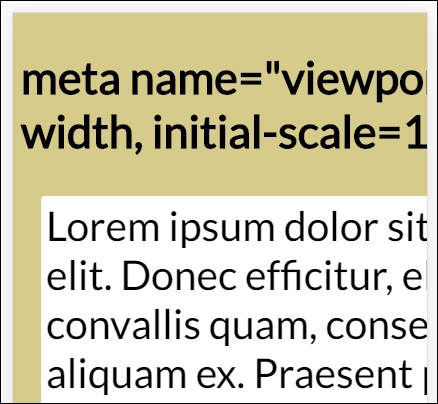
The first stage in making our site responsive is to add the viewport directive; without it, we are likely to end up with a similar effect to this when resizing our sites:

See what I mean? It looks awful—text is cut off, we would have to swipe to the right...ugh! In stark contrast, adding one line of code can have a dramatic effect:

Our example uses the Google Chrome set to emulate an iPhone 6 Plus. The code needed to restore sanity to our example can be added to the <head> of our code:

<meta name="viewport" content="width=device-width,...
CONTINUE READING
83
Tech Concepts
36
Programming languages
73
Tech Tools
Icon Unlimited access to the largest independent learning library in tech of over 8,000 expert-authored tech books and videos.
Icon Innovative learning tools, including AI book assistants, code context explainers, and text-to-speech.
Icon 50+ new titles added per month and exclusive early access to books as they are being written.
Responsive Web Design with HTML5 and CSS3 Essentials
notes
bookmark Notes and Bookmarks search Search in title playlist Add to playlist download Download options font-size Font size

Change the font size

margin-width Margin width

Change margin width

day-mode Day/Sepia/Night Modes

Change background colour

Close icon Search
Country selected

Close icon Your notes and bookmarks

Confirmation

Modal Close icon
claim successful

Buy this book with your credits?

Modal Close icon
Are you sure you want to buy this book with one of your credits?
Close
YES, BUY

Submit Your Feedback

Modal Close icon
Modal Close icon
Modal Close icon