Sign In Start Free Trial
Account

Add to playlist

Create a Playlist

Modal Close icon
You need to login to use this feature.
  • Book Overview & Buying Building a Web Application with PHP and MariaDB: A Reference Guide
  • Table Of Contents Toc
Building a Web Application with PHP and MariaDB: A Reference Guide

Building a Web Application with PHP and MariaDB: A Reference Guide

By : Sai S Sriparasa
4.3 (3)
close
close
Building a Web Application with PHP and MariaDB: A Reference Guide

Building a Web Application with PHP and MariaDB: A Reference Guide

4.3 (3)
By: Sai S Sriparasa

Overview of this book

This is a step-by-step, tutorial guide designed to help readers transition from beginners to more experienced developers using clear explanations. The variety of examples will help readers build, secure, and host real-time web applications. If you are a developer who wants to use PHP and MariaDB to build web applications, this book is ideal for you. Beginners can use this book to start with the basics and learn how to build and host web applications. Seasoned PHP Developers can use this book to get familiar with the new features of PHP 5.4 and 5.5, unit testing, caching, security, and performance optimization.
Table of Contents (12 chapters)
close
close
11
Index

Sorting data

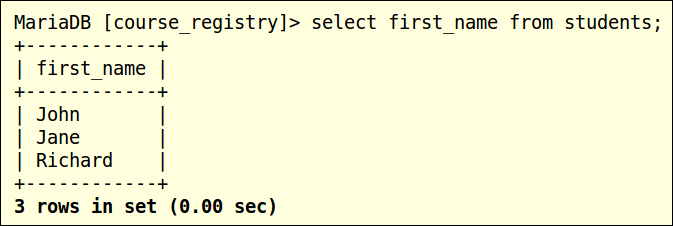
Now that we have looked at different techniques of retrieving the data, let us look at how the data can be represented in a more ordered way. When we execute a SELECT statement, the data is retrieved in the order in which it exists in the database. This would be the order in which the data is stored; therefore, it is not a good idea to depend upon MariaDB's default sorting. MariaDB provides an explicit mechanism for sorting data; we can use the ORDER BY clause with the SELECT statement and sort the data as needed. To understand how sorting can be of help, let us begin by querying the students table and only retrieving the first_name column:

Sorting data

In the first example, we are going by MariaDB's default sort, and this would give us the data that is being returned based on the order of the insert:

Sorting data

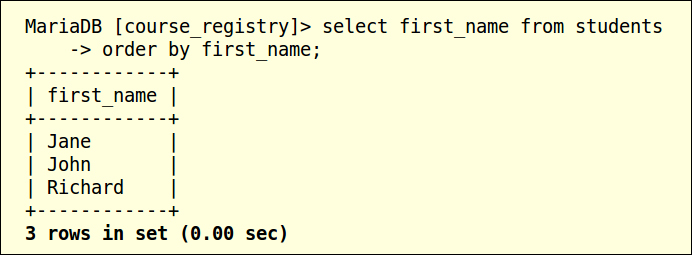
In this example, we are ordering the data based on the first_name column. The ORDER BY clause by default sorts in ascending order, so the data would be sorted in an ascending alphabetical order and if the first character of one or more strings is the same, then the data is sorted by the second character, which is why Jane comes before John. To explicitly mention the sort order as ascending, we can use the keyword asc after the column name:

Sorting data

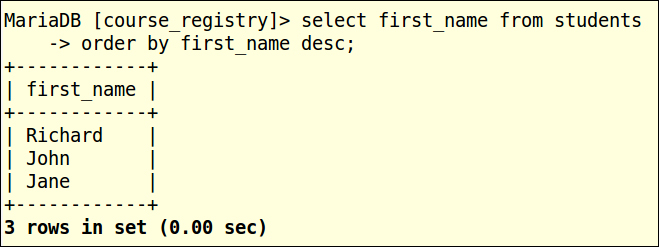
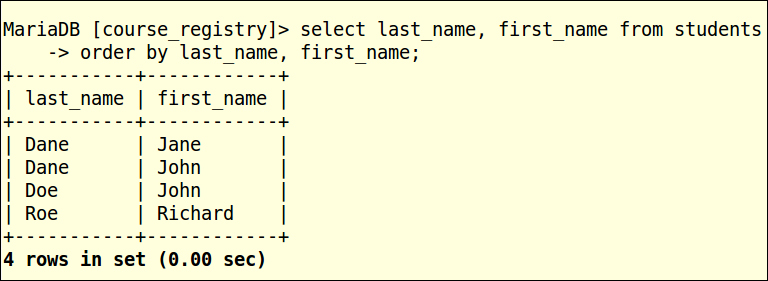
In this example, we are again ordering the data based on the first_name column and the ORDER BY clause has been supplied with desc, we are setting the sort direction to descending, which denotes that the data has been sorted in a descending order. MariaDB also provides a multi-column sort, which is a sort within a sort. To perform a multi-column sort, we would specify the column names after the ORDER BY clause separated by comma (,). The way the multi-column works is, the data would be first sorted by the first column that is mentioned in the ORDER BY clause, and then the dataset that has already been sorted by the first column is again sorted by the next column and the data is returned back. As a muti-column sort performs sorting on multiple levels, the order of columns will determine the way the data is ordered. To perform this example, let us insert another row with the student name John Dane and the student ID being 4, the reason for using John Dane is to make sure that there are more than one students that share the first name of John (John Doe and John Dane) and the last name of Dane (Jane Dane and John Dane) exclusively:

Sorting data

In this example, we are retrieving the last_name and first_name columns from the students table and are first ordering the data by "last_name" and then reordering the previously ordered dataset by first_name. We are not restricted by the ORDER BY clause to use only the columns being used for the sort. This will only help us sort the data in the correct direction.

Visually different images
CONTINUE READING
83
Tech Concepts
36
Programming languages
73
Tech Tools
Icon Unlimited access to the largest independent learning library in tech of over 8,000 expert-authored tech books and videos.
Icon Innovative learning tools, including AI book assistants, code context explainers, and text-to-speech.
Icon 50+ new titles added per month and exclusive early access to books as they are being written.
Building a Web Application with PHP and MariaDB: A Reference Guide
notes
bookmark Notes and Bookmarks search Search in title playlist Add to playlist font-size Font size

Change the font size

margin-width Margin width

Change margin width

day-mode Day/Sepia/Night Modes

Change background colour

Close icon Search
Country selected

Close icon Your notes and bookmarks

Confirmation

Modal Close icon
claim successful

Buy this book with your credits?

Modal Close icon
Are you sure you want to buy this book with one of your credits?
Close
YES, BUY

Submit Your Feedback

Modal Close icon
Modal Close icon
Modal Close icon