Sign In Start Free Trial
Account

Add to playlist

Create a Playlist

Modal Close icon
You need to login to use this feature.
  • Book Overview & Buying Oracle API Management 12c Implementation
  • Table Of Contents Toc
Oracle API Management 12c Implementation

Oracle API Management 12c Implementation

By : Carrasco
5 (1)
close
close
Oracle API Management 12c Implementation

Oracle API Management 12c Implementation

5 (1)
By: Carrasco

Overview of this book

Oracle SOA Governance is a comprehensive, service-orientated governance solution that is designed to make the transition to SOA easier. API management is the discipline that governs the software development lifecycle of APIs. It defines the tools and processes needed to build, publish and operate APIs including the management of the community of developers around it. This book illustrates how to successfully implement API Management in your organization. To achieve this, the importance of defining an API management strategy and implementation roadmap so that capabilities are implemented in the right order and timeframes is described. It starts by describing all of the fundamental concepts around API Management and related disciplines such as SOA Governance and DevOps in order to dispel the confusion surrounding these topics. The book then takes you on the journey of implementing API Management, using a realistic case study of an organization that needs an API Management solution. You will start by identifying the key business drivers to implement APIs and then create an API Management strategy and a roadmap to realize this strategy. You’ll then go through a number of use cases, each focused on addressing specific business requirements. These will help you understand each of the Oracle API Management products, how they fit into an overall architecture, and how to implement them. The book concludes by providing some tips and guidelines around defining a deployment topology for the Oracle API Management products and the steps to install them.
Table of Contents (8 chapters)
close
close
7
Index

API Management

Before elaborating further on this topic we would like to describe more accurately what an API actually is. Application Programming Interface, or API for short, is a type of SOA asset that characterizes itself by:

  • Making use of lightweight data transport and data formats such as REST and JSON

    Note

    Representational State Transfer (REST) is a an architectural style for the creation of web services using native methods or verbs (GET, POST, PUT, DELETE, and others) within the Hypertext Transfer Protocol (HTTP) to access resources via fully qualified uniform resource identifiers (URIs).

    For further reading, go to the following URL:

    http://en.wikipedia.org/wiki/Representational_state_transfer

    JavaScript Object Notation (JSON) is a lightweight data format based on the JavaScript language. For further reading, go to http://www.json.org/.

  • Stateless (meaning there is no session or persistence of state; a request is received and a response is sent as part of the same thread)
  • Being highly scalable
  • Being public (accessible via public Internet) or private (accessible only via private channels such as virtual private networks—VPNs, corporate wide area networks—WANs and/or a companies' extranet)
  • An API technical contract (basically its interface) may or may not be declared; however if done so, a variety of notations (many of which are still evolving) can be used. For example:

Tip

A bit of history: APIs actually predate SOA by far. APIs (or a least the notion of creating application interfaces to interact with other applications) existed even in the mainframe days. However, the term API as we know it today really refers to web APIs as the term gained popularity during the mobile app revolution, especially as mobile app developers in their search for a lightweight alternative to the then popular SOAP/WSDL-based web services, started creating services using REST and JSON which eventually became known as RESTful APIs.

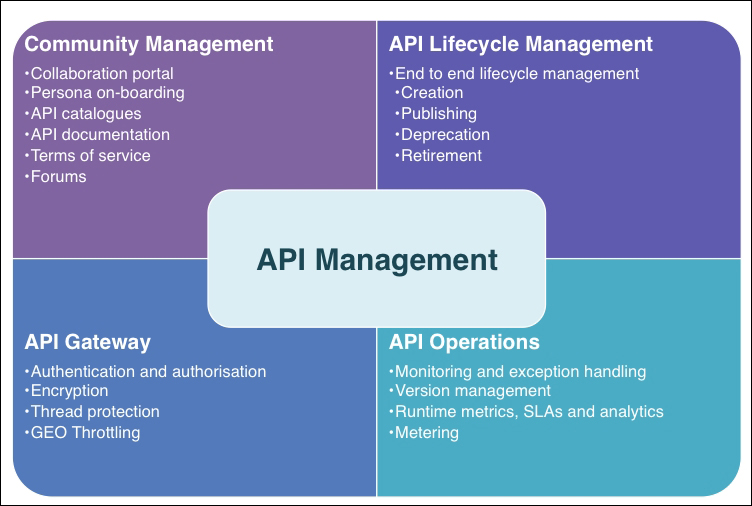
A basic definition of API Management is the adoption and adaptation of SOA Governance principles and tools in the context of managing the end-to-end lifecycle of an API and the community around it.

API Management

From the diagram (which is an extended version of Gartner's Application Services Governance) the following fundamental similarities and differences can be noted:

  • The concept of Community Management is central to API Management, whereas in SOA Governance, although it was present, it was never a fundamental pillar.

    Tip

    By community, we mean all the personas (actors) that participate in the API ecosystem, from consumers of an API (app developers for example) to the creators of the API (developers) and administrators of the API platform.

  • More focus has been given to the runtime management of the API. For this reason, API Management tools tend to provide a lot of insight into API runtime analytics.
  • There is a lot more flexibility around how an API is defined and built. This is reflected by the fact that several notations are available to define an API (some of them listed earlier in the chapter).
  • The notion of API economy becomes very relevant to the business as it provides an opportunity to monetize APIs' usage. This means that the business sees an API as another revenue stream.

Having said that, we can conclude that API Management extends SOA Governance objectives by focusing on:

  • Productizing and externalizing information assets and business functionality via APIs: APIs should be handled as products in their own right that offer information assets and business functionality to customers (known and unknown).
  • Community management: Management of the API community (external and internal) by providing a facility where different people (developers, designers, architects, operators, business partners) can collaborate.

    Tip

    One of the key tenets of API Management is the ability to manage a community of known and unknown people alike via a web portal that is usually publicly available (meaning via public Internet access). While this principle might not be true in all scenarios (that is, a company might want to make APIs available only to partners via an extranet), this is a generally accepted definition among API practitioners.

  • Runtime lifecycle management: End-to-end management of an API through all of its phases. The API lifecycle starts during the creation of the API and ends when the API is retired. The typical phases are: creation, publishing, deprecation, and retirement.
  • Runtime analytics and metering: Robust runtime analytics focused as much on consumer usage—metering (that is, total API calls, consumer SLAs, and others) and analytics as on platform statistics (API status, throughput, latency, and others).
  • Continuous delivery: Having the ability to rapidly build, test and make APIs available for general use, and most importantly the continuous improvement of the API is fundamental in any API Management strategy and therefore API Management tooling. Having said that, adopting disciplines such as Development Operations (DevOps) as the main method to deliver APIs becomes a fundamental objective.

    Note

    This book will not cover DevOps in great detail as other books and articles are dedicated explicitly to this topic. This book, however, will touch on areas that are related to DevOps but in the context of SOA Governance and API Management.

  • Global deployment models: APIs (or more specifically web APIs) were born in support of scalable and flexible mobile and web architectures. Web and mobile applications respect no geographical boundaries; however, resources that can be globally accessible via the Internet are exposed to issues such as network latency, bottlenecks, a single point of failure and language localizations, to name a few. Having said that, an objective of API Management should be to provide cloud-based multi-geography deployments with localized capabilities such as localized language and throttling.
  • Web security: The topic of security is a broad and complex one as it is relevant for every layer of a technology stack. However, when talking about APIs one should not try to boil the ocean. The focus should be on threads that apply web and mobile applications such as the one listed in the Open Web Application Security Project (OWASP) Top 10 project.
  • Monetization: Give the business the ability to monetize APIs. The objective should be making APIs a new revenue stream for the business.
    API Management
Visually different images
CONTINUE READING
83
Tech Concepts
36
Programming languages
73
Tech Tools
Icon Unlimited access to the largest independent learning library in tech of over 8,000 expert-authored tech books and videos.
Icon Innovative learning tools, including AI book assistants, code context explainers, and text-to-speech.
Icon 50+ new titles added per month and exclusive early access to books as they are being written.
Oracle API Management 12c Implementation
notes
bookmark Notes and Bookmarks search Search in title playlist Add to playlist font-size Font size

Change the font size

margin-width Margin width

Change margin width

day-mode Day/Sepia/Night Modes

Change background colour

Close icon Search
Country selected

Close icon Your notes and bookmarks

Confirmation

Modal Close icon
claim successful

Buy this book with your credits?

Modal Close icon
Are you sure you want to buy this book with one of your credits?
Close
YES, BUY

Submit Your Feedback

Modal Close icon
Modal Close icon
Modal Close icon