Sign In Start Free Trial
Account

Add to playlist

Create a Playlist

Modal Close icon
You need to login to use this feature.
  • Book Overview & Buying Magento 2 Development Essentials
  • Table Of Contents Toc
  • Feedback & Rating feedback
Magento 2 Development Essentials

Magento 2 Development Essentials

By : J Miguel
4 (4)
close
close
Magento 2 Development Essentials

Magento 2 Development Essentials

4 (4)
By: J Miguel

Overview of this book

Magento is the e-commerce software and platform trusted by the world's leading brands. Used by thousands of merchants for their transactions worth billions, it provides the flexibility to customize the content and functionality of your website. By strengthening your fundamentals in Magento development, you can develop the best solutions and take advantage of the growing market. This fast-paced tutorial will provide you with skills you need to successfully create themes, extensions, and solutions to Magento 2 projects. This book begins by setting up Magento 2 before gradually moving onto setting the basic options of the Sell System. You will take advantage of Search Engine Optimization aspects, create design and customize theme layout, develop new extensions, and adjust the Magento System to achieve great performance. By sequentially working through the steps in each chapter, you will quickly explore all the features of Magento 2 to create a great solution. With ample examples and a practical approach, this book will ensure your success with this astonishing e-commerce management system.
Table of Contents (11 chapters)
close
close
10
Index

XAMPP installation

First of all, let's access the XAMPP website on https://www.apachefriends.org/.

XAMPP installation

XAMPP has three distinct versions for different operating systems (OS): Windows, Linux, and OS X. Choose your preferred version to download, and start the installation process.

XAMPP for Windows installation

XAMPP for Windows has three different kinds of installation files:

  • Installer: This is a classic Windows installation method
  • Zip: This method uses compressed files to install manually
  • 7zip: This method uses compressed files to install manually

The (.exe) installer is the most popular process to install. Download it and execute to start the installation process, shown as follows:

XAMPP for Windows installation
  1. You can skip FileZilla FTP Server, Mercury Mail Server, and Tomcat for our installation purposes but feel free to consult Apache Friends Support Forum for further information at https://community.apachefriends.org.
  2. On XAMPP, we have the option to use Bitnami (https://bitnami.com/xampp), but for learning purposes, we will install Magento in a classic way.
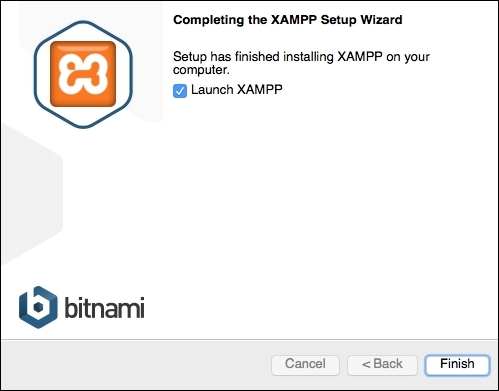
  3. Complete the installation by pressing the Finish button.
    XAMPP for Windows installation
  4. In order to start XAMPP for Windows, you can execute xampp-control.exe and start the Apache web server.
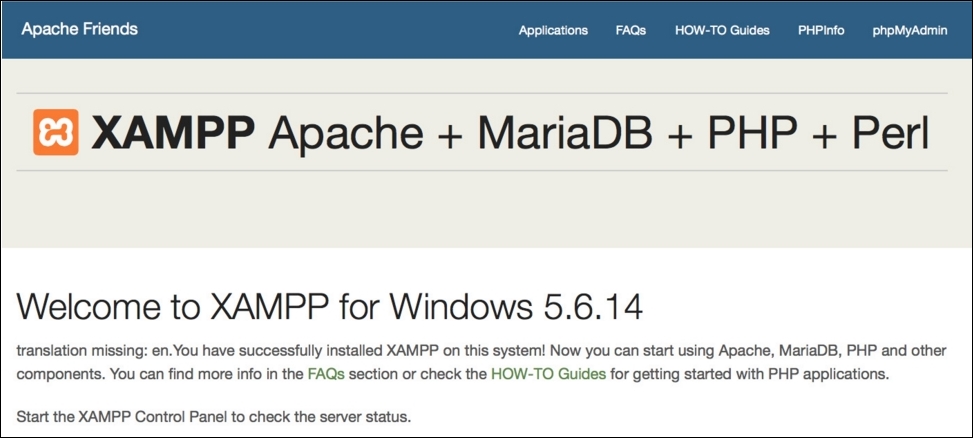
  5. To test if everything is working, type http://localhosturl in your favorite web browser. You will see the XAMPP start page:
    XAMPP for Windows installation

XAMPP for Linux installation

XAMPP for Linux has two main versions of installation files:

  • 32-bit version
  • 64-bit version

Choose the file according to your architecture and follow these steps:

  1. Change the permissions to the installer:
    chmod 755 xampp-linux-*-installer.run
  2. Run the installer:
    sudo ./xampp-linux-*-installer.run
    

    XAMPP is now installed below the /opt/lampp directory.

  3. To start XAMPP, execute this command on terminal:
    sudo /opt/lampp/lampp start
    
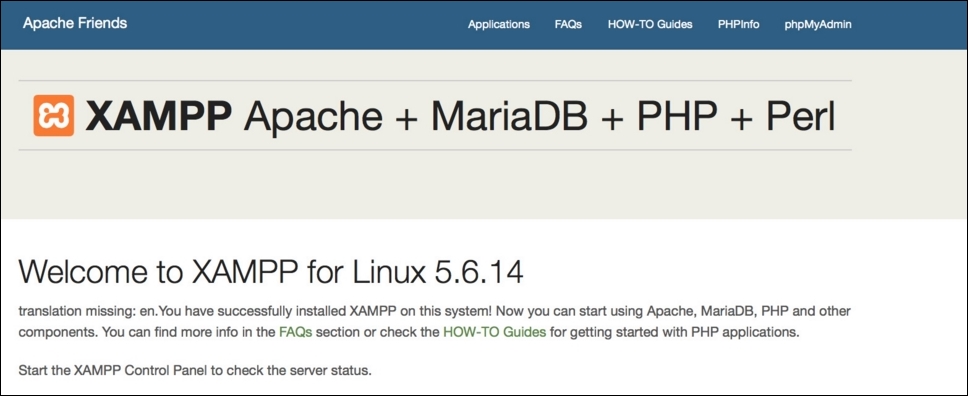
  4. To test if everything is working, type the http://localhost URL in your favorite web browser. You will see the XAMPP start page:
    XAMPP for Linux installation

XAMPP for OS X installation

To install XAMPP for OS X, you simply need to follow these steps:

  1. Download the DMG image file.
  2. Open the image file to start the installation process.
  3. The steps are pretty much the same as Windows installation.
  4. To test if everything is working, type the http://localhost URL in your favorite web browser. You will see the XAMPP start page:
    XAMPP for OS X installation

The XAMPP htdocs folder is the docroot folder of your server. Everything that you save on htdocs can be accessed via any browser. For example, if you save index.php inside the htdocs root, you can access this script by entering http://localhost/index.php. If you save your file in the packt folder, you can access it by http://localhost/packt/index.php. Piece of cake!

Visually different images
CONTINUE READING
83
Tech Concepts
36
Programming languages
73
Tech Tools
Icon Unlimited access to the largest independent learning library in tech of over 8,000 expert-authored tech books and videos.
Icon Innovative learning tools, including AI book assistants, code context explainers, and text-to-speech.
Icon 50+ new titles added per month and exclusive early access to books as they are being written.
Magento 2 Development Essentials
notes
bookmark Notes and Bookmarks search Search in title playlist Add to playlist font-size Font size

Change the font size

margin-width Margin width

Change margin width

day-mode Day/Sepia/Night Modes

Change background colour

Close icon Search
Country selected

Close icon Your notes and bookmarks

Confirmation

Modal Close icon
claim successful

Buy this book with your credits?

Modal Close icon
Are you sure you want to buy this book with one of your credits?
Close
YES, BUY

Submit Your Feedback

Modal Close icon
Modal Close icon
Modal Close icon