Sign In Start Free Trial
Account

Add to playlist

Create a Playlist

Modal Close icon
You need to login to use this feature.
  • Book Overview & Buying Web Development with Django Cookbook
  • Table Of Contents Toc
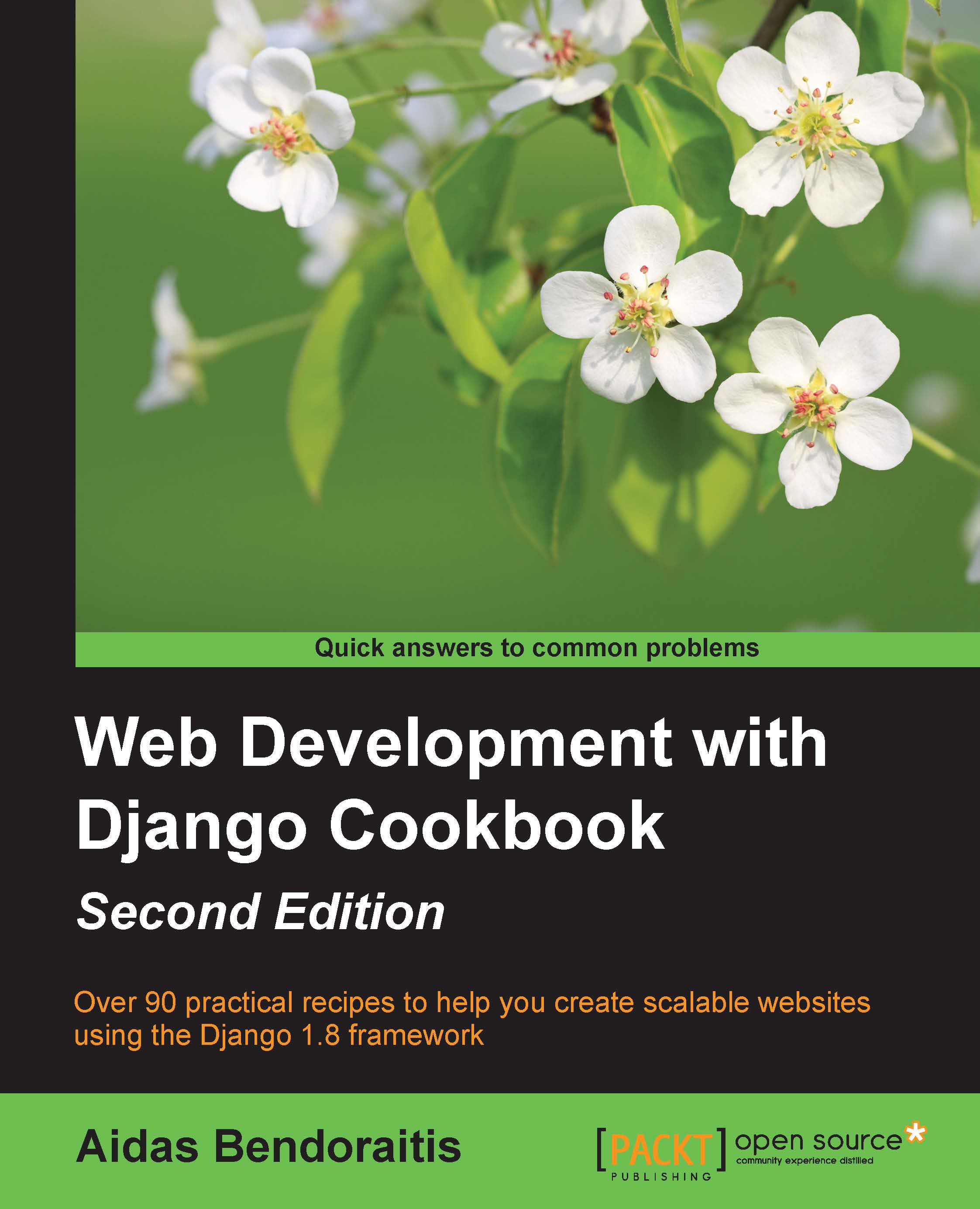
Web Development with Django Cookbook

Web Development with Django Cookbook - Second Edition

By : Aidas Bendoraitis
4 (8)
close
close
Web Development with Django Cookbook

Web Development with Django Cookbook

4 (8)
By: Aidas Bendoraitis

Overview of this book

Django is a web framework that was designed to strike a balance between rapid web development and high performance. It has the capacity to handle applications with high levels of user traffic and interaction, and can integrate with massive databases on the backend, constantly collecting and processing data in real time. Through this book, you'll discover that collecting data from different sources and providing it to others in different formats isn't as difficult as you thought. It follows a task-based approach to guide you through all the web development processes using the Django framework. We’ll start by setting up the virtual environment for a Django project and configuring it. Then you’ll learn to write reusable pieces of code for your models and find out how to manage database schema changes using South migrations. After that, we’ll take you through working with forms and views to enter and list data. With practical examples on using templates and JavaScript together, you will discover how to create the best user experience. In the final chapters, you'll be introduced to some programming and debugging tricks and finally, you will be shown how to test and deploy the project to a remote dedicated server. By the end of this book, you will have a good understanding of the new features added to Django 1.8 and be an expert at web development processes.
Table of Contents (13 chapters)
close
close
12
Index

Caching the method return value


If you call the same model method with heavy calculations or database queries multiple times in the request-response cycle, the performance of the view might be very slow. In this recipe, you will learn about a pattern that you can use to cache the return value of a method for later repetitive use. Note that we are not using the Django cache framework here, we are just using what Python provides us by default.

Getting ready

Choose an app with a model that has a time-consuming method that will be used repetitively in the same request-response cycle.

How to do it...

This is a pattern that you can use to cache a method return value of a model for repetitive use in views, forms, or templates, as follows:

class SomeModel(models.Model):
    # ...
    def some_expensive_function(self):
        if not hasattr(self, "_expensive_value_cached"):
            # do some heavy calculations...
            # ... and save the result to result variable
            self._expensive_value_cached...
CONTINUE READING
83
Tech Concepts
36
Programming languages
73
Tech Tools
Icon Unlimited access to the largest independent learning library in tech of over 8,000 expert-authored tech books and videos.
Icon Innovative learning tools, including AI book assistants, code context explainers, and text-to-speech.
Icon 50+ new titles added per month and exclusive early access to books as they are being written.
Web Development with Django Cookbook
notes
bookmark Notes and Bookmarks search Search in title playlist Add to playlist font-size Font size

Change the font size

margin-width Margin width

Change margin width

day-mode Day/Sepia/Night Modes

Change background colour

Close icon Search
Country selected

Close icon Your notes and bookmarks

Confirmation

Modal Close icon
claim successful

Buy this book with your credits?

Modal Close icon
Are you sure you want to buy this book with one of your credits?
Close
YES, BUY

Submit Your Feedback

Modal Close icon
Modal Close icon
Modal Close icon