Sign In Start Free Trial
Account

Add to playlist

Create a Playlist

Modal Close icon
You need to login to use this feature.
  • Book Overview & Buying Modular Programming with PHP 7
  • Table Of Contents Toc
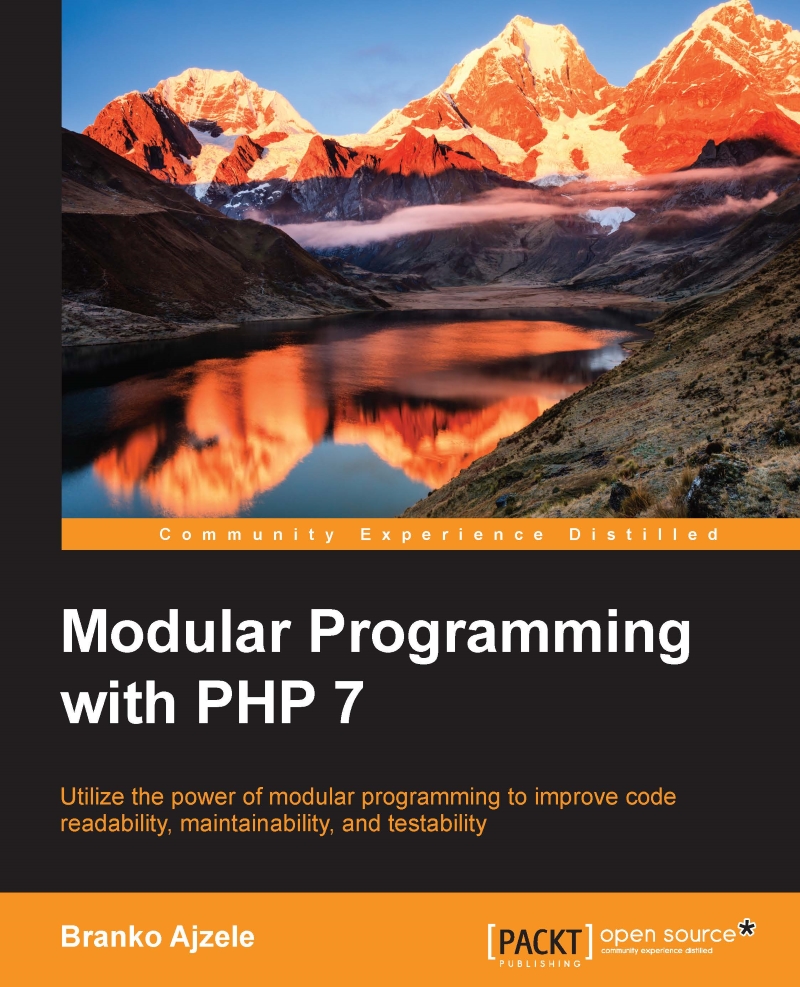
Modular Programming with PHP 7

Modular Programming with PHP 7

By : Branko Ajzele
5 (1)
close
close
Modular Programming with PHP 7

Modular Programming with PHP 7

5 (1)
By: Branko Ajzele

Overview of this book

Modular design techniques help you build readable, manageable, reusable, and more efficient codes. PHP 7, which is a popular open source scripting language, is used to build modular functions for your software. With this book, you will gain a deep insight into the modular programming paradigm and how to achieve modularity in your PHP code. We start with a brief introduction to the new features of PHP 7, some of which open a door to new concepts used in modular development. With design patterns being at the heart of all modular PHP code, you will learn about the GoF design patterns and how to apply them. You will see how to write code that is easy to maintain and extend over time with the help of the SOLID design principles. Throughout the rest of the book, you will build different working modules of a modern web shop application using the Symfony framework, which will give you a deep understanding of modular application development using PHP 7.
Table of Contents (14 chapters)
close
close
Lock Free Chapter
1
1. Ecosystem Overview
13
Index

Chapter 3. SOLID Design Principles

Building modular software requires strong knowledge of the class design. There are numerous guidelines out there, addressing the way we name our classes, number of variables they should have, what the size of methods should be, and so on. The PHP ecosystem managed to pack these into official PSR standard, more precisely PSR-1: Basic Coding Standard and PSR-2: Coding Style Guide. These are all general programming guidelines that keep our code readable, understandable, and maintainable.

Aside from programming guidelines, there are more specific design principles that we can apply during the class design. Ones that address the notions of low coupling, high cohesion, and strong encapsulation. We call them SOLID design principles, a term coined by Robert Cecil Martin in the early 2000s.

SOLID is an acronym for the following five principles:

  • S: Single responsibility principle (SRP)
  • O: Open/closed principle (OCP)
  • L: Liskov substitution principle (LSP...
Visually different images
CONTINUE READING
83
Tech Concepts
36
Programming languages
73
Tech Tools
Icon Unlimited access to the largest independent learning library in tech of over 8,000 expert-authored tech books and videos.
Icon Innovative learning tools, including AI book assistants, code context explainers, and text-to-speech.
Icon 50+ new titles added per month and exclusive early access to books as they are being written.
Modular Programming with PHP 7
notes
bookmark Notes and Bookmarks search Search in title playlist Add to playlist download Download options font-size Font size

Change the font size

margin-width Margin width

Change margin width

day-mode Day/Sepia/Night Modes

Change background colour

Close icon Search
Country selected

Close icon Your notes and bookmarks

Confirmation

Modal Close icon
claim successful

Buy this book with your credits?

Modal Close icon
Are you sure you want to buy this book with one of your credits?
Close
YES, BUY

Submit Your Feedback

Modal Close icon
Modal Close icon
Modal Close icon