Sign In Start Free Trial
Account

Add to playlist

Create a Playlist

Modal Close icon
You need to login to use this feature.
  • Book Overview & Buying Visualforce Development Cookbook
  • Table Of Contents Toc
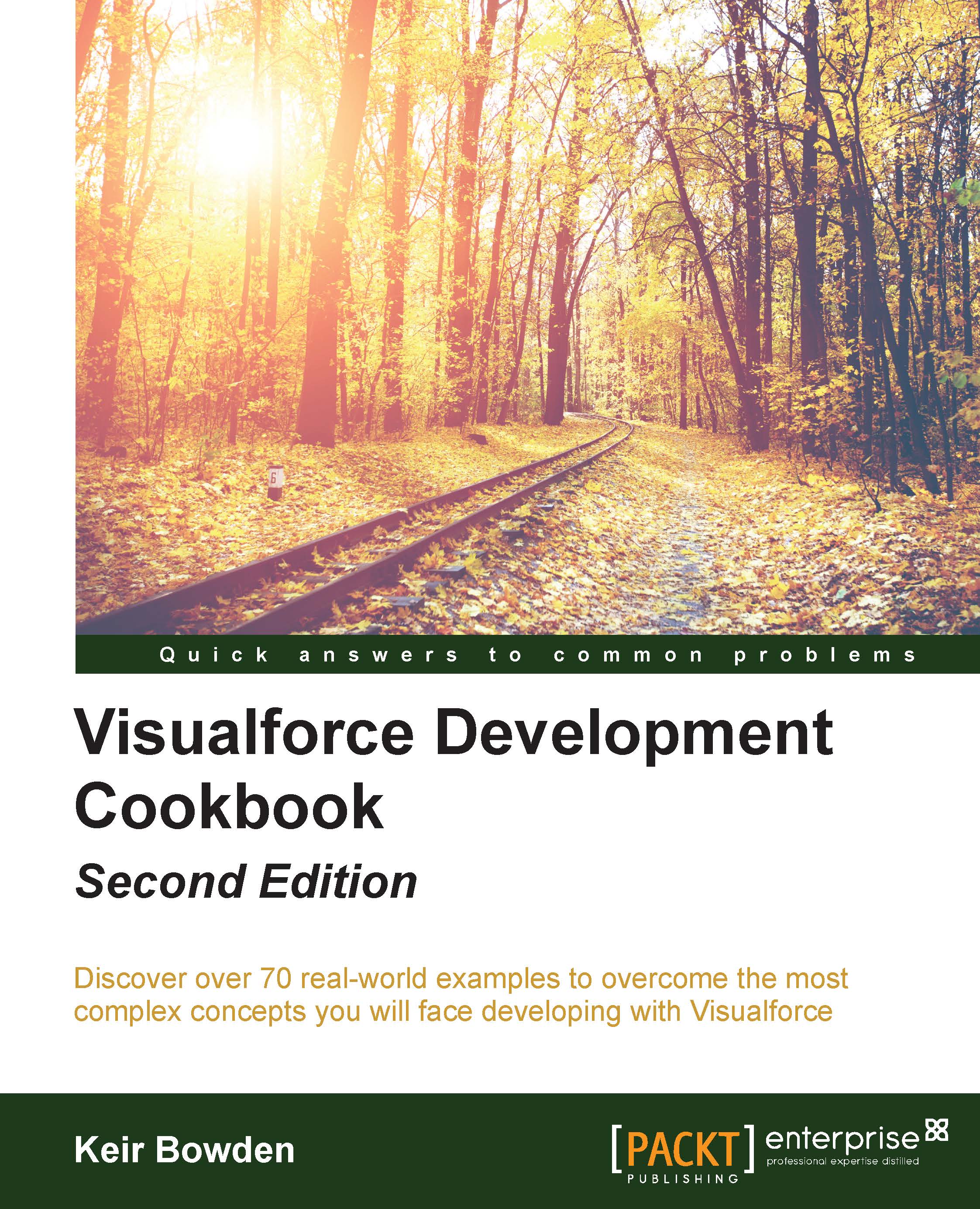
Visualforce Development Cookbook

Visualforce Development Cookbook - Second Edition

By : Keir Bowden
4.9 (8)
close
close
Visualforce Development Cookbook

Visualforce Development Cookbook

4.9 (8)
By: Keir Bowden

Overview of this book

Visualforce is a framework that allows developers to build sophisticated, custom user interfaces that can be hosted natively on the Force.com platform. The Visualforce framework includes a tag-based markup language, similar to HTML that is used to write the Visualforce pages and a set of controllers that are used to write business logic to the Visualforce pages. Visualforce Development Cookbook provides solutions to a variety of challenges faced by Salesforce developers and demonstrates how easy it is to build rich, interactive pages using Visualforce. Whether you are looking to make a minor addition to the standard page functionality or override it completely, this book will provide you with the help you require throughout. You will start by learning about the simple utilities and will build up to more advanced techniques for data visualization and to reuse functionality. You will learn how to perform various tasks such as creating multiple records from a single page, visualizing data as charts, using JavaScript to enhance client-side functionality, building a public website, and making data available to a mobile device. With an interesting chapter on tackling common issues faced while developing Visualforce pages, the book provides lots of practical examples to enhance and extend your Salesforce user interface.
Table of Contents (11 chapters)
close
close

Updating attributes in component controllers


Updating fields of sObjects passed as attributes to custom components is straightforward, and can be achieved through simple merge syntax statements. This is not so simple when the attribute is primitive and will be updated by the component controller, as parameters are passed by value, and thus any changes are made to a copy of the primitive. For example, passing the name field of a contact sObject, rather than the contact sObject itself, would mean that any changes made in the component would not be visible to the containing page.

In this situation, the primitive must be encapsulated inside a containing class. The class instance attribute is still passed by value, so it cannot be updated to point to a different instance, but the properties of the instance can be updated.

In this recipe, we will create a containing class that encapsulates a Date primitive and a Visualforce component that allows the user to enter the date via day/month/year picklists...

CONTINUE READING
83
Tech Concepts
36
Programming languages
73
Tech Tools
Icon Unlimited access to the largest independent learning library in tech of over 8,000 expert-authored tech books and videos.
Icon Innovative learning tools, including AI book assistants, code context explainers, and text-to-speech.
Icon 50+ new titles added per month and exclusive early access to books as they are being written.
Visualforce Development Cookbook
notes
bookmark Notes and Bookmarks search Search in title playlist Add to playlist download Download options font-size Font size

Change the font size

margin-width Margin width

Change margin width

day-mode Day/Sepia/Night Modes

Change background colour

Close icon Search
Country selected

Close icon Your notes and bookmarks

Confirmation

Modal Close icon
claim successful

Buy this book with your credits?

Modal Close icon
Are you sure you want to buy this book with one of your credits?
Close
YES, BUY

Submit Your Feedback

Modal Close icon
Modal Close icon
Modal Close icon