Sign In Start Free Trial
Account

Add to playlist

Create a Playlist

Modal Close icon
You need to login to use this feature.
  • Book Overview & Buying Building Microservices with Go
  • Table Of Contents Toc
Building Microservices with Go

Building Microservices with Go

By : Nic Jackson
3.1 (12)
close
close
Building Microservices with Go

Building Microservices with Go

3.1 (12)
By: Nic Jackson

Overview of this book

Microservice architecture is sweeping the world as the de facto pattern to build web-based applications. Golang is a language particularly well suited to building them. Its strong community, encouragement of idiomatic style, and statically-linked binary artifacts make integrating it with other technologies and managing microservices at scale consistent and intuitive. This book will teach you the common patterns and practices, showing you how to apply these using the Go programming language. It will teach you the fundamental concepts of architectural design and RESTful communication, and show you patterns that provide manageable code that is supportable in development and at scale in production. We will provide you with examples on how to put these concepts and patterns into practice with Go. Whether you are planning a new application or working in an existing monolith, this book will explain and illustrate with practical examples how teams of all sizes can start solving problems with microservices. It will help you understand Docker and Docker-Compose and how it can be used to isolate microservice dependencies and build environments. We finish off by showing you various techniques to monitor, test, and secure your microservices. By the end, you will know the benefits of system resilience of a microservice and the advantages of Go stack.
Table of Contents (11 chapters)
close
close

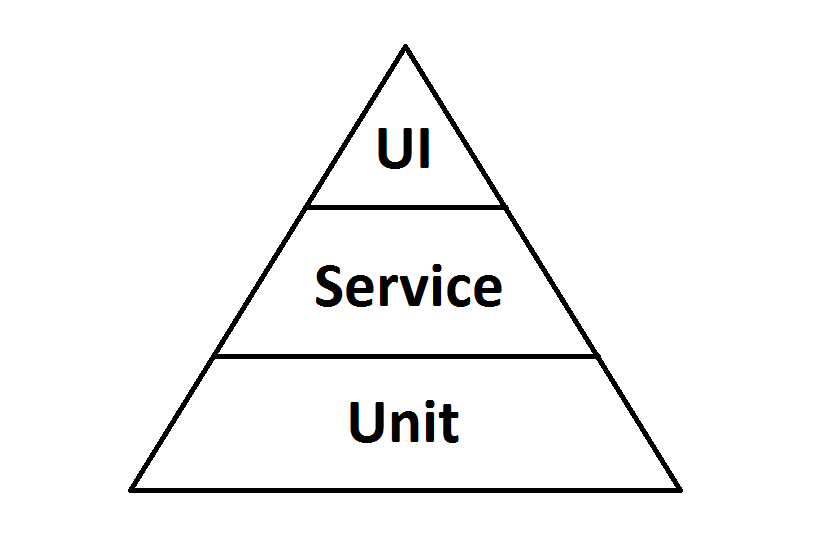
The testing pyramid


Mike Cohn is credited with having created the concept of a testing pyramid in his book Succeeding with Agile. The concept is that your cheapest (fastest) tests to run, which will be your unit tests, go at the bottom of the pyramid; service level integration tests are on top of this, and at the very top, you place full end-to-end tests, which are the costliest element. Because this is a pyramid, the number of tests gets smaller as you move up the pyramid.

In the early days of automated testing, all the testing was completed at the top of the pyramid. While this did work from a quality perspective, it meant the process of debugging the area at fault would be incredibly complicated and time-consuming. If you were lucky, there might be a complete failure which could be tracked down to a stack trace. If you were unlucky, then the problem would be behavioral; and even if you knew the system inside out, it would involve plowing through thousands of lines of code and manually...

CONTINUE READING
83
Tech Concepts
36
Programming languages
73
Tech Tools
Icon Unlimited access to the largest independent learning library in tech of over 8,000 expert-authored tech books and videos.
Icon Innovative learning tools, including AI book assistants, code context explainers, and text-to-speech.
Icon 50+ new titles added per month and exclusive early access to books as they are being written.
Building Microservices with Go
notes
bookmark Notes and Bookmarks search Search in title playlist Add to playlist font-size Font size

Change the font size

margin-width Margin width

Change margin width

day-mode Day/Sepia/Night Modes

Change background colour

Close icon Search
Country selected

Close icon Your notes and bookmarks

Confirmation

Modal Close icon
claim successful

Buy this book with your credits?

Modal Close icon
Are you sure you want to buy this book with one of your credits?
Close
YES, BUY

Submit Your Feedback

Modal Close icon
Modal Close icon
Modal Close icon