Sign In Start Free Trial
Account

Add to playlist

Create a Playlist

Modal Close icon
You need to login to use this feature.
  • Book Overview & Buying RESTful  Web API Design with Node.js
  • Table Of Contents Toc
RESTful  Web API Design with Node.js

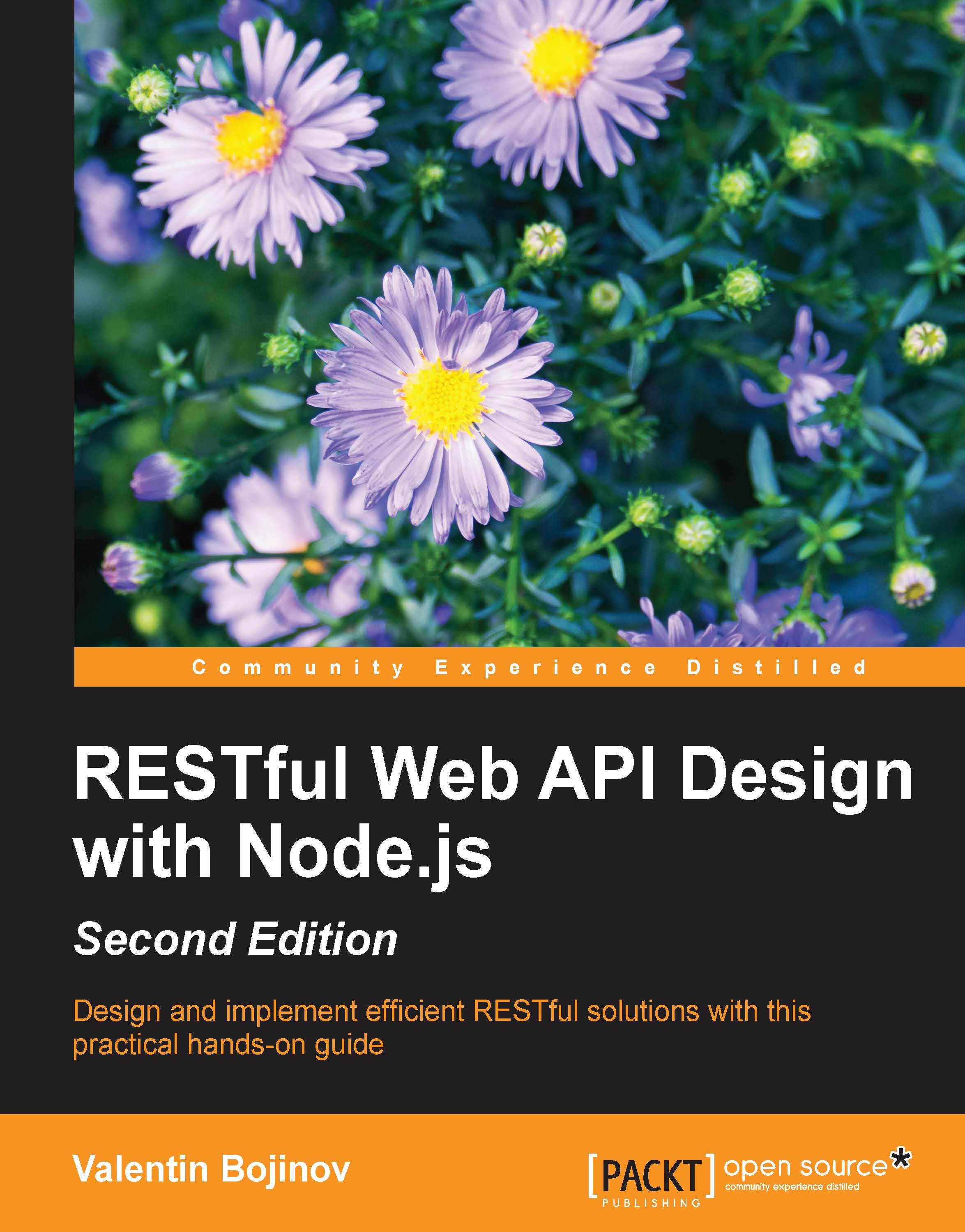
RESTful Web API Design with Node.js - Second Edition

By : Bojinov
4.1 (13)
close
close
RESTful  Web API Design with Node.js

RESTful Web API Design with Node.js

4.1 (13)
By: Bojinov

Overview of this book

In this era of cloud computing, every data provisioning solution is built in a scalable and fail-safe way. Thus, when building RESTful services, the right choice for the underlying platform is vital. Node.js, with its asynchronous, event-driven architecture, is exactly the right choice to build RESTful APIs. This book will help you enrich your development skills to create scalable, server-side, RESTful applications based on the Node.js platform. Starting with the fundamentals of REST, you will understand why RESTful web services are better data provisioning solution than other technologies. You will start setting up a development environment by installing Node.js, Express.js, and other modules. Next, you will write a simple HTTP request handler and create and test Node.js modules using automated tests and mock objects. You will then have to choose the most appropriate data storage type, having options between a key/value or document data store, and also you will implement automated tests for it. This module will evolve chapter by chapter until it turns into a full-fledged and secure Restful service.
Table of Contents (7 chapters)
close
close

Authentication

An application considers a user authenticated when their identity has been successfully validated against a trusted store. Such trusted stores can be either any kind of specially maintained database, storing the credentials of the application (basic authentication), or a third-party service that checks a given identity against its own trusted store (third-party authentication).

Basic authentication

HTTP basic authentication is one of the most popular and straightforward authentication mechanisms available out there. It relies on HTTP headers in the request, which provide the user's credentials. Optionally, the server may reply with a header, forcing the clients to authenticate themselves. The following diagram shows a client-server interaction when basic authentication is carried out:

Basic authentication

Whenever an HTTP request is sent to an endpoint secured by HTTP basic authentication, the server replies with a HTTP 401 Unauthorized status code, and optionally with a WWW-Authenticate...

CONTINUE READING
83
Tech Concepts
36
Programming languages
73
Tech Tools
Icon Unlimited access to the largest independent learning library in tech of over 8,000 expert-authored tech books and videos.
Icon Innovative learning tools, including AI book assistants, code context explainers, and text-to-speech.
Icon 50+ new titles added per month and exclusive early access to books as they are being written.
RESTful  Web API Design with Node.js
notes
bookmark Notes and Bookmarks search Search in title playlist Add to playlist download Download options font-size Font size

Change the font size

margin-width Margin width

Change margin width

day-mode Day/Sepia/Night Modes

Change background colour

Close icon Search
Country selected

Close icon Your notes and bookmarks

Confirmation

Modal Close icon
claim successful

Buy this book with your credits?

Modal Close icon
Are you sure you want to buy this book with one of your credits?
Close
YES, BUY

Submit Your Feedback

Modal Close icon
Modal Close icon
Modal Close icon