
Sign In Start Free Trial
Account

Add to playlist

Create a Playlist

Modal Close icon
You need to login to use this feature.
  • Book Overview & Buying Drupal 8 Development Cookbook
  • Table Of Contents Toc
  • Feedback & Rating feedback
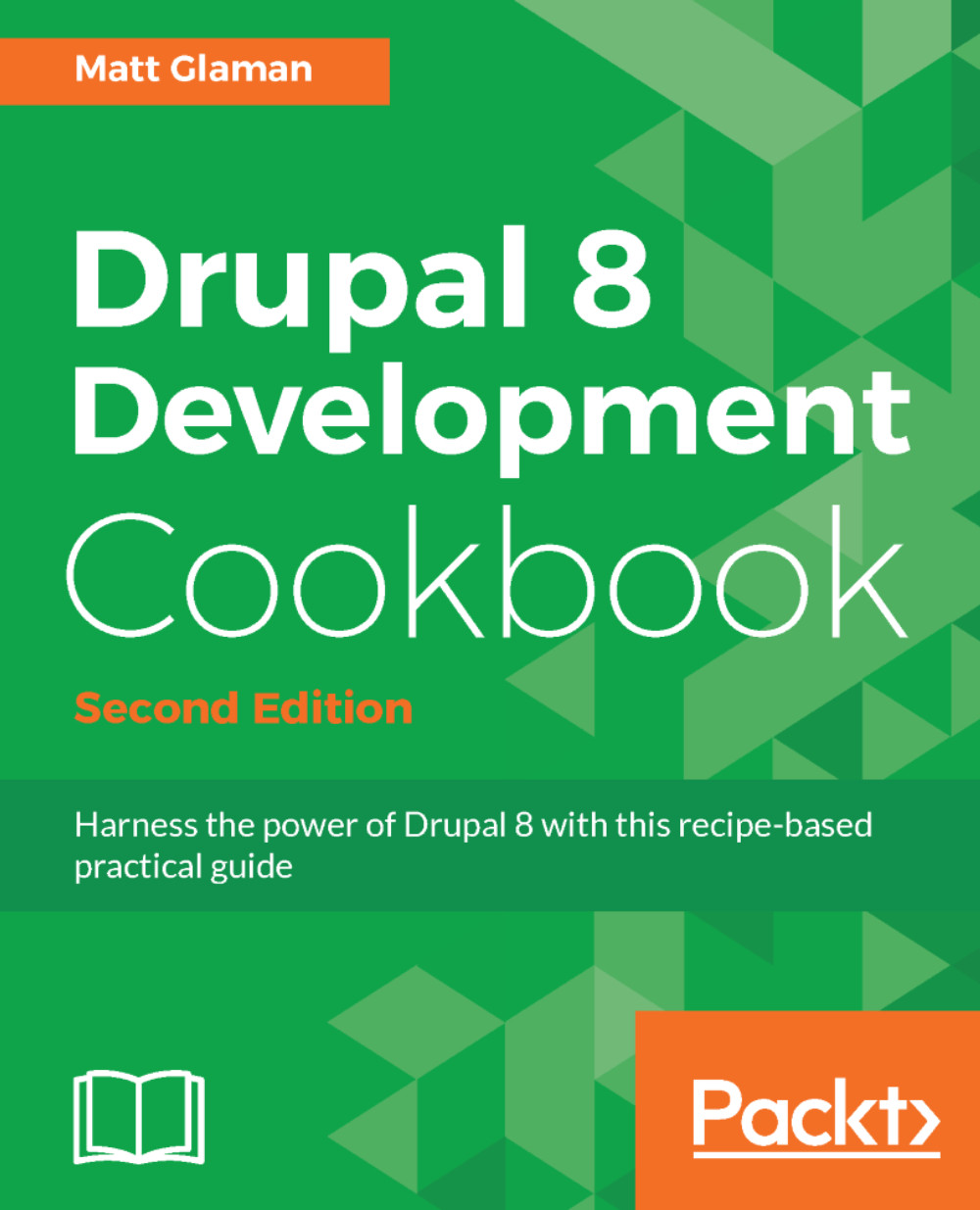
Drupal 8 Development Cookbook

Drupal 8 Development Cookbook - Second Edition

By : Matt Glaman
4.7 (3)
close
close
Drupal 8 Development Cookbook

Drupal 8 Development Cookbook

4.7 (3)
By: Matt Glaman

Overview of this book

Began as a message board, Drupal today is open source software maintained and developed by a community of over 1,000,000 users and developers. Drupal is used by numerous local businesses to global corporations and diverse organizations all across the globe. With Drupal 8’s exciting features it brings, this book will be your go-to guide to experimenting with all of these features through helpful recipes. We’ll start by showing you how to customize and configure the Drupal environment as per your requirements, as well as how to install third-party libraries and then use them in the Drupal environment. Then we will move on to creating blocks and custom modules with the help of libraries. We will show you how to use the latest mobile-first feature of Drupal 8, which will help you make your apps responsive across all the major platforms. This book will also show you how to incorporate multilingual facilities in your sites, use web services and third-party plugins with your applications from inside Drupal 8, and test and deploy your apps.
Table of Contents (14 chapters)
close
close

Creating a configuration entity type

In this recipe, we will create a configuration entity type called Announcement. This will provide a configuration entity that allows you to create, edit, and delete messages that can be displayed on the site for important announcements.

Configuration entities do not interact with Drupal’s Field API and do not have a user interface to add fields. They have properties defined on their class like models in other frameworks. However, configuration entities do not have dedicated tables in the database. They are stored in the config table as serialized data. The purpose of a configuration entity is for configuration. Examples of configuration entities are view displays, form displays, and contact forms.

How to do it…

  1. First, we need to create the src/Entity directory in the module’s directory. This will translate to the \Drupal\mymodule\Entity namespace and allow for entity type discovery:
    mkdir -p src/Entity
  2. Create...
Visually different images
CONTINUE READING
83
Tech Concepts
36
Programming languages
73
Tech Tools
Icon Unlimited access to the largest independent learning library in tech of over 8,000 expert-authored tech books and videos.
Icon Innovative learning tools, including AI book assistants, code context explainers, and text-to-speech.
Icon 50+ new titles added per month and exclusive early access to books as they are being written.
Drupal 8 Development Cookbook
notes
bookmark Notes and Bookmarks search Search in title playlist Add to playlist download Download options font-size Font size

Change the font size

margin-width Margin width

Change margin width

day-mode Day/Sepia/Night Modes

Change background colour

Close icon Search
Country selected

Close icon Your notes and bookmarks

Confirmation

Modal Close icon
claim successful

Buy this book with your credits?

Modal Close icon
Are you sure you want to buy this book with one of your credits?
Close
YES, BUY

Submit Your Feedback

Modal Close icon
Modal Close icon
Modal Close icon