Sign In Start Free Trial
Account

Add to playlist

Create a Playlist

Modal Close icon
You need to login to use this feature.
  • Book Overview & Buying WordPress Plugin Development Cookbook
  • Table Of Contents Toc
  • Feedback & Rating feedback
WordPress Plugin Development Cookbook

WordPress Plugin Development Cookbook - Second Edition

By : Yannick Lefebvre
4.4 (12)
close
close
WordPress Plugin Development Cookbook

WordPress Plugin Development Cookbook

4.4 (12)
By: Yannick Lefebvre

Overview of this book

WordPress is a popular, powerful, and open Content Management System. Learning how to extend its capabilities allows you to unleash its full potential, whether you're an administrator trying to find the right extension, a developer with a great idea to enhance the platform for the community, or a website developer working to fulfill a client's needs. This book shows readers how to navigate WordPress' vast set of API functions to create high-quality plugins with easy-to-configure administration interfaces. With new recipes and materials updated for the latest versions of WordPress 4.x, this second edition teaches you how to create plugins of varying complexity ranging from a few lines of code to complex extensions that provide intricate new capabilities. You'll start by using the basic mechanisms provided in WordPress to create plugins and execute custom user code. You will then see how to design administration panels, enhance the post editor with custom fields, store custom data, and modify site behavior based on the value of custom fields. You'll safely incorporate dynamic elements on web pages using scripting languages, and build new widgets that users will be able to add to WordPress sidebars and widget areas. By the end of this book, you will be able to create WordPress plugins to perform any task you can imagine.
Table of Contents (13 chapters)
close
close

Creating a new enclosing shortcode

A different type of shortcode that exists in WordPress is one that encloses content in posts and pages. Using a syntax similar to HTML tags, enclosing shortcodes can be used to identify parts of an item's content that need to be treated in a special way. For example, it is possible to use this type of shortcode to style a part of the post.

As an example of how to create enclosing shortcodes, this recipe shows you how to create a set of tags that will identify part of a post or page that should only be shown to visitors that are logged in to a site. In this way, the shortcode acts similarly to a filter hook, with the added bonus that you do not need to parse for instances of these tags in your code, as would normally be done in a filter callback.

How to do it...

Follow these steps to create a new enclosing shortcode to identify private parts of website content:

  1. Navigate to the WordPress plugins directory of your development installation.
  2. Create a new directory called ch2-private-item-text.
  3. Navigate to this directory and create a new text file called ch2-private-item-text.php.
  4. Open the new file in a code editor and add an appropriate header at the top of the plugin file, naming the plugin Chapter 2 - Private Item Text.
  5. Add the following line of code to declare a new shortcode and specify the name of the function that should be called when the shortcode is found in posts or pages:
    add_shortcode( 'private', 
                   'ch2pit_private_shortcode' );
  6. Add the following code section to provide an implementation for the ch2pit_private_shortcode function:
    function ch2pit_private_shortcode( $atts, 
                                       $content = null ) {
        if ( is_user_logged_in() ) {
            return '<div class="private">' . $content .
                '</div>';
        } else {
            $output = '<div class="register">';
            $output .= 'You need to become a member to ';
            $output .= 'access this content.</div>';
            return $output;
        }
    }
  7. Save and close the plugin file.
  8. Log in to the administration page of your development WordPress installation.
  9. Click on Plugins in the left-hand navigation menu.
  10. Activate your new plugin.
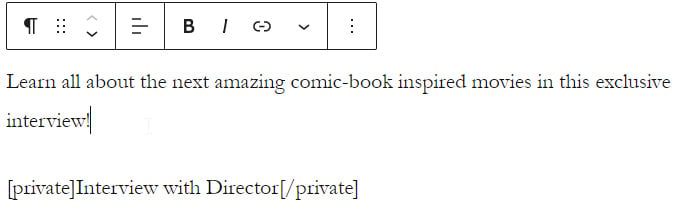
  11. Create a new post and wrap some of the content with the [private] and [/private] tags:
Figure 2.12 – Using the private enclosing shortcode

Figure 2.12 – Using the private enclosing shortcode

  1. Save and view the post to see that the text is visible while you are logged in to your site.
  2. Open an incognito browser view and visit the page to see that the enclosed text has been replaced by a general message.

How it works...

Similar to a filter function, enclosing shortcodes receive a copy of the text that has been wrapped with new tags through the $content parameter. It is then possible to return this text with additional HTML code, or completely replace it with new content. In this specific case, we used the is_user_logged_in WordPress function to determine whether the current visitor is logged in to the site. Based on the result of that query, the code determines whether the original content should be displayed with some additional div tags, or whether the visitor should see a message encouraging them to join the website to see this content.

See also

  • The Creating a new simple shortcode recipe
Visually different images
CONTINUE READING
83
Tech Concepts
36
Programming languages
73
Tech Tools
Icon Unlimited access to the largest independent learning library in tech of over 8,000 expert-authored tech books and videos.
Icon Innovative learning tools, including AI book assistants, code context explainers, and text-to-speech.
Icon 50+ new titles added per month and exclusive early access to books as they are being written.
WordPress Plugin Development Cookbook
notes
bookmark Notes and Bookmarks search Search in title playlist Add to playlist download Download options font-size Font size

Change the font size

margin-width Margin width

Change margin width

day-mode Day/Sepia/Night Modes

Change background colour

Close icon Search
Country selected

Close icon Your notes and bookmarks

Confirmation

Modal Close icon
claim successful

Buy this book with your credits?

Modal Close icon
Are you sure you want to buy this book with one of your credits?
Close
YES, BUY

Submit Your Feedback

Modal Close icon
Modal Close icon
Modal Close icon