Sign In Start Free Trial
Account

Add to playlist

Create a Playlist

Modal Close icon
You need to login to use this feature.
  • Book Overview & Buying Selenium Framework Design in Data-Driven Testing
  • Table Of Contents Toc
Selenium Framework Design in Data-Driven Testing

Selenium Framework Design in Data-Driven Testing

By : Carl Cocchiaro
4.4 (13)
close
close
Selenium Framework Design in Data-Driven Testing

Selenium Framework Design in Data-Driven Testing

4.4 (13)
By: Carl Cocchiaro

Overview of this book

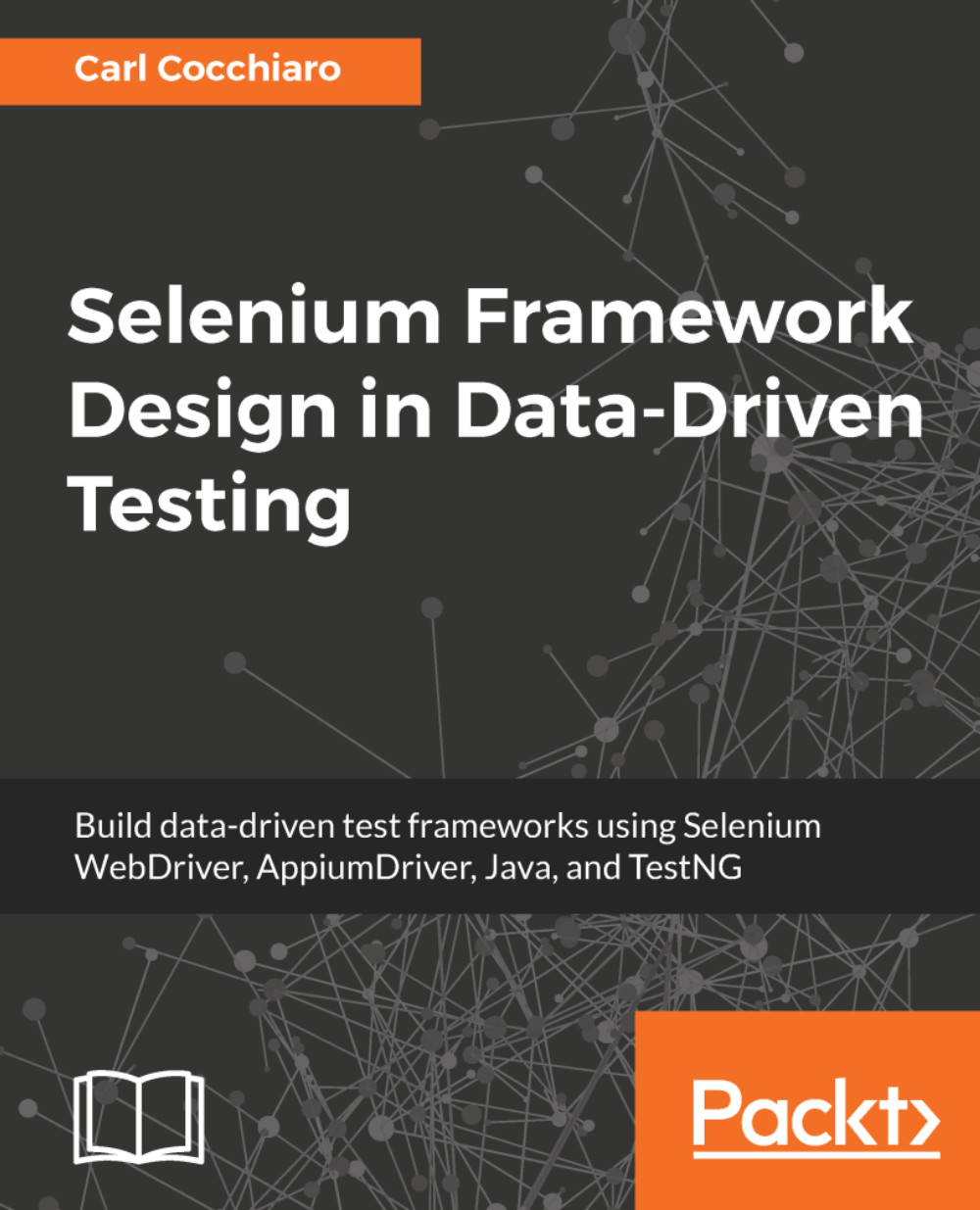
The Selenium WebDriver 3.x Technology is an open source API available to test both Browser and Mobile applications. It is completely platform independent in that tests built for one browser or mobile device, will also work on all other browsers and mobile devices. Selenium supports all major development languages which allow it to be tied directly into the technology used to develop the applications. This guide will provide a step-by-step approach to designing and building a data-driven test framework using Selenium WebDriver, Java, and TestNG. The book starts off by introducing users to the Selenium Page Object Design Patterns and D.R.Y Approaches to Software Development. In doing so, it covers designing and building a Selenium WebDriver framework that supports both Browser and Mobile Devices. It will lead the user through a journey of architecting their own framework with a scalable driver class, Java utility classes, JSON Data Provider, Data-Driven Test Classes, and support for third party tools and plugins. Users will learn how to design and build a Selenium Grid from scratch to allow the framework to scale and support different browsers, mobile devices, versions, and platforms, and how they can leverage third party grids in the Cloud like SauceLabs. Other topics covered include designing abstract base and sub-classes, inheritance, dual-driver support, parallel testing, testing multi-branded applications, best practices for using locators, and data encapsulation. Finally, you will be presented with a sample fully-functional framework to get them up and running with the Selenium WebDriver for browser testing. By the end of the book, you will be able to design your own automation testing framework and perform data-driven testing with Selenium WebDriver.
Table of Contents (11 chapters)
close
close

Introduction

In this chapter, users will be introduced to data-driven testing, the Selenium Page Object Model, and Don't Repeat Yourself (DRY) approaches to testing, all of which work hand-in-hand with each other, and are required for scalable frameworks. Let's briefly discuss each.

Data-driven testing

The premise of data-driven testing is that test methods and test data are separated to allow the adding of new test permutations without changing the test methods, to reduce the amount of code, reduce the amount of maintenance required for testing, and to store common libraries in a central location—those being the page object classes. Data is encapsulated in a central location such as a database, JSON, or CSV file, property file, or an Excel spreadsheet, to name a few. Test methods then allow dynamic data to be passed into them on the fly using parameters and data providers of choice. The test methods themselves become "templates" for positive, negative, boundary, and/or limit testing, extending coverage of the suite of tests with limited code additions.

TestNG data-driven testing tip:

http://testng.org/doc/documentation-main.html

Selenium Page Object Model

The Selenium Page Object Model is based on the programming concepts that a page object class should include all aspects of the page under test, such as the elements on the page, the methods for interacting with those elements, variables, and properties associated with the class. Following that concept, there is no data stored in the page object class. The test classes themselves call methods on the page object instances they are testing, but have no knowledge of the granular elements in the class. Finally, the actual test data is encapsulated outside the test class in a central location. In other words, there is an abstract layer created between the tests and the actual page object classes. This reduces the amount of code being written and allows them to be reused in various testing scenarios, thus following the DRY approaches to programming. From a maintenance point of view, changes to methods and locators are made in limited, central places, reducing the amount of time required to maintain ever-changing applications.

DRY 

DRY approaches to creating page object and test classes simply mean promoting the use of common classes, locators, methods, and inheritance to eliminate and avoid repeating the same actions over and over in multiple places. Instead, abstract base classes are created, containing all common objects and methods, and used as libraries to be called using parameters, which vary based on the data that is passed into them from the test classes. All subclasses derived from these base classes inherit all the common code, objects, locators, and methods, and enforce all of the abstract methods required by the base class. In essence, this approach avoids common copy and paste actions that result in duplicate code in multiple places.

As per Wikipedia (https://en.wikipedia.org/wiki/Data-driven_testing):

"Data-driven testing (DDT) is a term used in the testing of computer software to describe testing done using a table of conditions directly, as test inputs and verifiable outputs as well as the process where test environment settings and control are not hardcoded. In the simplest form the tester supplies the inputs from a row in the table and expects the outputs which occur in the same row. The table typically contains values which correspond to boundary or partition input spaces. In the control methodology, test configuration is "read" from a database."

What you will learn

Users will learn how to design and build the Java singleton class required to control the Selenium driver of choice for the Application Under Test (AUT).

CONTINUE READING
83
Tech Concepts
36
Programming languages
73
Tech Tools
Icon Unlimited access to the largest independent learning library in tech of over 8,000 expert-authored tech books and videos.
Icon Innovative learning tools, including AI book assistants, code context explainers, and text-to-speech.
Icon 50+ new titles added per month and exclusive early access to books as they are being written.
Selenium Framework Design in Data-Driven Testing
notes
bookmark Notes and Bookmarks search Search in title playlist Add to playlist download Download options font-size Font size

Change the font size

margin-width Margin width

Change margin width

day-mode Day/Sepia/Night Modes

Change background colour

Close icon Search
Country selected

Close icon Your notes and bookmarks

Confirmation

Modal Close icon
claim successful

Buy this book with your credits?

Modal Close icon
Are you sure you want to buy this book with one of your credits?
Close
YES, BUY

Submit Your Feedback

Modal Close icon
Modal Close icon
Modal Close icon