Sign In Start Free Trial
Account

Add to playlist

Create a Playlist

Modal Close icon
You need to login to use this feature.
  • Book Overview & Buying Node.js Web Development
  • Table Of Contents Toc
  • Feedback & Rating feedback
Node.js Web Development

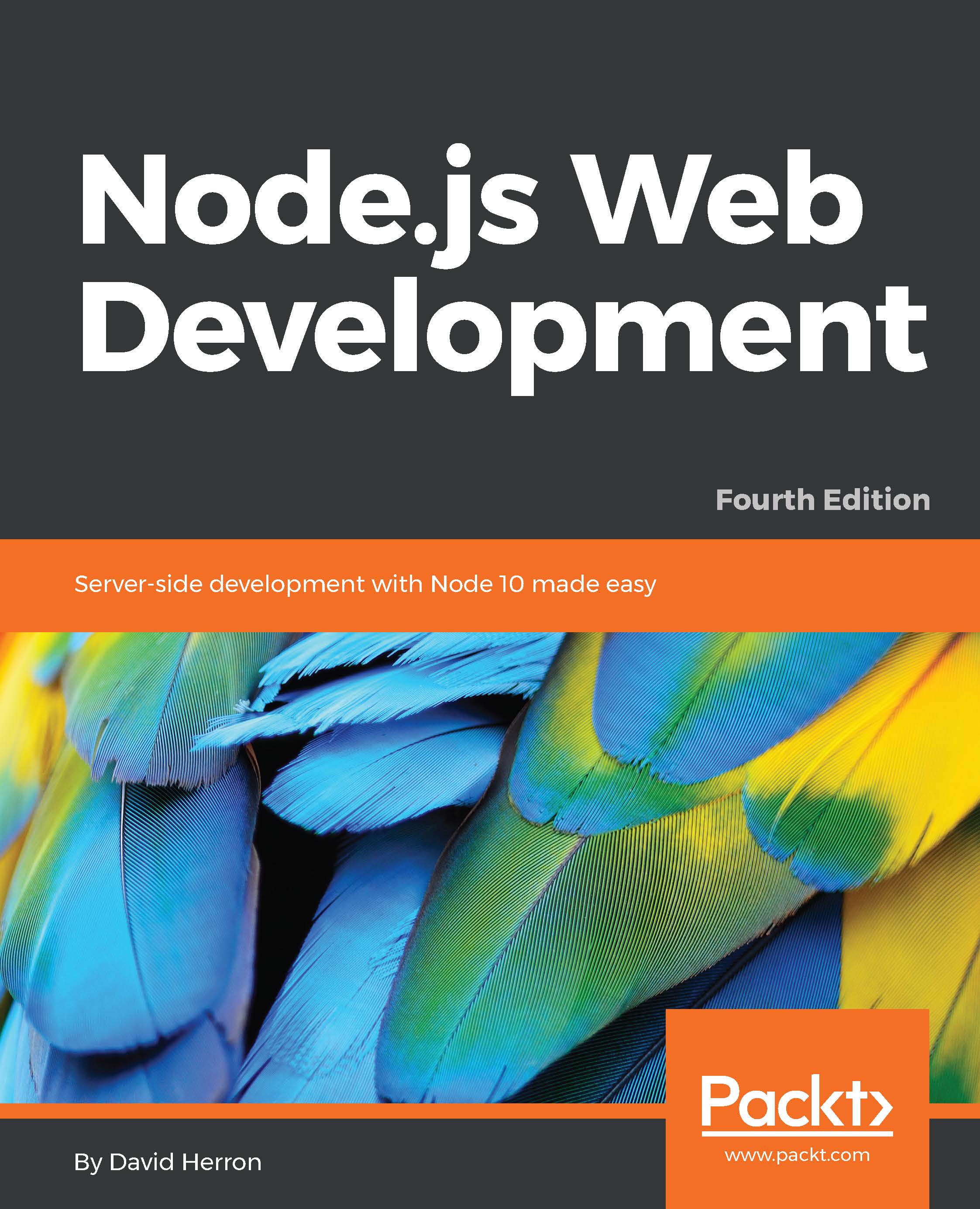
Node.js Web Development - Fourth Edition

By : David Herron
3.8 (9)
close
close
Node.js Web Development

Node.js Web Development

3.8 (9)
By: David Herron

Overview of this book

Node.js is a server-side JavaScript platform using an event-driven, non-blocking I/O model allowing users to build fast and scalable data-intensive applications running in real time. This book gives you an excellent starting point, bringing you straight to the heart of developing web applications with Node.js. You will progress from a rudimentary knowledge of JavaScript and server-side development to being able to create, maintain, deploy and test your own Node.js application.You will understand the importance of transitioning to functions that return Promise objects, and the difference between fs, fs/promises and fs-extra. With this book you'll learn how to use the HTTP Server and Client objects, data storage with both SQL and MongoDB databases, real-time applications with Socket.IO, mobile-first theming with Bootstrap, microservice deployment with Docker, authenticating against third-party services using OAuth, and use some well known tools to beef up security of Express 4.16 applications.
Table of Contents (14 chapters)
close
close

HTTP server applications


The HTTP server object is the foundation of all Node.js web applications. The object itself is very close to the HTTP protocol, and its use requires knowledge of that protocol. In most cases, you'll be able to use an application framework such as Express that hides the HTTP protocol details, allowing the programmer to focus on business logic.

We already saw a simple HTTP server application in Chapter 2, Setting up Node.js, which is as follows:

const http = require('http'); 
http.createServer((req, res) => { 
  res.writeHead(200, {'Content-Type': 'text/plain'}); 
  res.end('Hello, World!\n'); 
}).listen(8124, '127.0.0.1'); 
console.log('Server running at http://127.0.0.1:8124'); 

The http.createServer function creates an http.Server object. Because it is an EventEmitter, this can be written in another way to make that fact explicit:

const http = require('http'); 
const server = http.createServer(); 
server.on('request',  (req, res) => { 
  res.writeHead(200, {'Content...
Visually different images
CONTINUE READING
83
Tech Concepts
36
Programming languages
73
Tech Tools
Icon Unlimited access to the largest independent learning library in tech of over 8,000 expert-authored tech books and videos.
Icon Innovative learning tools, including AI book assistants, code context explainers, and text-to-speech.
Icon 50+ new titles added per month and exclusive early access to books as they are being written.
Node.js Web Development
notes
bookmark Notes and Bookmarks search Search in title playlist Add to playlist download Download options font-size Font size

Change the font size

margin-width Margin width

Change margin width

day-mode Day/Sepia/Night Modes

Change background colour

Close icon Search
Country selected

Close icon Your notes and bookmarks

Confirmation

Modal Close icon
claim successful

Buy this book with your credits?

Modal Close icon
Are you sure you want to buy this book with one of your credits?
Close
YES, BUY

Submit Your Feedback

Modal Close icon
Modal Close icon
Modal Close icon