
Sign In Start Free Trial
Account

Add to playlist

Create a Playlist

Modal Close icon
You need to login to use this feature.
  • Book Overview & Buying TypeScript Microservices
  • Table Of Contents Toc
TypeScript Microservices

TypeScript Microservices

By : Parth Ghiya
3 (7)
close
close
TypeScript Microservices

TypeScript Microservices

3 (7)
By: Parth Ghiya

Overview of this book

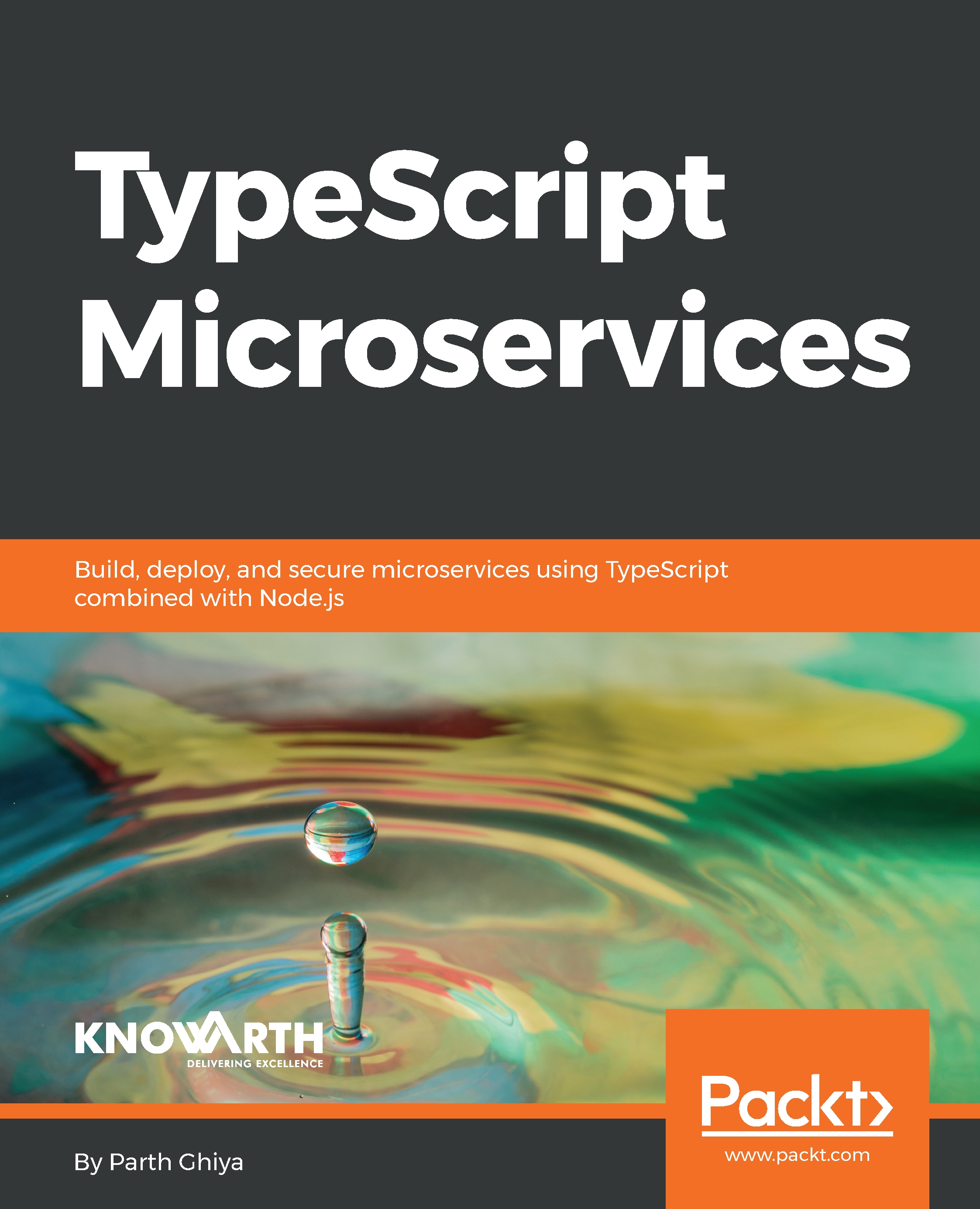
In the last few years or so, microservices have achieved the rock star status and right now are one of the most tangible solutions in enterprises to make quick, effective, and scalable applications. The apparent rise of Typescript and long evolution from ES5 to ES6 has seen lots of big companies move to ES6 stack. If you want to learn how to leverage the power of microservices to build robust architecture using reactive programming and Typescript in Node.js, then this book is for you. Typescript Microservices is an end-to-end guide that shows you the implementation of microservices from scratch; right from starting the project to hardening and securing your services. We will begin with a brief introduction to microservices before learning to break your monolith applications into microservices. From here, you will learn reactive programming patterns and how to build APIs for microservices. The next set of topics will take you through the microservice architecture with TypeScript and communication between services. Further, you will learn to test and deploy your TypeScript microservices using the latest tools and implement continuous integration. Finally, you will learn to secure and harden your microservice. By the end of the book, you will be able to build production-ready, scalable, and maintainable microservices using Node.js and Typescript.
Table of Contents (12 chapters)
close
close

Introduction to reactive programming

If we want a view of reactive programming from 50,000 above ground level, it can briefly be termed as:

When input x in any function changes, output y automatically updates in the corresponding response without the need to manually invoke it. In short, the sole purpose is to continuously respond to external inputs whenever prompted by output worlds.

Reactive programming is achieved through utilities such as map, filter, reduce, subscribe, unsubscribe, streams. Reactive programming focuses more on events and message-driven patterns rather than manually fiddling with huge implementation details.

Let's take a practical day-to-day example to understand reactive programming. We all have used Excel since the beginning of our IT lives. Now, let's say you write one formula based on a cell value. Now, whenever the cell value is changed...

CONTINUE READING
83
Tech Concepts
36
Programming languages
73
Tech Tools
Icon Unlimited access to the largest independent learning library in tech of over 8,000 expert-authored tech books and videos.
Icon Innovative learning tools, including AI book assistants, code context explainers, and text-to-speech.
Icon 50+ new titles added per month and exclusive early access to books as they are being written.
TypeScript Microservices
notes
bookmark Notes and Bookmarks search Search in title playlist Add to playlist download Download options font-size Font size

Change the font size

margin-width Margin width

Change margin width

day-mode Day/Sepia/Night Modes

Change background colour

Close icon Search
Country selected

Close icon Your notes and bookmarks

Confirmation

Modal Close icon
claim successful

Buy this book with your credits?

Modal Close icon
Are you sure you want to buy this book with one of your credits?
Close
YES, BUY

Submit Your Feedback

Modal Close icon
Modal Close icon
Modal Close icon