
Sign In Start Free Trial
Account

Add to playlist

Create a Playlist

Modal Close icon
You need to login to use this feature.
  • Book Overview & Buying Mastering Flask Web Development
  • Table Of Contents Toc
Mastering Flask Web Development

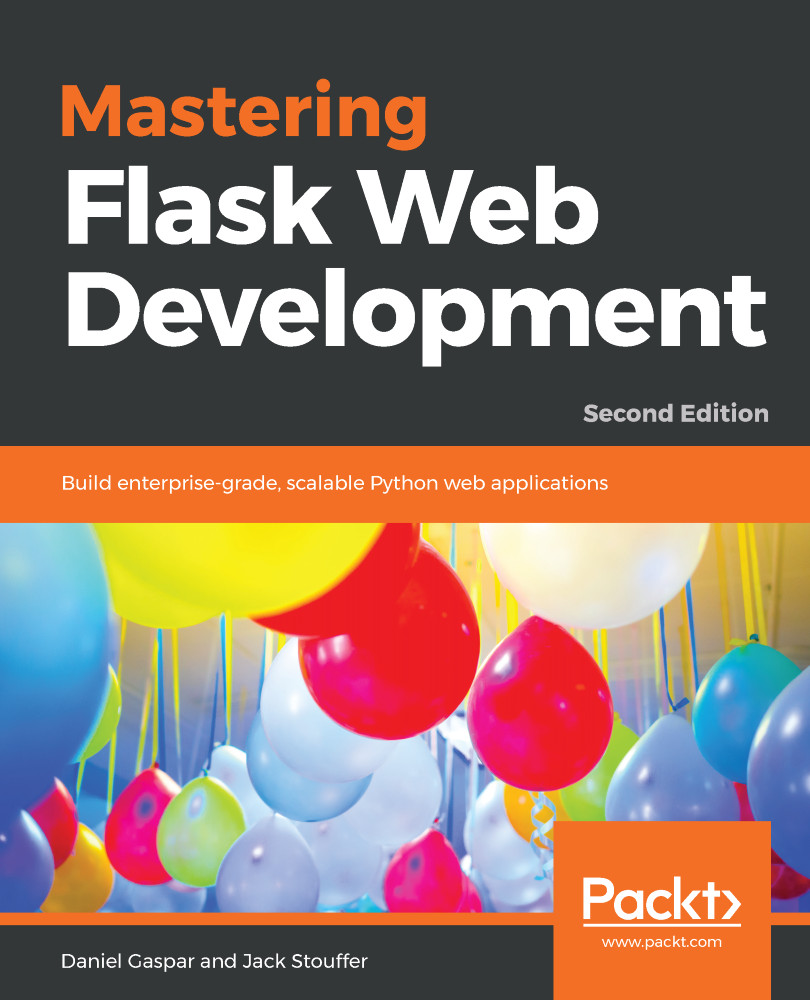
Mastering Flask Web Development - Second Edition

By : Gaspar, Jack Stouffer
2 (2)
close
close
Mastering Flask Web Development

Mastering Flask Web Development

2 (2)
By: Gaspar, Jack Stouffer

Overview of this book

Flask is a popular Python framework known for its lightweight and modular design. Mastering Flask Web Development will take you on a complete tour of the Flask environment and teach you how to build a production-ready application. You'll begin by learning about the installation of Flask and basic concepts such as MVC and accessing a database using an ORM. You will learn how to structure your application so that it can scale to any size with the help of Flask Blueprints. You'll then learn how to use Jinja2 templates with a high level of expertise. You will also learn how to develop with SQL or NoSQL databases, and how to develop REST APIs and JWT authentication. Next, you'll move on to build role-based access security and authentication using LDAP, OAuth, OpenID, and database. Also learn how to create asynchronous tasks that can scale to any load using Celery and RabbitMQ or Redis. You will also be introduced to a wide range of Flask extensions to leverage technologies such as cache, localization, and debugging. You will learn how to build your own Flask extensions, how to write tests, and how to get test coverage reports. Finally, you will learn how to deploy your application on Heroku and AWS using various technologies, such as Docker, CloudFormation, and Elastic Beanstalk, and will also learn how to develop Jenkins pipelines to build, test, and deploy applications.
Table of Contents (15 chapters)
close
close

MongoDB in Flask

MongoDB is far and away the most popular NoSQL database. MongoDB is also the best-supported NoSQL database for Flask and Python in general. Therefore, our examples will focus on MongoDB.

MongoDB is a document storage NoSQL database. Documents are stored in collections, which allow the grouping of similar documents, but no similarities between documents are necessary to store a document in a collection. Documents are defined in a JSON superset named BSON (short for Binary JSON). BSON allows JSON to be stored in binary format rather than in string format, saving a lot of space. BSON also distinguishes between several different ways of storing numbers, such as 32-bit integers and doubles.

To understand the basics of MongoDB, we will use Flask-MongoEngine to cover the same functionality of Flask-SQLAlchemy in the previous chapters. Remember that these are just examples...

CONTINUE READING
83
Tech Concepts
36
Programming languages
73
Tech Tools
Icon Unlimited access to the largest independent learning library in tech of over 8,000 expert-authored tech books and videos.
Icon Innovative learning tools, including AI book assistants, code context explainers, and text-to-speech.
Icon 50+ new titles added per month and exclusive early access to books as they are being written.
Mastering Flask Web Development
notes
bookmark Notes and Bookmarks search Search in title playlist Add to playlist download Download options font-size Font size

Change the font size

margin-width Margin width

Change margin width

day-mode Day/Sepia/Night Modes

Change background colour

Close icon Search
Country selected

Close icon Your notes and bookmarks

Confirmation

Modal Close icon
claim successful

Buy this book with your credits?

Modal Close icon
Are you sure you want to buy this book with one of your credits?
Close
YES, BUY

Submit Your Feedback

Modal Close icon
Modal Close icon
Modal Close icon