
Sign In Start Free Trial
Account

Add to playlist

Create a Playlist

Modal Close icon
You need to login to use this feature.
  • Book Overview & Buying Hands-On Microservices ??? Monitoring and Testing
  • Table Of Contents Toc
  • Feedback & Rating feedback
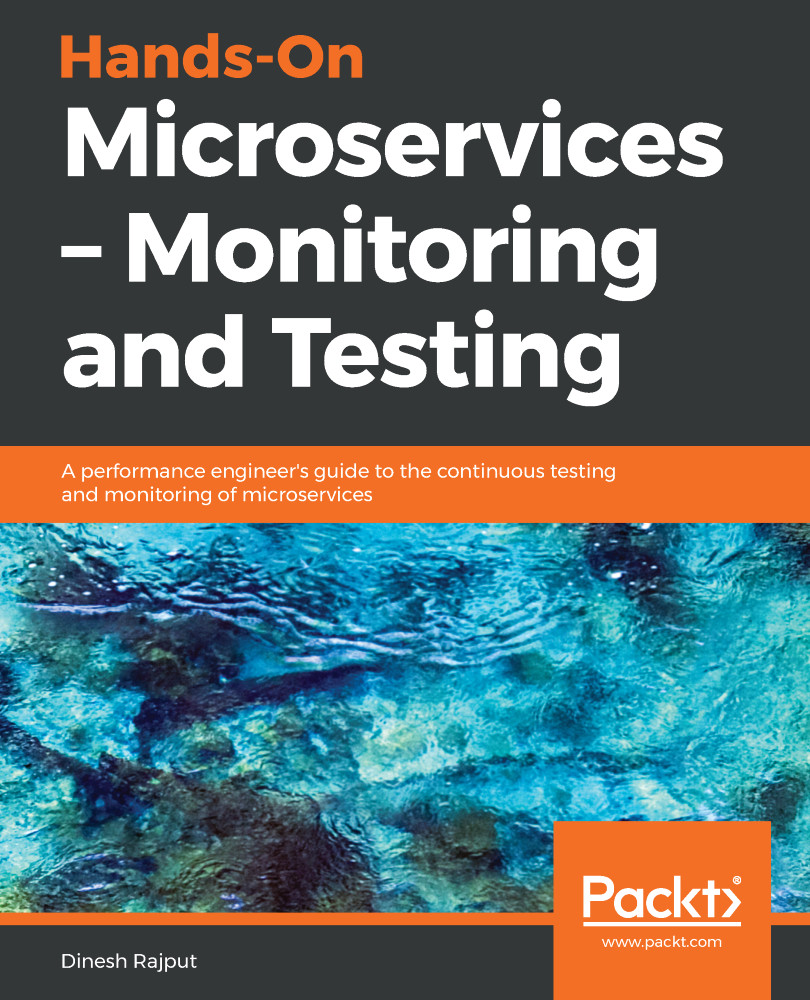
Hands-On Microservices ??? Monitoring and Testing

Hands-On Microservices ??? Monitoring and Testing

By : Rajput
2.7 (6)
close
close
Hands-On Microservices ??? Monitoring and Testing

Hands-On Microservices ??? Monitoring and Testing

2.7 (6)
By: Rajput

Overview of this book

Microservices are the latest "right" way of developing web applications. Microservices architecture has been gaining momentum over the past few years, but once you've started down the microservices path, you need to test and optimize the services. This book focuses on exploring various testing, monitoring, and optimization techniques for microservices. The book starts with the evolution of software architecture style, from monolithic to virtualized, to microservices architecture. Then you will explore methods to deploy microservices and various implementation patterns. With the help of a real-world example, you will understand how external APIs help product developers to focus on core competencies. After that, you will learn testing techniques, such as Unit Testing, Integration Testing, Functional Testing, and Load Testing. Next, you will explore performance testing tools, such as JMeter, and Gatling. Then, we deep dive into monitoring techniques and learn performance benchmarking of the various architectural components. For this, you will explore monitoring tools such as Appdynamics, Dynatrace, AWS CloudWatch, and Nagios. Finally, you will learn to identify, address, and report various performance issues related to microservices.
Table of Contents (11 chapters)
close
close

Microservices deployment

In Chapter 2, Anatomy of Microservice Decomposition Services, we created a distributed application based on the microservice architecture and architected the application as a set of services. We can now deploy each service as a set of service instances to improve throughput and availability. The microservice architecture makes the service deployable and scalable, meaning all service instances are isolated from each other.

The microservice architecture allows us to build and deploy a service quickly. It also allows us to limit the number of resources used, including CPU, memory, and I/O resources. A microservice application has tens of hundreds of services. You can independently increase or decrease resources of a deployment machine based on the usage of a service. Microservices also allow you to write a service in any language and framework, so you can...

Visually different images
CONTINUE READING
83
Tech Concepts
36
Programming languages
73
Tech Tools
Icon Unlimited access to the largest independent learning library in tech of over 8,000 expert-authored tech books and videos.
Icon Innovative learning tools, including AI book assistants, code context explainers, and text-to-speech.
Icon 50+ new titles added per month and exclusive early access to books as they are being written.
Hands-On Microservices ??? Monitoring and Testing
notes
bookmark Notes and Bookmarks search Search in title playlist Add to playlist download Download options font-size Font size

Change the font size

margin-width Margin width

Change margin width

day-mode Day/Sepia/Night Modes

Change background colour

Close icon Search
Country selected

Close icon Your notes and bookmarks

Confirmation

Modal Close icon
claim successful

Buy this book with your credits?

Modal Close icon
Are you sure you want to buy this book with one of your credits?
Close
YES, BUY

Submit Your Feedback

Modal Close icon
Modal Close icon
Modal Close icon