
Sign In Start Free Trial
Account

Add to playlist

Create a Playlist

Modal Close icon
You need to login to use this feature.
  • Book Overview & Buying Hands-On Swift 5 Microservices Development
  • Table Of Contents Toc
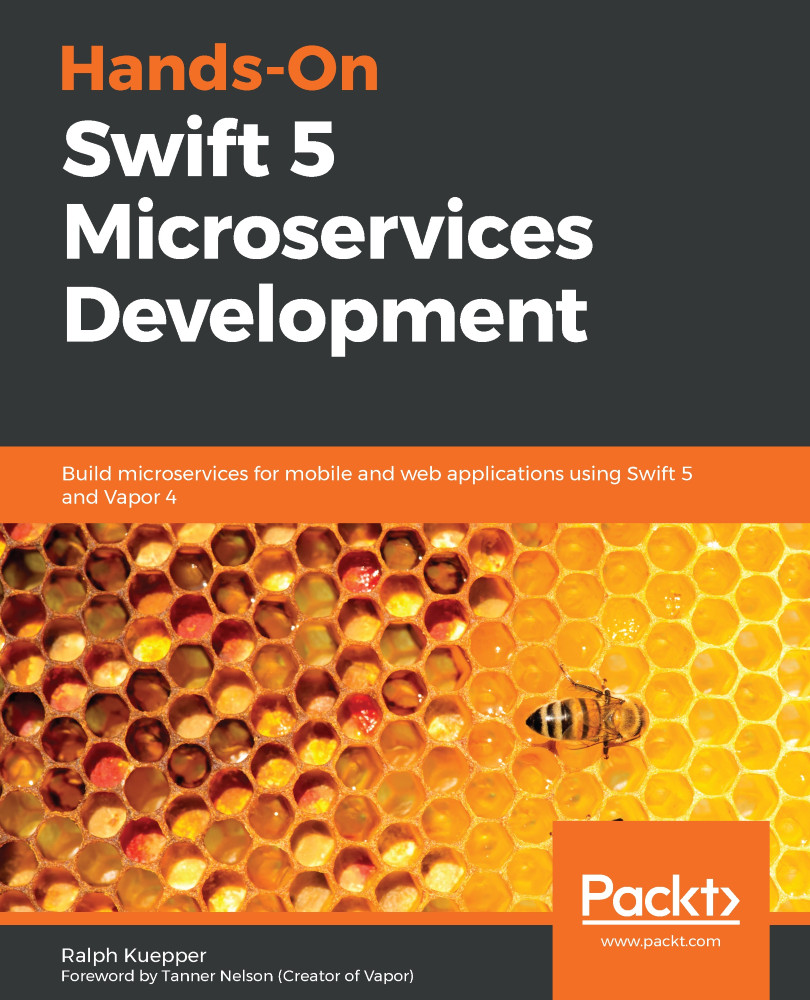
Hands-On Swift 5 Microservices Development

Hands-On Swift 5 Microservices Development

By : Ralph Kuepper
3 (6)
close
close
Hands-On Swift 5 Microservices Development

Hands-On Swift 5 Microservices Development

3 (6)
By: Ralph Kuepper

Overview of this book

The capabilities of the Swift programming language are extended to server-side development using popular frameworks such as Vapor. This enables Swift programmers to implement the microservices approach to design scalable and easy-to-maintain architecture for iOS, macOS, iPadOS, and watchOS applications. This book is a complete guide to building microservices for iOS applications. You’ll start by examining Swift and Vapor as backend technologies and compare them to their alternatives. The book then covers the concept of microservices to help you get started with developing your first microservice. Throughout this book, you’ll work on a case study of writing an e-commerce backend as a microservice application. You’ll understand each microservice as it is broken down into details and written out as code throughout the book. You’ll also become familiar with various aspects of server-side development such as scalability, database options, and information flow for microservices that are unwrapped in the process. As you advance, you’ll get to grips with microservices testing and see how it is different from testing a monolith application. Along the way, you’ll explore tools such as Docker, Postman, and Amazon Web Services. By the end of the book, you’ll be able to build a ready-to-deploy application that can be used as a base for future applications.
Table of Contents (19 chapters)
close
close

Scaling and monitoring using Google Cloud

Scaling in Google Cloud is conceptually similar to AWS. You have a load balancer, instances, and policies that can scale your instances up or down. Google Cloud also, just like AWS, offers more than only one way to manage services and autoscaling: Kubernetes can be directly managed within Google Cloud (just like in the AWS Elastic Kubernetes Service (EKS); see Chapter 14, Docker and the Cloud, for details).

Let's assume, though, that we have set up our app through App Engine like we did in Chapter 15, Deploying Microservices in the Cloud. In that case, autoscaling is already enabled by default! There is nothing more we need to do. Google is automatically checking the CPU, RAM, and other metrics, and scales up and down depending on your needs.

If, however, you have a more sophisticated setup, in which you have set up a few instances...

CONTINUE READING
83
Tech Concepts
36
Programming languages
73
Tech Tools
Icon Unlimited access to the largest independent learning library in tech of over 8,000 expert-authored tech books and videos.
Icon Innovative learning tools, including AI book assistants, code context explainers, and text-to-speech.
Icon 50+ new titles added per month and exclusive early access to books as they are being written.
Hands-On Swift 5 Microservices Development
notes
bookmark Notes and Bookmarks search Search in title playlist Add to playlist download Download options font-size Font size

Change the font size

margin-width Margin width

Change margin width

day-mode Day/Sepia/Night Modes

Change background colour

Close icon Search
Country selected

Close icon Your notes and bookmarks

Confirmation

Modal Close icon
claim successful

Buy this book with your credits?

Modal Close icon
Are you sure you want to buy this book with one of your credits?
Close
YES, BUY

Submit Your Feedback

Modal Close icon
Modal Close icon
Modal Close icon