
Sign In Start Free Trial
Account

Add to playlist

Create a Playlist

Modal Close icon
You need to login to use this feature.
  • Book Overview & Buying Drupal 8 Module Development
  • Table Of Contents Toc
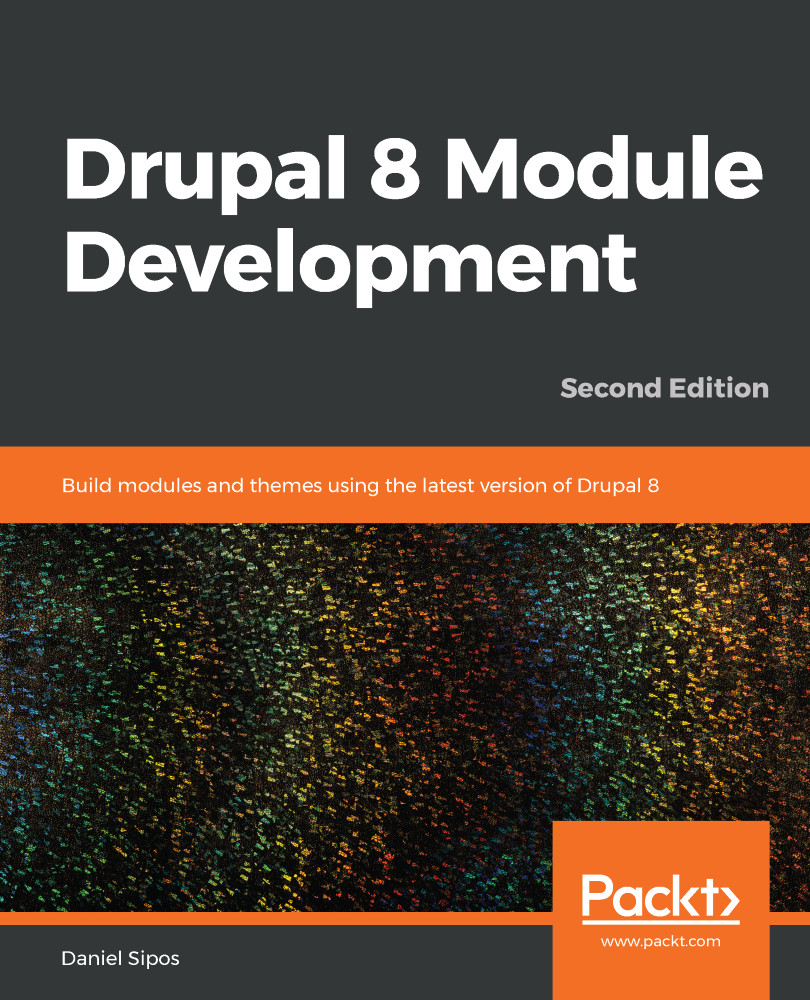
Drupal 8 Module Development

Drupal 8 Module Development - Second Edition

By : Daniel Sipos
4.3 (8)
close
close
Drupal 8 Module Development

Drupal 8 Module Development

4.3 (8)
By: Daniel Sipos

Overview of this book

Drupal 8 comes with a release cycle that allows for new functionality to be added at a much faster pace. However, this also means code deprecations and changing architecture that you need to stay on top of. This book updates the first edition and includes the new functionality introduced in versions up to, and including 8.7. The book will first introduce you to the Drupal 8 architecture and its subsystems before diving into creating your first module with basic functionality. You will work with the Drupal logging and mailing systems, learn how to output data using the theme layer and work with menus and links programmatically. Then, you will learn how to work with different kinds of data storages, create custom entities, field types and leverage the Database API for lower level database queries. You will further see how to introduce JavaScript into your module, work with the various file systems and ensure the code you write works on multilingual sites. Finally, you will learn how to programmatically work with Views, write automated tests for your functionality and also write secure code in general. By the end, you will have learned how to develop your own custom module that can provide complex business solutions. And who knows, maybe you’ll even contribute it back to the Drupal community. Foreword by Dries Buytaert, founder of Drupal.
Table of Contents (20 chapters)
close
close

Summary

In this chapter, we covered the main aspects of caching in Drupal 8 any module developer needs to be familiar with. We introduced some key concepts and talked about the two main types of caching—Internal Page Cache (used for anonymous users) and Dynamic Page Cache (used for authenticated users).

We dug deeper into cacheability metadata, which is probably the most important and common thing we need to understand. It's imperative to use this properly so that all the render arrays we build are cached and invalidated correctly. We also saw how block plugins have specific methods we can use to define their cacheability metadata and how access results should also receive cacheability dependencies, as needed. Stemming from this, we also explored lazy builders and the auto-placeholdering strategies that allow us to handle highly dynamic components while maintaining...

CONTINUE READING
83
Tech Concepts
36
Programming languages
73
Tech Tools
Icon Unlimited access to the largest independent learning library in tech of over 8,000 expert-authored tech books and videos.
Icon Innovative learning tools, including AI book assistants, code context explainers, and text-to-speech.
Icon 50+ new titles added per month and exclusive early access to books as they are being written.
Drupal 8 Module Development
notes
bookmark Notes and Bookmarks search Search in title playlist Add to playlist download Download options font-size Font size

Change the font size

margin-width Margin width

Change margin width

day-mode Day/Sepia/Night Modes

Change background colour

Close icon Search
Country selected

Close icon Your notes and bookmarks

Confirmation

Modal Close icon
claim successful

Buy this book with your credits?

Modal Close icon
Are you sure you want to buy this book with one of your credits?
Close
YES, BUY

Submit Your Feedback

Modal Close icon
Modal Close icon
Modal Close icon