


-
Book Overview & Buying
-
Table Of Contents

Drupal 9 Module Development - Third Edition
By :


Drupal 9 Module Development
By:
Overview of this book
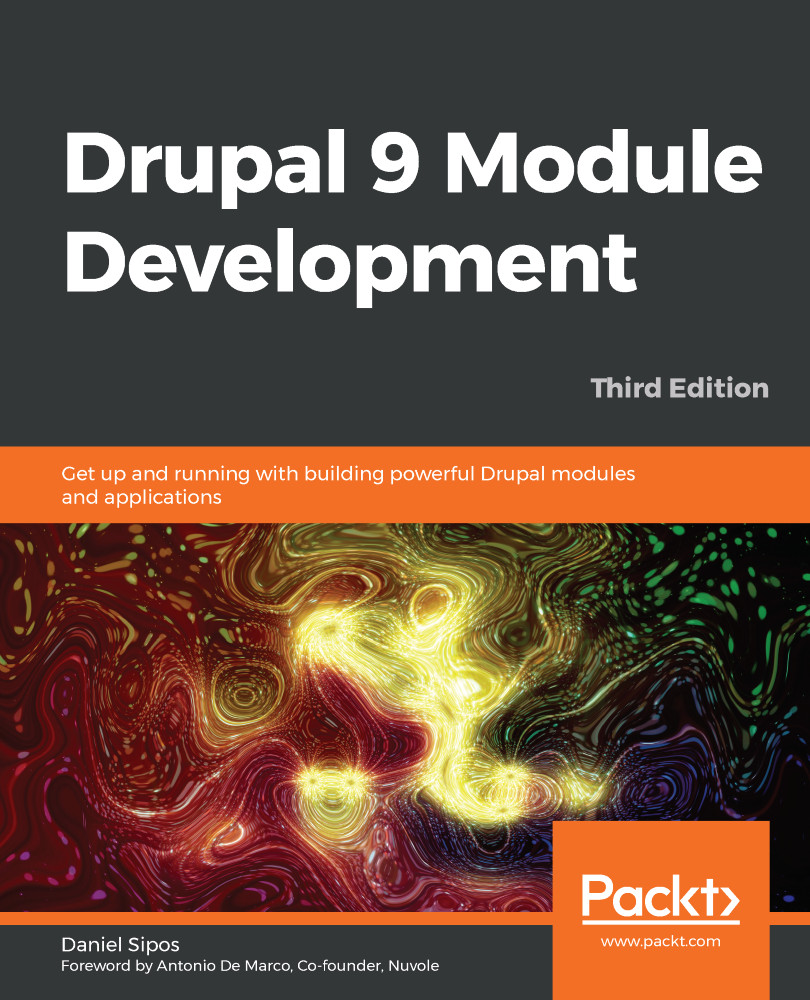
With its latest release, Drupal 9, the popular open source CMS platform has been updated with new functionalities for building complex Drupal apps with ease. This third edition of the Drupal Module Development guide covers these new Drupal features, helping you to stay on top of code deprecations and the changing architecture with every release.
The book starts by introducing you to the Drupal 9 architecture and its subsystems before showing you how to create your first module with basic functionality. You’ll explore the Drupal logging and mailing systems, learn how to output data using the theme layer, and work with menus and links programmatically. Once you’ve understood the different kinds of data storage, this Drupal guide will demonstrate how to create custom entities and field types and leverage the Database API for lower-level database queries. You’ll also learn how to introduce JavaScript into your module, work with various file systems, and ensure that your code works on multilingual sites. Finally, you’ll work with Views, create automated tests for your functionality, and write secure code.
By the end of the book, you’ll have learned how to develop custom modules that can provide solutions to complex business problems, and who knows, maybe you’ll even contribute to the Drupal community!
Table of Contents (20 chapters)
Preface


Chapter 1: Developing for Drupal 9
 Free Chapter
Chapter 2: Creating Your First Module
Chapter 3: Logging and Mailing
Chapter 4: Theming
Chapter 5: Menus and Menu Links
Chapter 6: Data Modeling and Storage
Chapter 7: Your Own Custom Entity and Plugin Types
Chapter 8: The Database API
Chapter 9: Custom Fields
Chapter 10: Access Control
Chapter 11: Caching
Chapter 12: JavaScript and the Ajax API
Chapter 13: Internationalization and Languages
Chapter 14: Batches, Queues, and Cron

Chapter 15: Views
Chapter 16: Working with Files and Images
Chapter 17: Automated Testing
Chapter 18: Drupal Security
Other Books You May Enjoy


