


-
Book Overview & Buying
-
Table Of Contents

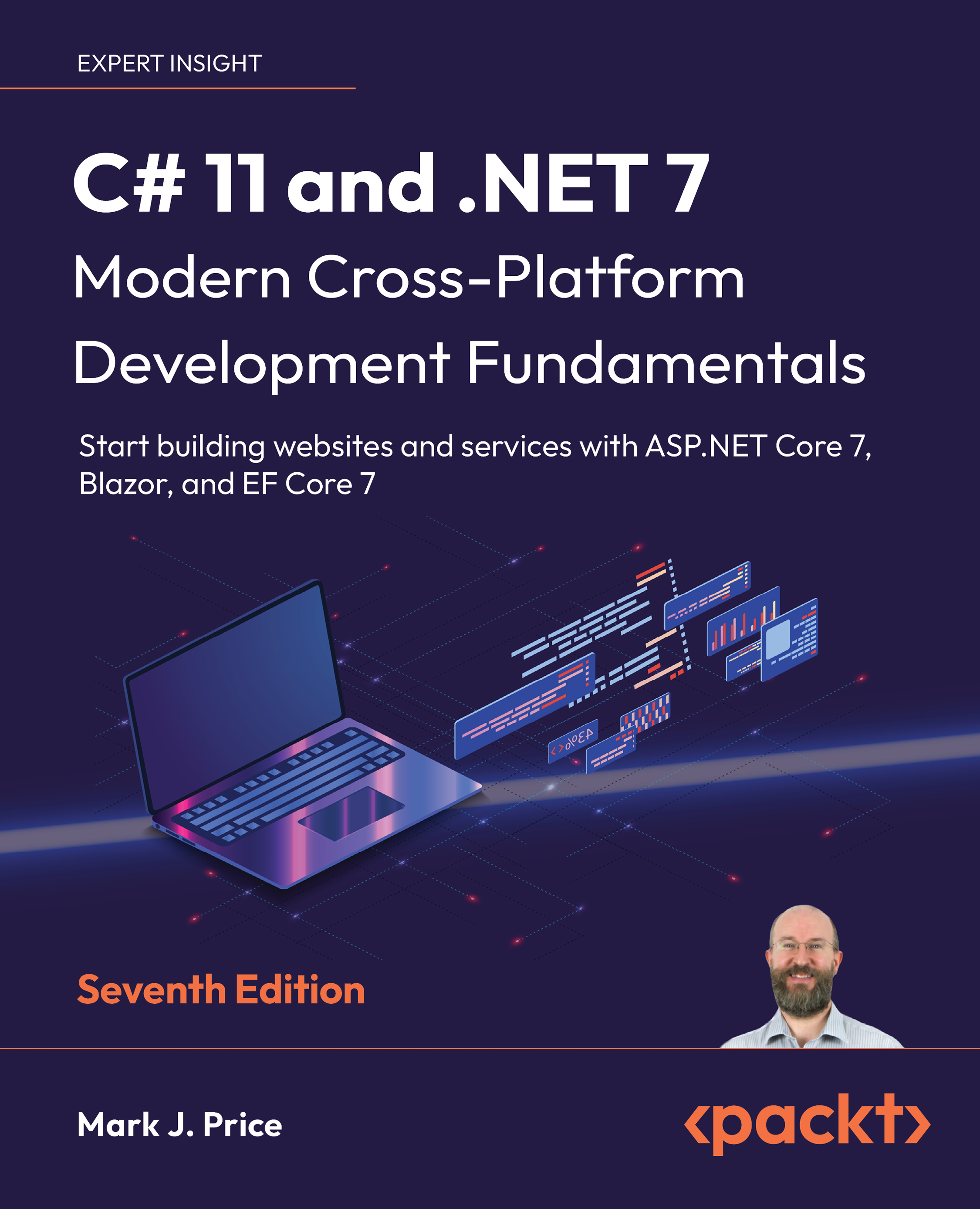
C# 11 and .NET 7 – Modern Cross-Platform Development Fundamentals - Seventh Edition
By :


C# 11 and .NET 7 – Modern Cross-Platform Development Fundamentals
By:
Overview of this book
Extensively revised to accommodate the latest features that come with C# 11 and .NET 7, this latest edition of our guide will get you coding in C# with confidence.
You’ll learn object-oriented programming, writing, testing, and debugging functions, implementing interfaces, and inheriting classes. Next, you’ll take on .NET APIs for performing tasks like managing and querying data, working with the filesystem, and serialization. As you progress, you’ll also explore examples of cross-platform projects you can build and deploy, such as websites and services using ASP.NET Core.
Instead of distracting you with unnecessary graphical user interface code, the first eleven chapters will teach you about C# language constructs and many of the .NET libraries through simple console applications. Having mastered the basics, you’ll then start building websites, web services, and browser apps.
By the end of this book, you’ll be able to create rich web experiences and have a solid grasp of object-oriented programming that you can build upon.
Table of Contents (19 chapters)
Preface


Hello, C#! Welcome, .NET!
 Free Chapter
Speaking C#
Controlling Flow, Converting Types, and Handling Exceptions
Writing, Debugging, and Testing Functions
Building Your Own Types with Object-Oriented Programming

Implementing Interfaces and Inheriting Classes
Packaging and Distributing .NET Types
Working with Common .NET Types
Working with Files, Streams, and Serialization
Working with Data Using Entity Framework Core
Querying and Manipulating Data Using LINQ
Introducing Web Development Using ASP.NET Core
Building Websites Using ASP.NET Core Razor Pages
Building Websites Using the Model-View-Controller Pattern
Building and Consuming Web Services
Building User Interfaces Using Blazor
Epilogue
Index


