Sign In Start Free Trial
Account

Add to playlist

Create a Playlist

Modal Close icon
You need to login to use this feature.
  • Book Overview & Buying C# 11 and .NET 7 – Modern Cross-Platform Development Fundamentals
  • Table Of Contents Toc
C# 11 and .NET 7 – Modern Cross-Platform Development Fundamentals

C# 11 and .NET 7 – Modern Cross-Platform Development Fundamentals - Seventh Edition

By : Mark J. Price
4.1 (54)
close
close
C# 11 and .NET 7 – Modern Cross-Platform Development Fundamentals

C# 11 and .NET 7 – Modern Cross-Platform Development Fundamentals

4.1 (54)
By: Mark J. Price

Overview of this book

Extensively revised to accommodate the latest features that come with C# 11 and .NET 7, this latest edition of our guide will get you coding in C# with confidence. You’ll learn object-oriented programming, writing, testing, and debugging functions, implementing interfaces, and inheriting classes. Next, you’ll take on .NET APIs for performing tasks like managing and querying data, working with the filesystem, and serialization. As you progress, you’ll also explore examples of cross-platform projects you can build and deploy, such as websites and services using ASP.NET Core. Instead of distracting you with unnecessary graphical user interface code, the first eleven chapters will teach you about C# language constructs and many of the .NET libraries through simple console applications. Having mastered the basics, you’ll then start building websites, web services, and browser apps. By the end of this book, you’ll be able to create rich web experiences and have a solid grasp of object-oriented programming that you can build upon.
Table of Contents (19 chapters)
close
close
18
Index

Practicing and exploring

Test your knowledge and understanding by answering some questions, getting some hands-on practice, and exploring the topics covered in this chapter with deeper research.

Exercise 2.1 – Test your knowledge

To get the best answer to some of these questions, you will need to do your own research. I want you to “think outside the book,” so I have deliberately not provided all the answers in the book.

I want to encourage you to get into the good habit of looking for help elsewhere, following the principle of “teach a person to fish.”

  1. What statement can you type in a C# file to discover the compiler and language version?
  2. What are the two types of comments in C#?
  3. What is the difference between a verbatim string and an interpolated string?
  4. Why should you be careful when using float and double values?
  5. How can you determine how many bytes a type like double uses in memory?
  6. When should you use the var keyword?
  7. What is the newest syntax to create an instance of a class like XmlDocument?
  8. Why should you be careful when using the dynamic type?
  9. How do you right-align a format string?
  10. What character separates arguments for a console app?

Appendix, Answers to the Test Your Knowledge Questions, is available to download from a link in the README in the GitHub repository: https://github.com/markjprice/cs11dotnet7.

Exercise 2.2 – Test your knowledge of number types

What type would you choose for the following “numbers”?

  1. A person’s telephone number
  2. A person’s height
  3. A person’s age
  4. A person’s salary
  5. A book’s ISBN
  6. A book’s price
  7. A book’s shipping weight
  8. A country’s population
  9. The number of stars in the universe
  10. The number of employees in each of the small or medium businesses in the United Kingdom (up to about 50,000 employees per business)

Exercise 2.3 – Practice number sizes and ranges

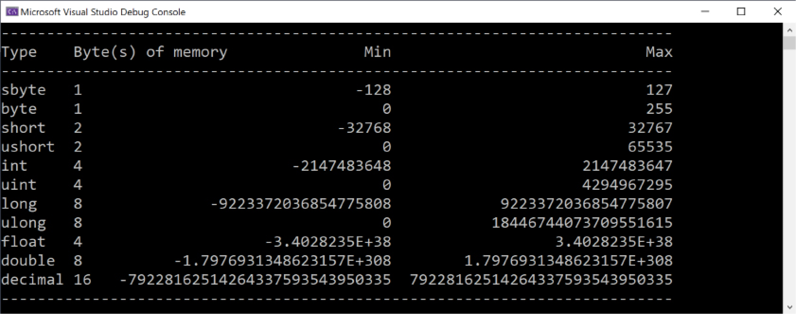
In the Chapter02 solution/workspace, create a console app project named Ch02Ex03Numbers that outputs the number of bytes in memory that each of the following number types uses and the minimum and maximum values they can have: sbyte, byte, short, ushort, int, uint, long, ulong, float, double, and decimal.

The result of running your console app should look something like Figure 2.10:

Text  Description automatically generated

Figure 2.10: The result of outputting number type sizes

As a bonus exercise, output a row for the System.Half type that was introduced in .NET 5.

Code solutions for all exercises are available to download or clone from the GitHub repository at the following link: https://github.com/markjprice/cs11dotnet7.

Exercise 2.4 – Explore topics

Use the links on the following page to learn more details about the topics covered in this chapter:

https://github.com/markjprice/cs11dotnet7/blob/main/book-links.md#chapter-2---speaking-c

CONTINUE READING
83
Tech Concepts
36
Programming languages
73
Tech Tools
Icon Unlimited access to the largest independent learning library in tech of over 8,000 expert-authored tech books and videos.
Icon Innovative learning tools, including AI book assistants, code context explainers, and text-to-speech.
Icon 50+ new titles added per month and exclusive early access to books as they are being written.
C# 11 and .NET 7 – Modern Cross-Platform Development Fundamentals
notes
bookmark Notes and Bookmarks search Search in title playlist Add to playlist download Download options font-size Font size

Change the font size

margin-width Margin width

Change margin width

day-mode Day/Sepia/Night Modes

Change background colour

Close icon Search
Country selected

Close icon Your notes and bookmarks

Confirmation

Modal Close icon
claim successful

Buy this book with your credits?

Modal Close icon
Are you sure you want to buy this book with one of your credits?
Close
YES, BUY

Submit Your Feedback

Modal Close icon
Modal Close icon
Modal Close icon